
Reading pre-performance plans, a performer's recollection, a live spectator's account and the main archive's revised research essay together, this article reconsiders the white cloth, questioning and ending: how does a participant's creative plan encounter a film's continuing events?
P4 Theater website essay · 2026-09-08
1. Separate the different things meant by “it has not ended”
One compelling reading of Shoot Self with You is that the camera prevents anything from truly ending. A person tries to stop, but the image keeps preserving; a performance closes, but further interpretations appear. This claim grasps the continuing power of media. It may also conflate different matters into a conclusion that is always right and therefore difficult to test.1
A performance's completion does not mean all participants cease to have relationships. A round of questioning stopping does not mean both parties completely agree. A film becoming public does not mean everyone involved endorses every later review. These concern form, interaction and circulation respectively. If an “ending” requires every level to close at once, every actual ending will have been defined as failure in advance.
The revised research essay Who Can Make a Completion Count?, published in the main archive on 7 September 2026, reorganises its materials around this problem. This article reads alongside it while returning to the pre-performance, post-performance and audience articles of 2023. The revision offers a useful method of judgment: first identify what is currently being asked to be completed, then see whether the same demand continues afterwards. More things happening does not by itself mean that the previous thing did not end.
This distinction does not lower the standard applied to the work. It makes criticism more specific: which action was completed, which question kept being asked, and who thought it still insufficient? Once different demands for completion are separated, readers can compare how they conflict, where adjustments occur and what evidence could change a conclusion.
- Research library · Defining the validity of completion: go directly to section four, which first specifies the demand, then checks whether the same matter continues to be required.
2. The white cloth is first a formal proposal by a participant
The post-performance article I Disappeared preserves a specific staging idea: cover a body with a white cloth, move to the back, then let the person leave while the cloth remains onstage. According to the recollection, the aim was to create an effect of disappearance. Coordinating objects, paths, sightlines and timing already makes this a creative proposal, not merely a symbol awaiting a critic's interpretation.2
This changes the scale on which the white cloth is judged. If the performer is required from the outset to disappear completely from every image, any photography will count as the proposal's negation. Yet creating a disappearance onstage and erasing every record are different tasks. An audience seeing the conditions that make a trick possible does not necessarily invalidate it. The question is what the form originally attempted to accomplish.
Another familiar reading treats the cloth only as a sign of retreat or vulnerability. That may be one layer of formal analysis, but should not cover over the participant's design work. A person can bear pressure, organise a performance, assess others' interventions and change their mind at the same time. Including these capacities in analysis does not automatically remove the difficulties they endure.1
The illustrations come from the post-performance article. They help readers see how it brings bodies, spectators and the event together; the images themselves cannot establish the white-cloth action's entire continuous process. The account of prior planning and live changes remains attributed to the writer's recollection. It is not rewritten as production fact established through checking every contemporary staging document.
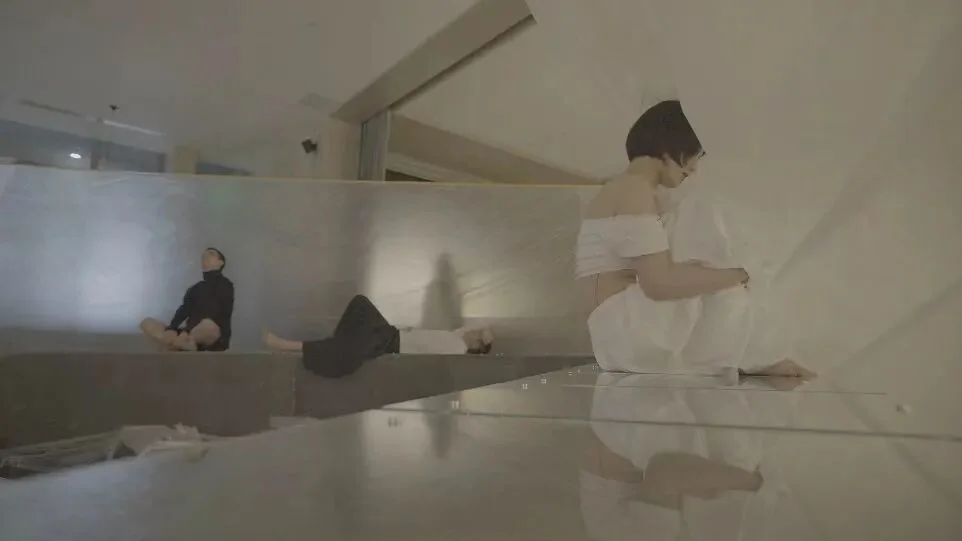
Originally published in I Disappeared — After Performing Last Rehearsal. Read as the article's visual material; a single image cannot establish the entire sequence of the white-cloth action. View image source
- Return to the performer's post-performance account: locate the cloth, the planned exit and the questions just before leaving, retaining the writer's uncertainty about their own answer.
3. Why a new question just before the exit changes the task
In the post-performance account, a question arises just before the writer leaves the stage, asking whether this is what they want. The writer considers it outside the script. What first had to be completed was an action in space; what now needed answering concerned personal desire. The two tasks are close in time but use different standards of judgment: whether an action can be completed is not the same question as whether someone can explain why they want it.2
A new question may bring an intensity the scene did not previously contain, or occupy an endpoint already arranged. We cannot assume in advance that improvisation is always open and planning always rigid. Established staging may be a participant's way of making a work completable; a live change may generate valuable material about relationships. Analysis needs to examine how these creative acts actually meet, rather than assign value in advance to “improvisation” or “planning”.
More difficult still, the writer gives no single motive for the answer. Two possibilities remain: wanting to end the performance, or truly being touched by the question. Criticism that chooses one final truth on the writer's behalf erases the account's most consequential part. An answer can take up a question, keep a scene moving and express emotion. A single affirmative word cannot establish how much each function contributes.1
This essay therefore suggests three separate readings of film, recollection and interpretation. First locate the cloth and questions in the post-performance text; then read section eight of the research version to see how the two tasks are distinguished; finally return to the film's sound and image. The research version explicitly notes duration differences between film versions. Its ledger timecodes are not applied without verification to the English-subtitled YouTube edition here.
- Research library · The white cloth's two endings: go directly to section eight to compare formal completion with explaining desire.
4. One account of power cannot explain both “OK”s
The revised research compares two kinds of sequence. In one, an objection receives a response, and the subsequent lines read no longer repeat the original explicit demand; why this happened remains unresolved. In the other, a proposal to skip a scene is confirmed, after which the agenda moves to the final scene. The latter supports the claim that “a particular proposal changed the arrangement” more strongly than an isolated expression of approval.1
This distinction deserves preservation. The first sequence cannot establish full shared deliberation over rules, but neither can it be described as no change at all. The second permits recognition of a local effect without proving equal decision-making capacity for everyone. The strength of judgment should follow the strength of evidence, rather than allowing one grand conclusion to absorb every local difference.
Vocal intensity particularly tempts criticism to go too far. A loud reply may be interpreted as acceptance or as a cutoff, but loudness alone cannot settle motivation. The research version also retains a correction to speaker attribution, reminding us that two adjacent voices may not form the exchange we imagine. Formal adjacency does not automatically become acknowledgment within a relationship.
What is cited here is the research version's checking of an existing dialogue ledger and local material. This article does not claim to have listened afresh to every scene in full. Readers can go directly to the two arguments and the objections to see how “what was observed” and “what remains undecidable” stand separately. Making that distinction navigable is more useful than merely stacking references at the end.
- Research library · Different outcomes of two OKs: read both cases to distinguish a demand ceasing to recur from an observable change of agenda.
- Research library · Strongest objections and evidence that could change the conclusion: examine the remaining limits of recollection, staging evidence and analysis within the film.
5. Performers, live spectators and film viewers may be judging different successes
Wang Yanan's Beginning to Speak is a public account by a live spectator, with positive descriptions of interruption, expression and being drawn into a recording. It belongs in the discussion because it is part of the work's reception history. One spectator's account nevertheless cannot stand for the whole audience or directly replace the experience of those later watching the finished film.3
It does not necessarily refute the performer's frustration, nor vice versa. The performer may be judging whether staging was realised or whether the audience was felt. A live spectator may be judging whether they were moved or recovered a means of expression. A film viewer encounters sound and image rearranged through photography and editing. Even when everyone says “success” or “failure”, they may not be answering the same question.
Collective creation cannot therefore be reduced to one overall balance sheet. An audience being moved does not automatically cancel a performer's difficulties; participant dissatisfaction does not make audience experience false. More explanatory work specifies the objects and conditions of each judgment and asks whether they can alter one another, rather than adding up a final score for every position.
The pre-performance article One More Time also explicitly describes filming throughout and plans for the footage to enter a film. Future viewing through moving images was therefore not a channel accidentally added afterwards.4 Yet the existence of a plan does not mean every later editing decision had already been made. Publicly stated intention and the actual organisation of the completed film still require separate analysis.
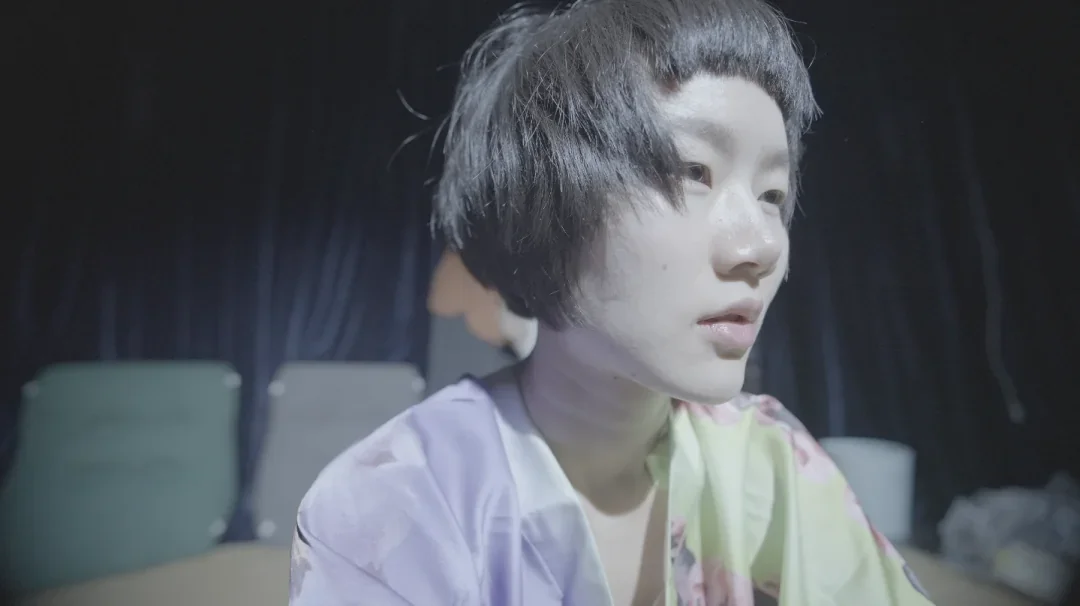
Originally published in P4 Finale: Last Rehearsal — Public Performance. The close composition is used to compare film and live viewing, not as a record of a particular spectator's experience. View image source
- Read Wang Yanan's Beginning to Speak: read it alongside the performer's account and compare what each evaluates.
6. How film reorganises a theatrical ending
The revised research notes that the contact sheets examined near the ending show different directions: equipment, tables and chairs, spectators, and white covering material. It accordingly withdraws an overly strong generalisation: the whole passage cannot be described as a camera continually fixing the same body in one kind of composition. This essay adopts that smaller formal caution; it does not reconstruct continuous shots from sampled frames.1
Disappearance in theatre depends on the sightlines of an audience present; an ending in film is also organised by framing, continuing sound and editing order. When the camera turns towards equipment or spectators, later viewers may begin to notice how the event is sustained. If sound continues, the image moving away does not immediately close the relationship of speaking. Such changes give film its own form of ending, beyond merely preserving a theatrical outcome.
Making the apparatus visible, however, does not mean everyone jointly controls it. Formal self-disclosure and decision-making capacity in production require different evidence. A film can make viewers aware of the camera's presence without that fact alone answering who decided the final cut. This essay retains that question for further research rather than filling a production-history gap with symbolic analysis.
The cloth thus concerns at least three forms of labour simultaneously: a participant designs an action for the stage; people present change the scene through questions and answers; the film organises it again for later viewers. None should be erased by the other two. Close interpretation keeps the three distinguishable within the same material while explaining their interaction.
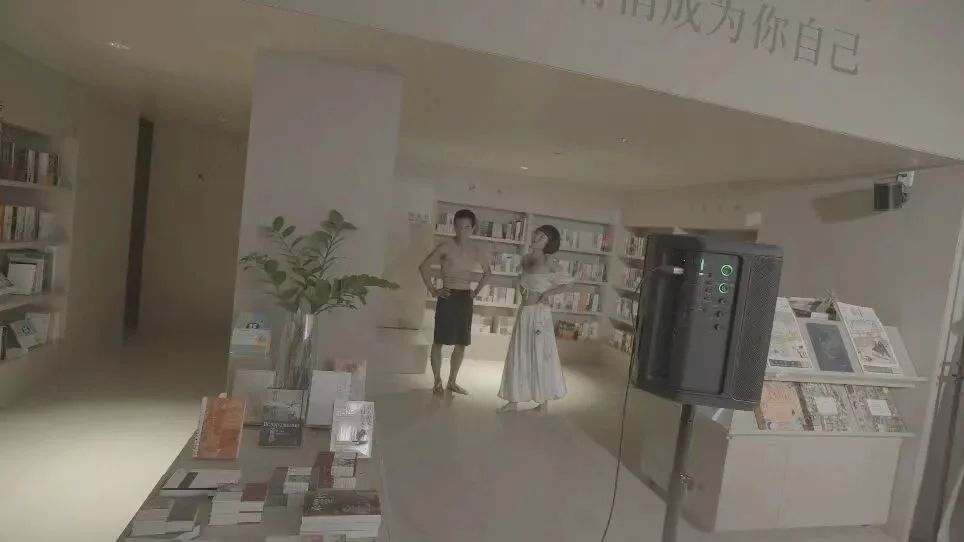
Event image originally published in the post-performance article. Compare the visible area, objects in the space and the later written account; faces alone are not used to identify speakers. View image source
- Watch Shoot Self with You with English subtitles: full-film entry. The research version's timecodes come from its source ledger; this article has not applied them as precise jump points for this YouTube edition.
- Main archive · Film and video directory: continue to the film, rehearsals and other moving images, distinguishing their material types.
7. Limited endings: let local completion count and criticism continue
A limited ending can first serve as a constraint on reading: do not demand that a scene resolve every relationship before acknowledging that it has completed a particular task. An action can be completed and a question can stop while people retain complex feelings. Treating that complexity as a reason to require further explanation may instead make completion permanently conditional.1
This position must also accept challenges. If later material shows the same demand returning under another name, the judgment of local completion should change. If a fuller passage reveals an explicit response previously missed, its effect should be acknowledged. Research stays open through evidence capable of changing conclusions, not by endlessly repeating “it cannot end”.
For the P4 website, this also means articles should not turn historical originals into appendages of today's argument. Original texts, research revision and film occupy their own positions here. Readers can support the revision or follow the originals towards a different judgment. Image sources, section-specific research links and clearly labelled film versions all allow disagreement to meet on the same material.
Perhaps the most useful question to take back to the film is: who, at this moment, is trying to complete what? Recognising a local proposal that was realised while seeing what it did not resolve brings us closer to collective creation's actual complexity than “everything succeeded” or “everything failed”. A work can end, relationships can continue, and criticism can retain reasons to begin again.
- Download the complete Markdown of the research discussed: preserve the public research version dated 7 September 2026, retaining its version and evidentiary scope when quoting it.
Sources and original texts
- Who Can Make a Completion Count? — P4 Theater research archive, 2026-09-07
2. Shoot Self with You | I Disappeared — After Performing Last Rehearsal — Jia Rui (identified in the body text) / published by P4, 2023-09-02
3. Last Rehearsal Review | Beginning to Speak — Wang Yanan — Wang Yanan, 2023-08-30
4. Shoot Self with You D | One More Time — Yun Jianhui (identified in the body text) / published by P4, 2023-08-24
5. P4 Finale | Last Rehearsal: Public Performance | Love, Death, Shoot Self with You — P4 Theater / He Fa, 2023-08-25
6. Shoot Self with You — P4 Theater, project page
An essay for the P4 Theater website, based on public archives. Its analysis is not presented as the direct speech of He Fa or other participants; historical source texts retain their own credits and dates.
Chinese webpage: https://p4theater.cn/knowledge/film-ending-and-authorship/