
Complete website republication: 2026-09-08; source version: 2026-07-10
Editorial introduction
Why is an “I love you” answered by “That was terrible acting”? Beginning with eight audiovisual windows, this essay follows how romance, horror, science fiction, games and curtain calls briefly take shape, then are interrupted by the material of the event. Its second half examines these forms' repeated returns and proposes three conditions at which this reading must stop.
“Three minutes” and “sudden genre death” in the title and argument are critical rhetoric, not statistics on the duration of every genre. Judgments about audience expectations and fatigue belong to formal criticism and cannot replace audience research. Timecodes follow the research master. The public YouTube edition linked below has not been aligned with it shot by shot, so master timecodes are not presented as jump points for that edition.
Source version: 2026-07-10; research archive publication: 2026-09-07; complete website republication: 2026-09-08. The full text, notes and references follow the selected version.
- Original in the research archive: consult the source version and original manuscript.
- YouTube: public edition with English subtitles: open the public film. The research master and this public edition have not been aligned shot by shot; no unverified time jumps are added here.
- Download the selected source version, original Markdown: the source file is preserved verbatim for citation and version comparison.
No Genre Survives Three Minutes
This is the research archive's public edition, retaining the source version's argument and limitations. Publication date: 2026-09-07. Publication does not signify completed peer review.
Source version date: 2026-07-10
Evidentiary scope: the factual basis of this essay is T0 dialogue and T1 checking against the 4K master without subtitles. “Genre contract”, “sudden genre death” and “emotional wreckage” are T3 critical terms. The essay adds no judgments about characters' psychology, real-life relationships, actual harm, consent, sound-source attribution or a director's sole intention.
No Genre Survives Three Minutes
Eight sudden genre deaths in Shoot Self with You
The easiest wrong question to ask of Shoot Self with You is: what genre is it, exactly? Documentary, fiction, theatre on film, performance art, or a metafilm that rehearses real relationships?
The film's answer is not “all of the above”. It does something fiercer: it brings each genre to life only to let it die on the spot.
“Genre” here does not mean a classification on a film website. It means a very short contract lodged in the viewer's body. Two people draw close, an “I love you” lands, and we instinctively await a response: the romance contract. Someone says “no eyes” and “struggling in the water”, and we wait for an image to deliver a monster or danger: the body-horror contract. A control tower calls an astronaut, and we wait for another space: the science-fiction contract. After “and then”, we wait for an action. When a game starts, we wait for rules to make collisions reversible. When someone says “the performance is over”, we expect sound, image and people to leave together.
Each time, Shoot Self with You offers a contract's opening but refuses to pay out the ending it usually promises.
It does not blend genres into one composite colour. A genre hybrid at least allows several sets of rules to coexist. This film is more like a room repeatedly converted on the fly: the bed has barely become a romance bed before a director's assessment sounds behind it; an embrace has barely found a lullaby's rhythm before “go die” occupies the same beat; the universe has barely acquired a control tower before the returning traveller is entered into a psychological monitoring report. Genres do not sit alongside one another. They die suddenly, one after another.
More crucially, what kills a genre is often precisely what that genre ordinarily works to keep off-screen.
1. An eight-second romance: why I love you dies within the same shot
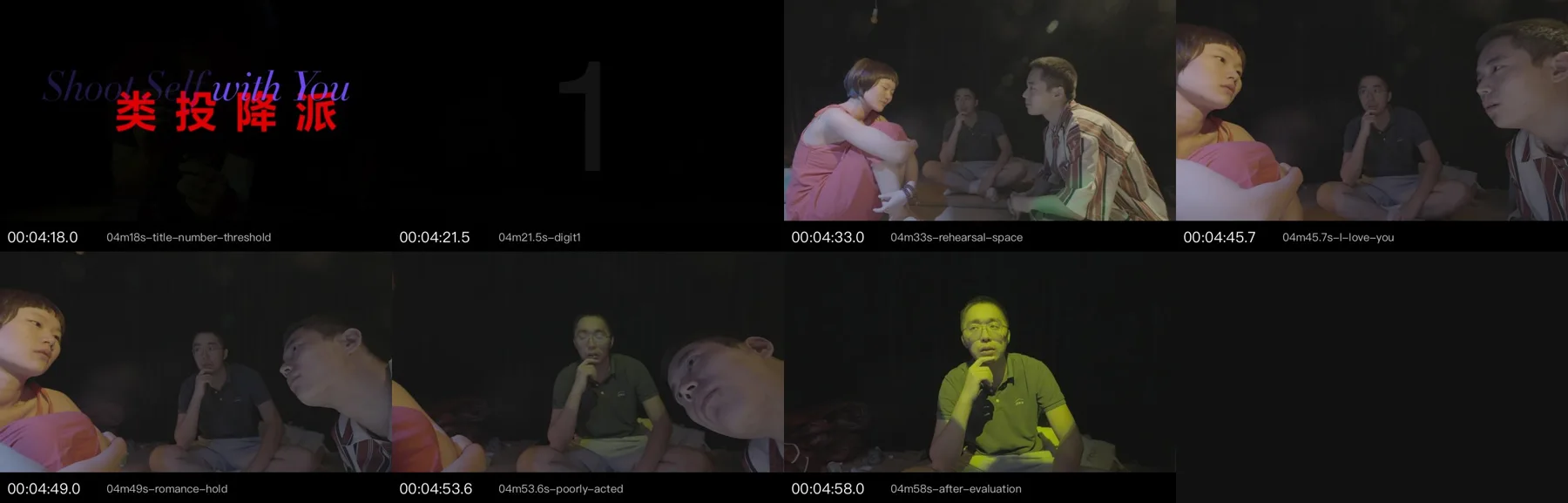
At 04:21, a translucent numeral 1 presses into the image. Seconds later, Amon sits with knees drawn up, Jia Rui approaches closely from the right, and Zichou sits behind them with chin in hand. Three people occupy the composition from the start, but habits of watching romance automatically crop the third out for us: the rear body becomes background, the foreground pair becomes the event.
At 04:45.700, Jia Rui says, “I love you.”
There is no cut. Amon remains on the left, Jia Rui's face still occupies the close right side, and Zichou remains a little behind, between the two. Viewers have just begun waiting: perhaps for words in return, perhaps a look, perhaps only the few seconds of silence a romance allows a confession.
At 04:53.600, Zichou says, “That was terrible acting.”
Only eight seconds, and the romance is dead.
The force of the sentence is not simply that it “breaks immersion”. Merely telling us they were acting would be a familiar play-within-a-play reversal. This is harsher: evaluation speaks from within the same composition without giving love an ending shot of its own. “That was terrible acting” therefore ends the present and reaches backwards to rewrite what preceded it. I love you changes from an emotional act that has occurred into an assignment just handed back.
Romance usually keeps rehearsal, lighting positions, onlookers and assessors outside the frame so that a declaration appears to belong to two people alone. Shoot Self with You does not attack love from outside. It lets the third person whom romance itself cropped out speak again. What kills the genre is the condition of production it must pretend does not exist to sustain itself.
This sets the film's initial rhythm. It is not “true feeling exposed as performance”, but any feeling, once spoken, may be rewritten as a question of quality before it has time to receive an answer.
2. Before the laughter has landed, the moon has risen
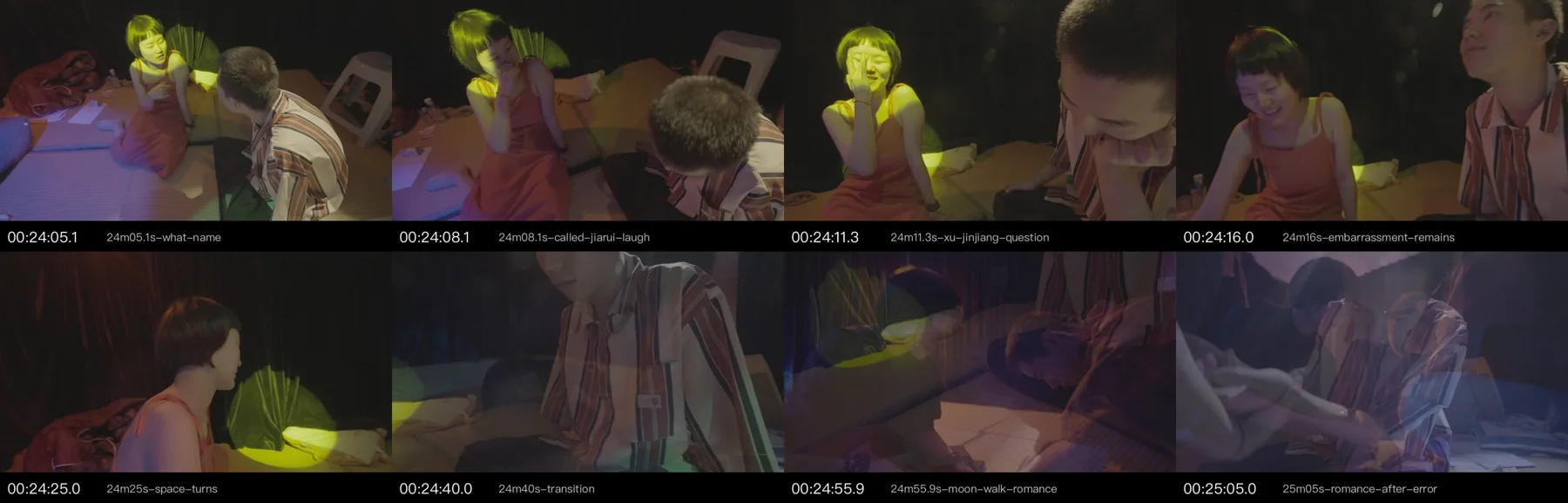
The second rupture occurs at 24:05-25:05. It is less sharp than the first but more uncomfortable, because no single line takes responsibility for announcing the genre change.
First comes a naming mishap. After leaving the low performing area and turning towards the lighting-control position, Zichou says, “Act properly, Jia Rui.” Someone promptly asks, “What name did he just call you?” The answer is, “He called you Jia Rui.” Laughter rises. Amon covers the face, closes the eyes, leans forward and back; Jia Rui lowers the head and brings a hand near the side of the face. Then comes the line that pins the mistake down: “Isn't your name Xu Jinjiang?”
In a backstage comedy, this could be a light outtake: laugh, cut it, do it again. But the shot wipes the event away for nobody. Hard light holds the mistake in view; Amon's body after laughing and Jia Rui's lowered head remain in time. The laughter releases some pressure without turning the wrong name into harmless behind-the-scenes entertainment.
Around 24:42, a dissolve begins. A striped shirt, padded surface, papers, red-pink clothing and indoor light press into one another. At 24:56.333, Amon says, “The moon looks quite beautiful tonight. Would you like to go out for a walk with me?”
There is no natural moon, road or opening door in the image. Romance switches on suddenly in a line of dialogue; the film still keeps us indoors, pressing the bodies left after the mistaken name, the light and the dissolve beneath that “moon”.
This is therefore not comedy ending and romance beginning. More precisely, romance is forced to revive on a backstage malfunction that has not been cleared away. The moon does not take anyone out of the embarrassment. It gives embarrassment another way to speak.
This reveals a second kind of genre death in Shoot Self with You: even dead, the previous genre refuses to hand over a clean stage. It remains inside the next through a face that has laughed, a lowered head, a mistaken name. Romance in the film thus always has an untimely aftertaste, not because characters are “insincere”, but because the image remembers that the previous scene has not been dealt with.
3. The horror film has no monster, only a bed that will not follow the dialogue
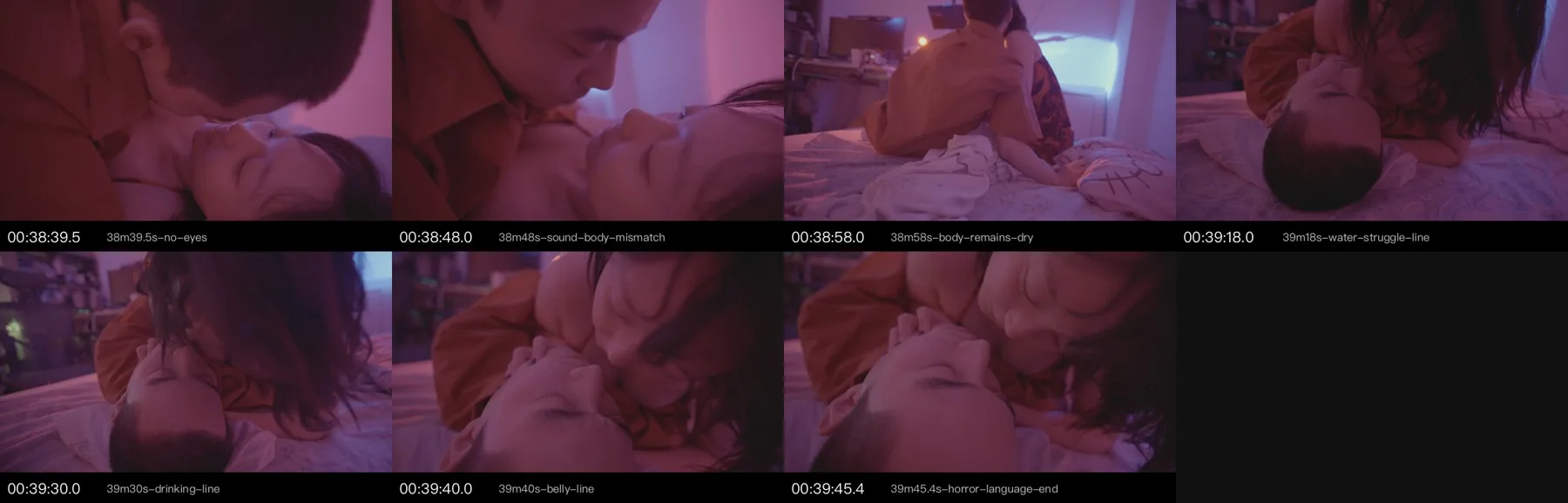
After 38:39, language rapidly builds a body-horror film: no eyes, empty sockets; she is in the water, struggling in the water; she has swallowed so much water, her belly is swollen.
Read only these sentences and the visual field already seems prescribed. We wait for empty sockets, drowning and a visible bodily abnormality. Horror's basic bargain is to turn what cannot be looked at directly into a body that can finally be seen.
But throughout 38:39-39:45, the 4K film never delivers that body. The image remains a pink-purple indoor bed surface: a face lying back, a body bending over, hair, white cloth, a pillow, orange-brown fabric and cold white light in the room. Angle, hair, low illumination and excessive proximity make the eyes difficult to distinguish, but they are not literal empty sockets. As the dialogue describes water, struggling, drinking water and a swollen belly, the image remains dry.
Horror has not been cancelled. On the contrary, it has moved into the gap between sound and image that cannot close.
Language keeps commanding the image to become evidence; the image offers only an ordinary body too close, too dark and too hard to read. Viewers must supply eyelessness and drowning on that body themselves. Body horror thus starts up while losing its body: the monster never appears in the image but lodges parasitically in expectation.
This differs from restrained horror deemed “more sophisticated because it does not show”. Restrained horror usually assures us that the monster is off-screen. Shoot Self with You withholds even that assurance. Water may be only words; empty sockets may be only words. Yet the shot also refuses to let those words become safely metaphorical, because the face and the obscured eye remain too close.
Horror dies here when the image refuses to deliver. What remains is no monster but an audiovisual debt: you have heard too much and seen too little.
4. A lullaby in reverse phase: sleep and go die occupy the same beat
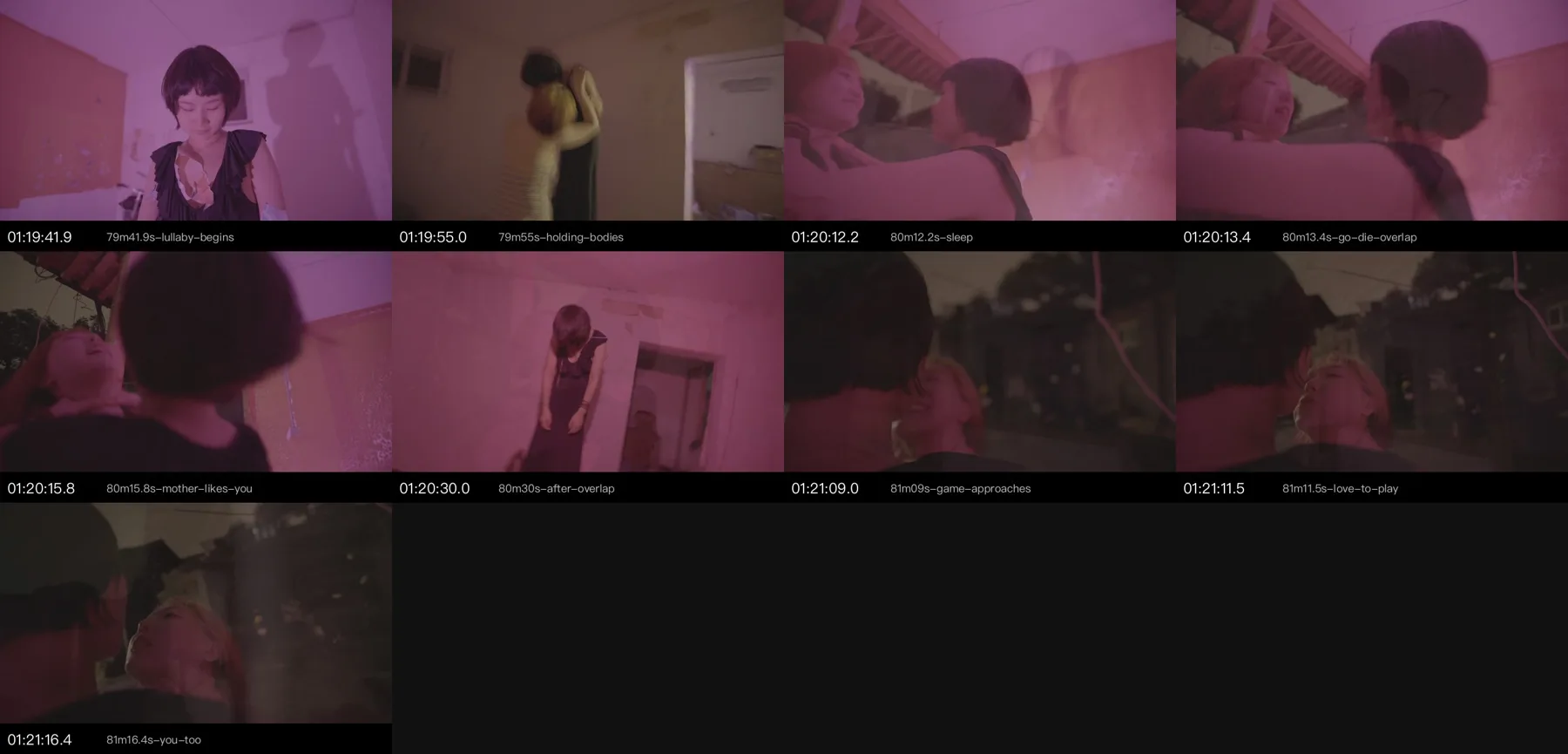
After 79:41, voices and holding bodies gradually suggest a lullaby. Repetition, closeness, being lulled to sleep, maternal affection: these elements should soften time and make repetition reassuring.
But in the seven seconds of 80:12.166-80:19.166, the reassuring beat is inverted from within:
- Ricky's
sleepoverlaps in time with the immediately followinggo die; - the next
sleepoverlaps with Amon'sgo die; - as
Mummy likes youbegins,go dieenters again.
The danger is not a violent reversal arriving after tenderness has finished. That would at least allow two successive scenes. The break occurs within the same slot of repetition: soothing and elimination share a rhythm; care and putting to death no longer have separate times.
Nor does the image supply a clear shot sequence telling us which body is caring and which attacking. Holding, entanglement, double exposure and bodies at close range compress the actions together. The credibility a lullaby builds through repetition fails inside repetition itself.
Then, around 81:11.500, speech turns to “I love playing this most” and “You do too.” A few seconds later, the pink intimate space cuts hard to a cold-coloured public space. A huge numeral 3 presses over a reflective floor, white barriers and audience positions.
The game is no fresh, light-hearted chapter. It inherits a lullaby that can no longer distinguish sleep from disappearance. All the later phrases about “playing”, “catching” and “what you like best” therefore carry the shadow of this short stretch of sound: when repetition can both lull and erase, game rules no longer mean safety by default.
5. The cheapest universe: the return flight becomes a psychological report
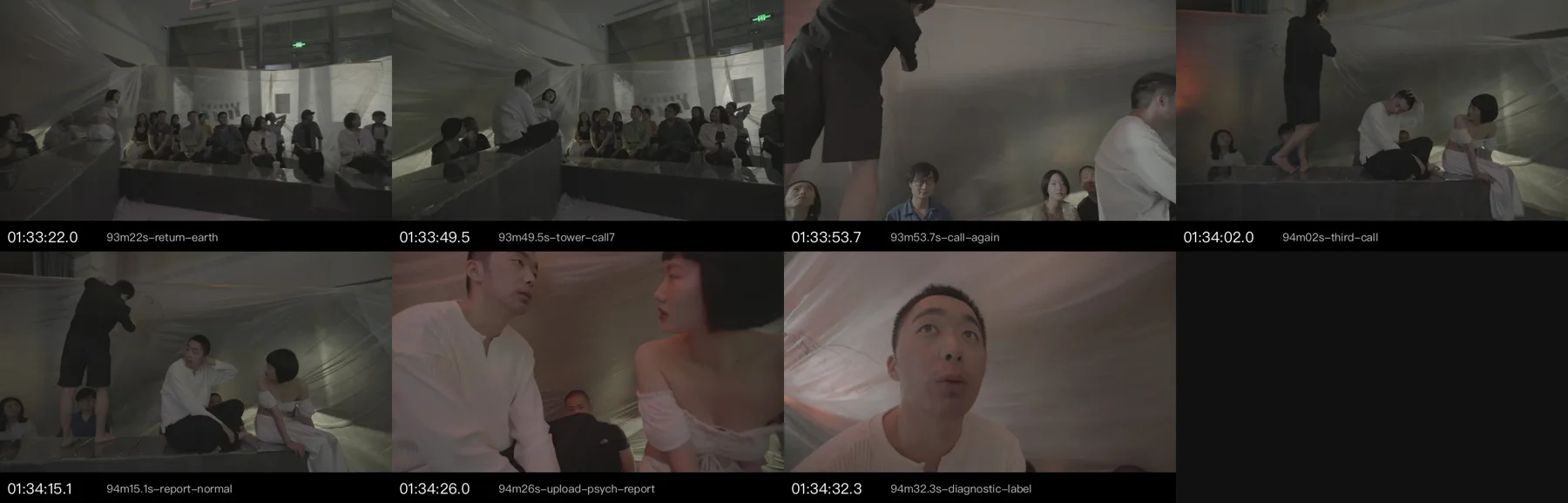
At 93:22, someone says “back to Earth”. A control tower then calls Astronaut 7; the call repeats, and lost contact is registered. With only a few words, science fiction's cheapest and most effective set has been built: Earth is distant, someone is returning, and a communications system exists at the other end.
Yet the image never leaves the public performing area. The white-cloth enclosure, nearby people, seated spectators and standing figures remain visible; nor does the voice acquire a confirmable radio-device source. The tower exists first as a communications formula spoken by a human mouth.
The decisive rupture comes after 94:15: 07 reports all normal, please upload your psychological monitoring report, followed by I am a megalomaniac and I am anxiety.
The astronaut has not travelled far but has been flattened into a number, a status and a report. Earth ceases to be a way home and resembles a destination awaiting a tick on a form.
Many science-fiction films keep bureaucracy in the background: towers, numbers and monitoring reports help persuade us that a vast universe exists. Shoot Self with You pushes that background forward until it consumes the whole world. Distance no longer takes shape through stars, travel or weightlessness, only through “normal or not”, “uploaded or not” and “which symptom”.
Science fiction therefore dies neither from low cost nor from a rudimentary theatrical space. It dies when administrative language cancels distance. The universe promised an outside one could leave for; the report folds every journey back into a person's assessable condition.
The remotest place in this film is neither the Moon nor Earth. It is the small distance someone tries to gain from the names others give their condition.
6. And then—nothing happens
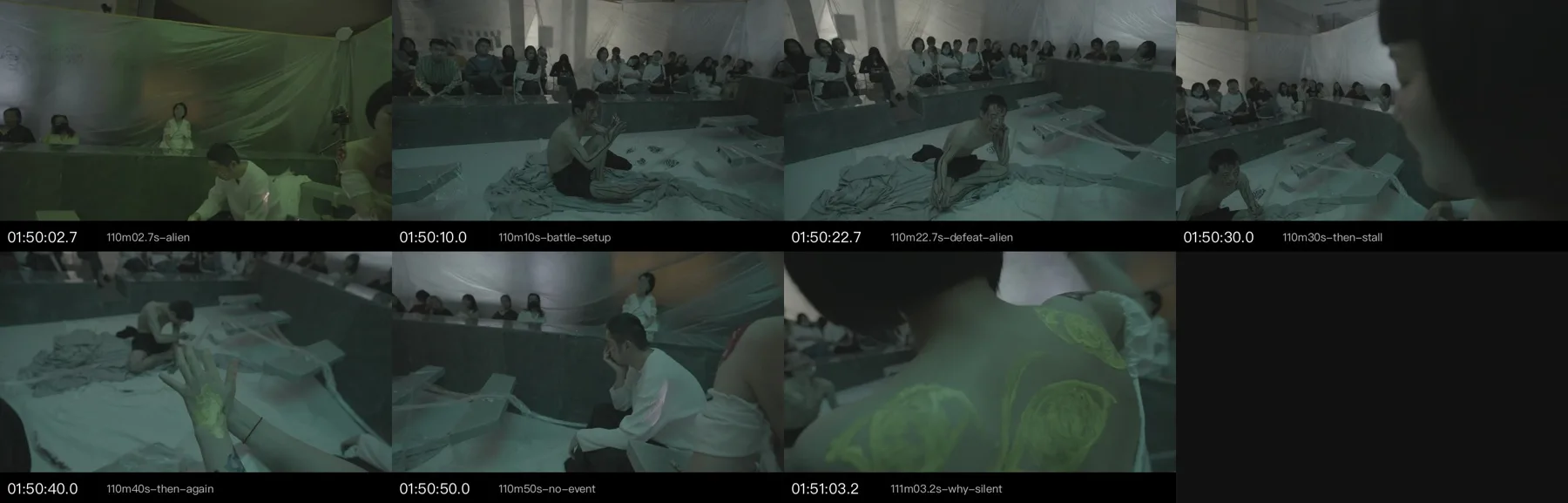
At 110:02.700, narrative receives an almost comically simplified model: suppose there is an alien. Next, one has to fight the alien. Then he defeats the alien.
Character, enemy, conflict and outcome are all present. An action film's skeleton is assembled in twenty seconds.
But no action occurs. The image remains the public performing area: sitting or lying bodies, bedding, white cloth and spectators behind. Stranger still, “and then” keeps appearing after victory has already been announced.
“And then” is narrative's cheapest engine. It need not explain; it only pushes one thing towards the next. Action depends particularly on it: run, then chase; hit, then fall; win, then leave. Here, however, each repetition of “and then” delays the next thing further. The connective becomes a gap instead of a bridge.
At 110:41 and 110:51, the prompting becomes “Have you thought of it?” At 111:03.200, the question is “Why aren't you speaking again?” The action hero has been defeated not by the alien but by the delay in producing the next sentence.
This exposes what action films are least inclined to admit: action does not grow naturally from verbs. Bodies, space, causality, stamina and filming must together deliver on “and then”. Here only verbal scaffolding remains, so “defeating the alien” can be completed in a sentence without producing any consequence in time.
When an event cannot occur, evaluation immediately turns towards the speaker: have you thought of it, why have you gone silent again? Once the genre's engine stalls, what is examined is no longer the story but why this person cannot produce a story faster.
7. Once a game meets a body, it is no longer just a game
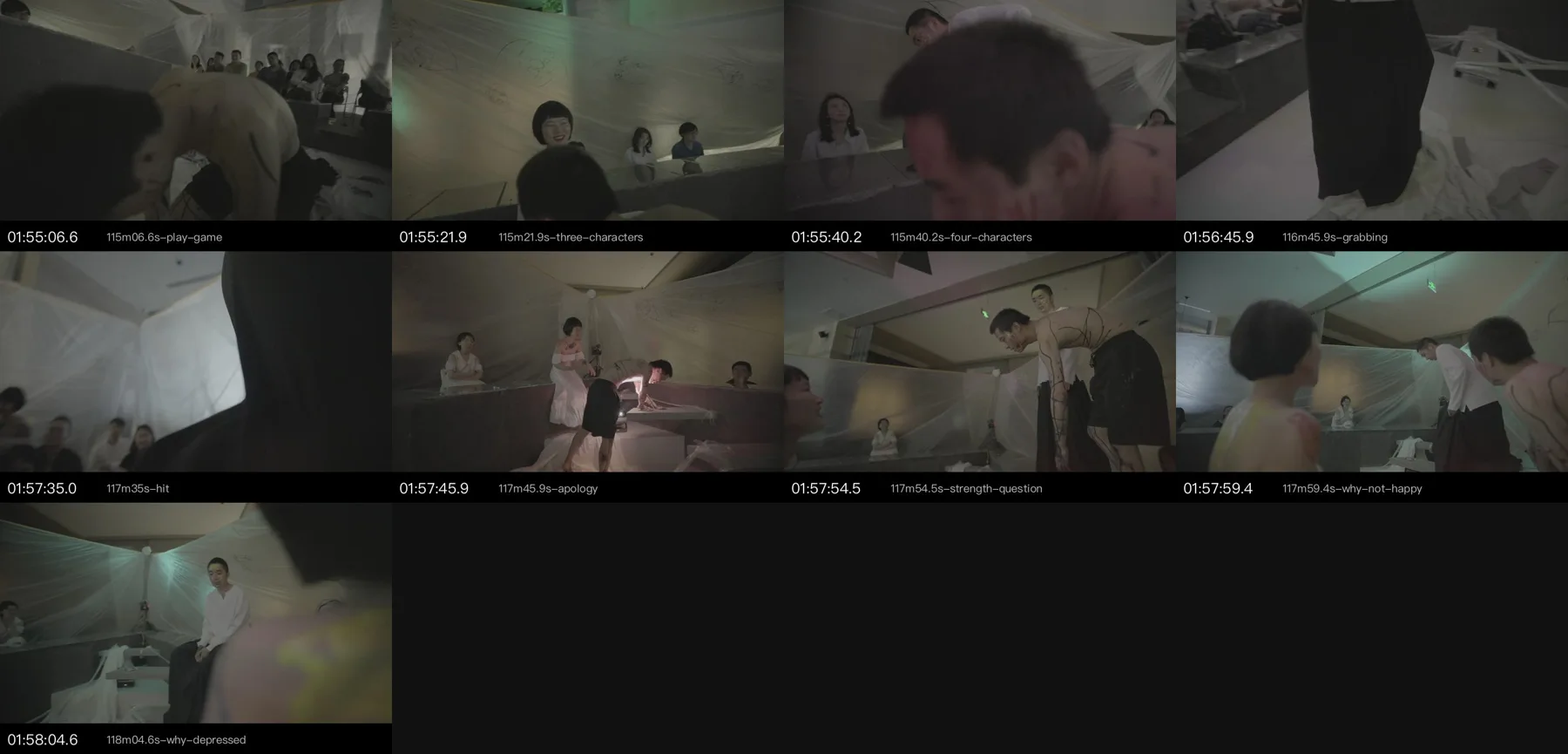
After 115:06.600, the event finally receives a seemingly stable genre container: playing a game. How many characters to say, who speaks first, who catches, who loses, who should catch whom. Rules compress disorder into repeatable actions with winners and losers.
The beginning is already unstable. After “three characters” is specified, “that night” (那天晚上, four Chinese characters) is stopped for being four, but the answer is “I haven't finished.” The rule begins counting speech still incomplete. The decisive rupture, however, waits for the body to enter.
As catching proceeds towards 117:45, people in the image cross, approach and collide. After laughter comes “sorry”; then someone asks, “Did I slap you?” We need not elevate this line into a judgment about actual harm to see that the game contract has changed. Once there is a need to establish whether a real blow occurred, once an apology enters, rules can no longer wholly reclaim the action.
A game promises reversibility. A capture can be reset, a loser replaced, roles cycled. But questions produced by bodily contact are irreversible: did it hurt, was there a hit, is an apology needed? “The next round” cannot automatically clear them away.
A sharper change follows 117:54.500: Do you still have strength? is repeated. The answer is “yes”. The event then asks why the person looks not at all happy, why so melancholy.
Physical stamina is thereby mistaken for the capacity to deliver emotion. Having strength seems to mean one should keep playing and should appear happy. The game's genre changes from rule to test: not only whether you can run, catch and speak, but whether you offer the correct expression.
The game does not die because someone “breaks the rules”. It dies because the rules cannot distinguish a body at play from a body that already needs to be taken seriously.
8. The curtain call is the final breach of genre contract
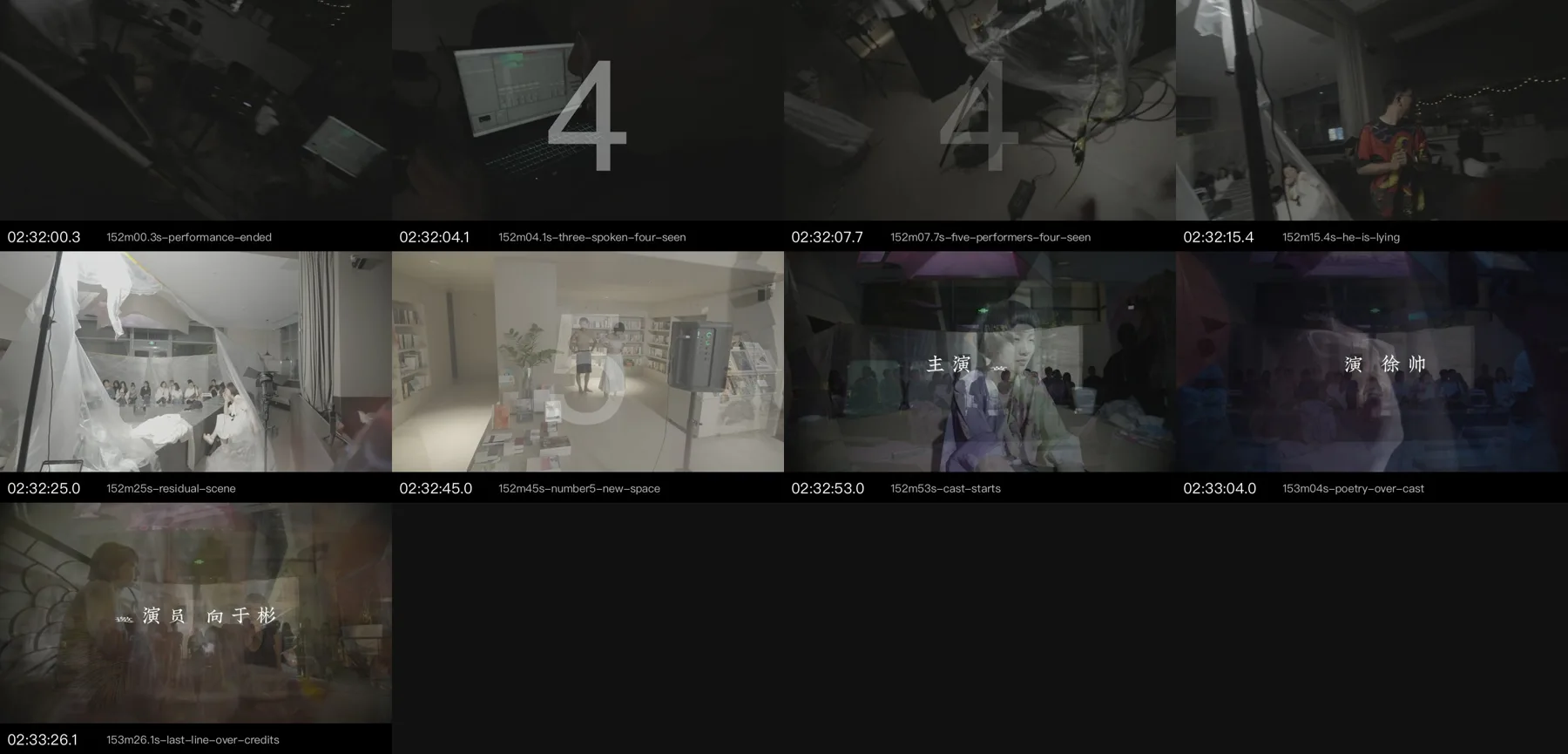
152:00.300: “Our performance is over.”
This is the clearest opening a curtain-call film could have. Thank the audience, count the performers, applause or dispersal, then names. The curtain-call genre depends less on a particular line than on synchronisation: when the end is spoken, performance ends; when people leave, sound leaves; when names appear, the event becomes the past.
Shoot Self with You dismantles this synchronisation piece by piece.
At 152:04.100, He Fa first says “thanks to the three”, corrects it to “oh no, four”, then “oh, five”. In the image, a huge 4 already presses over control equipment, cables, the floor and people's legs. When the voice speaks of “the five performers' great performance”, the image still holds 4. The numeral 5 appears only after the camera leaves the principal performing area and enters another bright space.
The numeral does not tidy up the mistake. It has its own delay.
After the declaration of an ending, believe in science, I'll wait for you on the Moon, he is lying to you, and residual phrases about a toilet, bare feet, a king and a door keep crossing the dispersal. Around 152:53, lead-cast credits begin and live images dissolve into a background for names, yet sound refuses to accept that it already belongs to the past. Jia Rui's low-positioned line “I just don't care about anything” arrives only at 153:26.100. It finds no face of its own and can only land on credits already running and a dissolving crowd.
Production roles, venues, special thanks, that evening's audience and the p4 theater logo continue after this. Sound reaches sustained silence only around 156:05.927; the near-black logo in the image remains longer. Even at the last, sound and image do not choose the same second to end.
The deepest rupture of the ending is therefore not “it says it has ended but continues”. That still imagines film as one whole. What actually happens is that each layer has a different ending time. Performance is verbally stopped before the headcount settles; the numerals catch up later; location sound passes through performers' names; when sound finally stops, the logo is still in the dark.
As a genre, the curtain call must send every layer away together. Shoot Self with You finally shows that even departure cannot be accomplished in unison.
9. What is killed is not genre but the viewer's capacity to predict
These eight ruptures are not random shifts of key. They share one precise pattern: every genre dies from what it ordinarily leaves off-screen.
- Romance dies from the evaluator it crops out.
- Backstage comedy dies from embarrassment laughter cannot clear.
- Body horror dies from sound and image refusing to corroborate each other.
- The lullaby dies from an impulse to eliminate lurking inside reassurance.
- Science fiction dies from the numbers and reports behind its universe.
- Action dies from the delay in production behind its verbs.
- The game dies from the real body its rules cannot absorb.
- The curtain call dies from the synchronisation ending requires but never achieves.
This is why “genre hybrid” is insufficient. Hybrids let different pleasures reinforce each other: love can carry suspense, comedy enter horror, science fiction contain action. Shoot Self with You will not let those pleasures cooperate steadily. It borrows a genre for seconds, tells viewers how to sit, wait, fear and relax, then immediately withdraws the instructions.
What is repeatedly killed is ultimately not romance, horror or science fiction, but our capacity to predict. We keep thinking we know what we are watching next; the film keeps proving in the next second that this knowledge depends on too many things being excluded.
Nor is it simply an anti-genre film. It never wholly rejects love, moons, monsters, astronauts, aliens, games or curtain calls. It needs them back again and again. In confusion, people still instinctively use genre to save themselves: love names a closeness, horror gives fear a body, science fiction gives departure a distance, action gives time a causal line, games give conflict rules, curtain calls give exhaustion an endpoint.
The film breaks these temporary containers one by one without mocking people for needing them.
The cruellest thing about Shoot Self with You is therefore neither “no story” nor “truth and fiction cannot be distinguished”. It lets every story capable of settling our emotions live briefly: short enough that we have only just recognised it, long enough that we have already entrusted our bodies to it. Then it lets it die.
And no genre that dies is buried.
It leaves a lowered head, laughter not quite spent, a still-dry bed, a “go die” overlapping “sleep”, a psychological report from the universe, an idling “and then”, a “sorry” after a collision, a numeral 4 reluctant to disappear in front of five performers.
This is the film's real continuity: not continuous story, but continuous emotional wreckage.
The next genre always begins beside the previous one's corpse.
10. One level further: genres are not cut dead but wired wrong
Saying only “romance suddenly becomes a rehearsal film” or “science fiction suddenly becomes a psychological report” still risks imagining Shoot Self with You as a film skilled at sharp turns, as though it simply switches channels between genres frequently.
What is truly strange is that it rarely lets every layer turn together.
A genre's temporary formation requires more than keywords. Several things must briefly point in the same direction: dialogue names the event, image delivers its space, bodies provide gestures, sound gives emotion a direction, and duration waits for an outcome. When these cooperate, we feel that we “know what we are watching”.
Rupture in Shoot Self with You always happens first in just one layer:
That was terrible actinghas rewritten love as rehearsal, but the shot and bodily distance have not reset.The moon / go out for a walkhas sent language outdoors while the image remains with indoor hard light and bodies after the naming mistake.She is struggling in the waterhas entered drowning while the sheets remain dry.Go diehas inverted soothing language while the lullaby's recurring beat and holding action continue.- The control tower has sent language into space while the camera still faces the public performing area.
Defeated the alienhas announced completed action while bodies have undergone no corresponding event andand thenstill demands the next step.- Game rules still judge winning and losing while bodies after collision have entered apology and confirmation.
The performance is overhas ended performance while numerals, voices, live images and names proceed by their own clocks.
I provisionally call this structure partial rupture.
Not a rupture only halfway complete and therefore insufficiently thorough: rather, one layer breaks first while another deliberately keeps going. The broken layer announces a new world; the unbroken layer drags old-world material into it.
A clean cut gives viewers permission to forget. One scene ends and another begins; the previous bodily postures, vocal pressure and unfinished questions may be left behind the cut. Partial rupture withholds that permission. Meaning has departed but bodies remain; image has changed domains but sound remains; performance is over but a sentence arrives late.
Genre death here is therefore not erasure but miswiring. A romance shot connects to a rehearsal assessment, a lullaby beat to a death command, cosmic communication to psychological diagnosis, a cast list to live sound still unfinished. Each wire works in isolation; together they cease to serve one emotional purpose.
The film's deepest strangeness comes from these miswired connections that remain live.
11. The crucial edit occurs when viewers reclassify the image
Many decisive ruptures in Shoot Self with You have no corresponding decisive visual cut.
At 04:53.600, the image has not changed, but Zichou's “That was terrible acting” forces viewers to look again at the same three-person composition. What we had cropped into foreground lovers and a background onlooker suddenly becomes a rehearsal composition of performers and an evaluator. The shot has not cut; the hierarchy of foreground and background has changed in our minds.
At 24:56.333, dialogue mentions the moon and going out, but the indoor dissolve never becomes an exterior. Viewers must decide whether to read the lamp as moonlight and the dissolve as romance, or continue seeing rehearsal material that has not been cleared away. Genre changes not through a new location but through our renaming the same pile of materials.
After 38:39, language successively assigns the same bed to an eyeless body, a body of water and a drowning site. The camera has not moved; the viewer's classification system is forced to move repeatedly.
After 110:02, the public performing area never becomes an extraterrestrial battlefield. Yet once “alien, fight, defeat” appear in sequence, we have briefly built an action film for it. When action fails to arrive, what is exposed is not a paucity of images but how we advanced ourselves a battle on the strength of three words.
These moments show that the sharpest edit need not occur between two frames. It occurs in the second when the same frame is successively assigned to two different genres.
Ordinary editing creates before and after by changing images. Shoot Self with You often retains the image and changes only what it asks viewers to do with it. One second you await a response to love, the next you assess acting; one second you imagine cosmic distance, the next you read a psychological state; one second you judge who wins, the next you judge whether someone was actually hurt.
The image has acquired no new content, but the work of viewing has been reassigned.
The film therefore does not simply refuse storytelling. It makes viewers produce narrative genre themselves, then watch their own production fail. Each rupture brings a belated self-discovery: the film has not just deceived me; I had already filled in, between its few clues, a contract it never formally signed.
12. Why viewing is tiring: the body cannot withdraw from its previous emotion in time
Genre has another often-overlooked function: it manages the viewer's body.
Romance slows breathing while awaiting a response; comedy lets pressure escape through laughter; horror tightens shoulders and neck while waiting for danger to become visible; action pushes attention towards the next movement; games let us temporarily trust that collisions are reversible; a curtain call lets the body release because the event is over.
Genre tells us not only “what this is” but “how to remain in the seat now”.
Shoot Self with You repeatedly withdraws genre before the body completes an emotional action. Laughter occurs, but embarrassment has not drained away. Horror words appear, but no monster materialises, leaving tension without an object of release. An alien is defeated, but no action has happened, leaving expectation nowhere to land. The game continues, but the body already requires an apology. The curtain call has begun, but residual lines keep calling viewers back into the event.
This produces a peculiar fatigue: not too much information or excessive length, but the accumulation within the body of unfinished postures of viewing.
You were ready to be moved by love and had to become a judge instead; ready to relax through laughter and had to keep holding the lowered person's embarrassment; ready to fear a monster and faced only words without physical evidence; ready to follow action and remained in the gap of “and then”; ready to leave at the ending and discovered the final sentence had not found its face.
Each sudden genre death leaves a small piece of muscle memory that has not withdrawn. The weight of the film's 156 minutes comes not only from what characters endure, but from the viewer's body being occupied by many incompatible instructions at once.
This explains why the film resembles neither pure slow cinema nor densely plotted narrative. Its time is not merely slow or full. It is more like a sustained failure of emotional gear changes: the previous gear has not disengaged before the next one engages.
13. Only after genre dies does what remains become visible
We can now take the opening claim one step further.
Shoot Self with You does not take pleasure in killing genres. After each death, what the film seeks to leave is less a feeling of ruin than whatever the genre's function had obscured.
While romance lives, we wait only for a response; after it dies, the third person's position of evaluation becomes clear. While backstage comedy lives, laughter releases; after it dies, the lowered head laughter did not carry away becomes visible. While body horror lives, we search for a monster; after it dies, we see the pressure of language forcing an ordinary body to become evidence. While science fiction lives, we imagine distance; after it dies, we see how numbers and reports cancel it. While the game lives, we track victory and defeat; after it dies, we see what winning and losing cannot fully reclaim in a body. While the curtain call lives, we wait for closure; after it dies, we see that its layers never shared one time.
Genre, in other words, is not the film's enemy. It is a temporary covering. It first helps us see a familiar object, then splits to expose what it was hiding.
This is why the film needs to restart genres rather than reject them throughout. Without romance living for those eight seconds, the assessment would not cut so deeply. Without the lullaby first offering a safe beat, overlapping go die would not jar so much. Without science fiction's distance, the psychological report would not feel so cramped. Without the curtain call's promise, the ending's unsynchronised layers would not become an event.
Genre must live first for death to disclose anything.
Ultimately, Shoot Self with You does not answer which genre it belongs to. It leaves another question:
When romance, horror, science fiction, action, games and curtain calls can no longer tidy experience away for you, are you still willing to remain with the remainder that has not been classified?
Perhaps this staying is the viewing the film asks for. Not hurriedly finding a larger genre for the residue, nor explaining every rupture back into a unified system, but continuing to look after the contract fails: at the bed, the lowered head, the dry white cloth, the idling “and then”, the logo not quite gone from the closing darkness.
Only after genre dies does cinema stop assigning uses to these things.
Only then are they, for the first time, simply themselves.
14. Genre is not an external label but an emergency grammar borrowed within the event
One claim now needs correction. We have kept saying “romance died” and “science fiction died” as though genre were a shell prepared in advance and people merely placed inside it.
Yet most genre cues in the film are first spoken by the people themselves.
They say “I love you”, the moon and going out; they say no eyes and struggling in water; they propose singing a lullaby; they call the tower and speak of returning to Earth; they use an alien and a battle to give a stalled story a skeleton; they say “let's play a game”. Finally, people in the event also say, “Our performance is over.”
Genre is therefore not only a viewer's habit but a temporary grammar borrowed when ordinary language fails.
They borrow romance to give an uncertain relationship one maximally clear sentence; the moon to give a relationship that cannot leave the room an outside in language; body horror to give inarticulate fear eye sockets, water and a belly; the lullaby to press an unmanageable body into a repetitive beat; science fiction to make leaving a return journey and lost contact a condition a tower can call to; action to let someone unable to continue at least say “there's an alien, and then defeat it”; a game to rewrite a faltering group relationship into character counts, catching and winning or losing; a curtain call to give an event nobody knows how to stop one sentence of ending.
These genres perform an emergency function, not an entertainment function.
That is also the problem. They are asked to accomplish far more than genre grammar can bear:
- A declaration of love must prove a relationship.
- A round of laughter must clear embarrassment away.
- A monster narrative must supply physical evidence for fear.
- A lullaby must soothe, suppress and eliminate a body at once.
- A return flight must explain why someone is leaving.
- An alien must rescue a narrative that cannot continue.
- A game must make real conflict into reversible movement.
- An ending sentence must stop every medium and every person together.
Genres keep dying suddenly not because people do not know how to use them, but because they can only force reality too heavy into grammar too light.
This gives the film's genre changes an unusual tragic quality. It is not a clever director playing jokes with genres, or an auteur flaunting the ability to deconstruct conventions at will. A feeling closer to the material is that people continually search for ready-made language able to explain the situation before them, and each time they find one, immediately discover it is insufficient.
Genre is no deception. It is a tool of survival that fails again and again.
15. Dead genres return, each time a little worse
If genres merely appeared, died and vanished, the film could still be organised into eight elegant passages. It refuses that neatness because the same genre returns tens of minutes later.
It is not restored. It returns wounded.
Words of love: from confession to command to emergency accounting
Words of love undergo at least five distinct transformations.
At 02:04.566, Jia Rui first says “I love you”. The camera then leaves the pair, passing the room, onlooking positions, a camera-holder and the title. On its very first appearance, the declaration receives no closure within a two-person relationship.
At 04:45.700, the same words are performed again and answered eight seconds later with “That was terrible acting.” Love changes from a relational statement into a line open to grading.
At 27:22.066, Jia Rui no longer confesses directly but commands, “Say you love me.” At 27:23.900, Amon replies, “I love you.” The words return but have lost spontaneity: they have become a response format delivered after demand and prompting.
At 79:35.500, Ricky says “I love you” again. Seconds later comes “Let me sing you a lullaby”, then the overlap of sleep / go die / Mummy likes you. This time the declaration does not lead towards romance but opens onto the lullaby's contamination.
At 125:31.600, Zichou urgently says, “I love you, love you, love you.” This triple declaration sits between two instances of “no”: a denial precedes it, and only 0.033 seconds after it ends Amon takes it up with another “no”. Ricky then says, “I haven't felt any love from you.”
Each time the words return, the voice may be more urgent and the repetitions more numerous, but they establish less of a relationship:
Confession
→ A repeated performance under evaluation
→ A commanded reply
→ A lead-in to a lullaby
→ An emergency rebuttal of “no love”
This is not the recurrence of a love motif but the wearing-out of a genre tool. By the fifth appearance, “I love you” seems less like opening a romance than repeatedly swiping an expired pass at a door that has not opened.
The moon: from romantic exterior to an object the room must supply
The moon does not appear only once either.
At 24:55, it arrives with “go out for a walk”, seemingly a romantic exit from the wrong-name embarrassment. Yet the image stays indoors.
Jia Rui then returns to the moon at 25:29, 25:43 and 25:46; it is called for again at 27:52 and 27:56; “the moon” returns at 28:22.533, followed at 28:24.900-28:27.600 by “I want the moon.”
The image continues mainly to offer a bare lamp, black curtains, ceiling, possible cables, padded surfaces and dissolving bodies. The moon becomes less like a celestial body and more like an object indoor lighting and language must deliver by proxy.
At first it belongs to a romantic invitation. By “I want the moon”, romantic scenery has become an object demanded. Genre has not taken people out of the room, only forced the lamp inside it to stand in for the moon.
The game: from declaring another's preference to actual rules, then to the body's resistance to absorption
Around 81:11.500, “I love playing this most” comes first, followed by “You do too” and “You like playing this most.” On its first appearance the game has no clear rules. It enters as a statement of preference, declaring someone else's “liking” for them.
After the huge numeral 3, the game moves into public space. At 115:06.600, “let's play a game” returns, this time finally acquiring rules for character counts, catching, winning and losing, and taking turns.
But the more specific the rules, the sooner bodies break through them. A declaration of preference cannot prove liking; winning and losing cannot prove a collision harmless. The game develops from an interest signed on another's behalf into an executable system, then returns to apology, stamina and “unhappiness”.
This is not one game repeated twice. It is a genre debt incurred on the first appearance and called in by the body on the second.
The universe: from a return address to a kinematic model to a blank in a story
“Back to Earth” and the tower calls at 93:22 still preserve an imagined distance. It soon collapses into reports and psychological monitoring.
At 101:21.233, Amon says again, “So, you're going back to Earth.” Zichou answers, “Oh, yes” and “I'm going to Earth.” But “going to the Moon” is then explained as acceleration, and “returning to Earth” as deceleration and falling. Planets change from destinations into kinematic models.
At 110:02.700, the universe shrinks further to “suppose there is an alien”. It no longer carries return, lost contact or distance, only supplies an enemy for a story unable to proceed.
Earth: a place one might return to
→ Earth/Moon: a model for explaining speed
→ Alien: a word filling a blank so a story can barely continue
Each time science fiction returns, its world is smaller. First there are a tower and a return flight, then only acceleration and deceleration, then only “there is an alien”. The universe has been worn down into a grammatical component.
The final scene: named, skipped, then declared over
At 139:06.833, Jia Rui says, “The final scene is—Whale Fall.” The ending first enters as a name. It is followed by confirmations of procedure, the director leaving the stage, whether to skip it, already performed and no need to perform it. Before the final scene has fully occurred, language has made it a past that can be skipped.
At 152:00.266, He Fa says, “Our performance is over.” After a non-silent seam of less than a second, however, the next words are “and then”.
The final scene is named on its first return, skipped on its second, and taken over by an ending declaration on its third. The ending genre becomes no more complete; it depends increasingly on verbal procedure. It does not finally reach an endpoint but keeps supplying an unreachable endpoint with a name, a past tense and an ending sentence.
The film's deeper structure is therefore not eight genres dying successively, but a limited set repeatedly recalled, repeatedly pressed into emergency service and repeatedly worn down. Every return carries the crack left by the previous failure.
16. Who, then, kills these genres?
“Sudden genre death” can create a misunderstanding: as though a murderer hidden behind the film precisely arranged every reversal and coolly dismantled audience expectation.
The film does not support such a single-agent murder story.
A line of evaluation alone does not kill romance. The uncut shot, the third person's continual presence and the two bodies retaining their distance are also needed for evaluation to contaminate the whole declaration backwards.
The image's refusal alone does not kill body horror. Dialogue must also keep escalating, the close face remain hard to distinguish, and the bed stay dry for the debt between sound and image to form.
The two words “go die” alone do not kill the lullaby. They must overlap sleep / Mummy likes you while the repetitive beat and holding bodies continue, so that the death command enters soothing from within instead of becoming an ordinary next sentence.
Nor does silence alone kill action. The outcome must already have been stated, bodies must lack corresponding action, and then must keep idling, and prompting must turn towards the speaker for action to slide from producing events into holding speech accountable.
There is, in other words, no single weapon. Every genre death results from dialogue, image, body, rhythm and duration temporarily ceasing to cooperate.
This also means “sudden genre death” cannot casually be attributed to directorial strategy. What this essay can establish is how the film organises material; material effects cannot directly be rewritten as one person's sole predesigned intention. Genres may be deliberately invoked or emerge accidentally in the event; there may be editing choices and bodies unable to continue as planned; someone may intend romance, science fiction or play while someone else is only searching for the next sentence.
Genre death has no sole author.
It resembles a many-sided failure to honour promises: words promise a world and images do not follow; rules promise to protect bodies and contact exceeds the boundary; an ending sentence promises to close an event whose layers share no clock.
No murderer does not mean no death. On the contrary, death is so concrete precisely because no one can control all these layers alone.
17. Where this reading must stop
If every “moon” means romance, every “alien” means science fiction and every laugh means comedy, “sudden genre death” quickly becomes an account that explains everything and therefore genuinely explains nothing.
At least three limits are needed to prevent it expanding into another overarching framework.
First, there must be a cluster of cues, not one isolated noun
An “alien” alone is a word. Connected with fighting, defeating, “and then”, prompting and stationary bodies, it forms temporary scaffolding for action.
The “moon” alone does not automatically mean romance either. Alongside an invitation out, dissolves, a two-person relationship and substitution by an indoor lamp, a romantic exit becomes a recognisable promise of viewing.
Second, the genre's promise must be specified
Romance promises time for a response; body horror visible evidence; a lullaby safety through repetition; science fiction an external space; action causal movement; a game reversibility under rules; a curtain call an ending together.
If no specific promise can be identified and all one can say is “this resembles a genre”, the analysis has not yet been established.
Third, one must locate how the film specifically blocks delivery
The blockage cannot be merely “I feel the atmosphere changed”. It must rest on checkable material: evaluation enters the same shot; indoor images do not deliver an exterior; a water narrative lacks visible evidence of water; soothing overlaps a death command; the tower remains a live human voice; and then produces no action; apology exceeds the game; numerals and sound remain unsynchronised after the ending.
Only when all three conditions hold—clustered cues, a specified promise, and a visible or audible obstruction—is “sudden genre death” an appropriate description.
These limits also restore the essay to a finite position. It is not declaring the ultimate genre of Shoot Self with You. It describes a recurrent local event: viewers have just used a familiar form to advance themselves an outcome when the film pulls apart the layers supporting that outcome.
It does not explain every shot and should not explain every shot.
Where it does explain, however, we can see something previously hard to name: the film dwells not inside a genre but in the brief interval after genre's promise fails and before the next name can cover it over.
There, romance retains people's distance without a response to love; horror retains tension without a monster; science fiction retains distant vocabulary without an outside world; the game retains action without a guarantee of safety; the curtain call retains names without a shared ending.
Shoot Self with You repeatedly leaves us in that interval.
Perhaps its cinema happens precisely here: genre has died, and the material has not yet been allowed to become something else.
Evidence notes (not part of the main essay)
Evidence levels
- T0: key dialogue and speaker attribution follow the V10 manually confirmed corpus and subsequent owner corrections.
- T1:
63frames across the eight windows were freshly extracted from the 4K master without subtitles, with existing audio and contact sheets consulted for checking. The consolidated ledger is 2026-07-10: Complete Recheck of Eight Sudden-Genre-Death Ruptures in the 4K Master Without Subtitles. - T3:
genre contract / sudden genre death / emotional wreckageare this essay's critical formulations, not factual film fields or statements of directorial intention.
Limits of use
The moon / go out for a walkestablishes only dialogue and an indoor dissolve, not a natural moon or an actual departure.No eyes / struggling in water / drinking water / swollen bellyis not presented as literal events visible in the image.- The control tower is described only as a communications formula, not upgraded into actual equipment or a radio sound source.
- The game passage makes no judgment about real harm, consent or character psychology. It analyses only the order of dialogue, actions, apologies, stamina and questions about emotion.
I just don't care about anythingis not extracted as a real person's final attitude. Only its timing and audiovisual position in the credits are described.- The essay does not use “genre” to cover the whole film. The eight windows are a formal sample that does not exclude other readings.
Difference from existing essays
This essay no longer takes “the power to organise events”, “failure retained”, “the body bearing weight”, “help and takeover”, “photographic address”, “recursive reference” or “archiving in the credits” as its main framework. It follows only one question not previously traced across the film: how, at specific moments, the film withdraws genre expectations viewers have just formed.
Website supplement: section-by-section material links
1. An eight-second romance: why I love you dies within the same shot
- Research checks for the eight audiovisual windows: see images and dialogue records corresponding to the master timecodes.
8. The curtain call is the final breach of genre contract
- Research checks for the eight audiovisual windows: see images and dialogue records corresponding to the master timecodes.
15. Dead genres return, each time a little worse
- Later revision: two OKs and skipping the puppet scene: compare versions. This essay reads the final scene and skipping together; the 7 September revision distinguishes the cancelled puppet scene from the subsequent arrangement of the final scene and acknowledges a local change of agenda.
17. Where this reading must stop
- Research checks for the eight audiovisual windows: see images and dialogue records corresponding to the master timecodes.
Sources and original texts
- No Genre Survives Three Minutes — P4 Theater research archive, 2026-07-10
2. Shoot Self with You — P4 Theater, project page
3. How Words Betray People: The Original Language Structure of Shoot Self with You — Credited in the original to Xiang Ye, 2026-05-03
4. Intimacy Does Not Belong to Two People | Shoot Self with You — Credited in the original to Shen Bailu, 2026-05-11
A complete republication from the P4 research archive. The website adds the editorial introduction, image-source links and section-by-section material navigation; the original manuscript's argument, references and evidentiary limits follow the stated source version.
Chinese webpage: https://p4theater.cn/knowledge/genres-die-in-three-minutes/