
A close reading of Li Chen's training account, alongside performance publicity, stills and segmented video, explores how bodily constraints form shared rules and how an observer can testify after becoming a participant.
P4 Theater website essay · 2026-09-08
1. The moment the reporter is called onstage
Li Chen's training account begins in a particular position: a soft chair beside a stove. She hears music, observes performers and describes the boundary between the room and the cold outside. At first, she can treat others as the objects of her writing. When director Jinzi calls everyone onstage, the observer is also given a task. Her observing position is not simply cancelled; it becomes a condition she herself must bear.1
This change deserves more precise attention than “the audience are also performers”. The latter makes every role sound already equal; the particular transition instead requires us to trace who issues the call, who decides to join, what they can do after joining and what they must obey. Li Chen first writes of helplessness and irritation, and only later of satisfaction. The outcome cannot erase the initial hesitation, nor need that hesitation invalidate the later experience.
The exercise has two clear conditions in her account: close your eyes and keep moving; hold an imaginary cup and sustain the idea that its water must not spill. The stage remains physical space, but participants temporarily cannot rely on familiar visual judgments. The unseen cup gives arms, bodies and attention a shared object. Action is no longer simply arbitrary movement.
This essay understands the exercise as a small model of a shared event. Its few rules suffice to change how people perceive one another; participants enter with different feelings but must address the same difficulty when they meet. This remains one participant's record of one training session. It does not represent every rehearsal or give a unified account of every performer's experience.
- Read Li Chen's performer-training account: attend to the two opening instructions and the passage about asking to share water after a collision.
2. How can a cup with no physical existence produce a real relationship?
The nonexistent cup has no weight and leaves no actual water marks, yet the original describes encounters, collisions and requests to share water. A fictional object lets another person take up an action: only if you acknowledge water in my hand can I ask to pour it into your cup. Reality here comes from the action being received and continued; it need not first be proven that the water physically exists.1
This differs from imagining alone. Solitary imagination requires only one's own consistency; shared fiction must be understood and answered by others. The angle of an arm, the speed of movement and a response to collision all express the rules. Another person can extend or misunderstand them. A shared language thus forms through repeated actions rather than existing as a fully shared idea before rehearsal begins.
The original moves from protecting one's own water to requesting and sharing it. “Keeping it intact” ceases to be the sole aim. If water can only be preserved by its holder, others first appear as dangers; if it can flow into another imaginary cup, others may become conditions for continuing the action. This essay attends to that structural change rather than fixing the water in a poetic account as one predetermined psychological symbol.
Likewise, willingness to share this fiction does not mean willingness to accept every subsequent action. The understanding formed in an exercise has its own object and duration. Analysis of P4's collective creation cannot expand effective local coordination into a permanently valid overall relationship. Nor should its limits deny that participants really created new ways of responding within it.
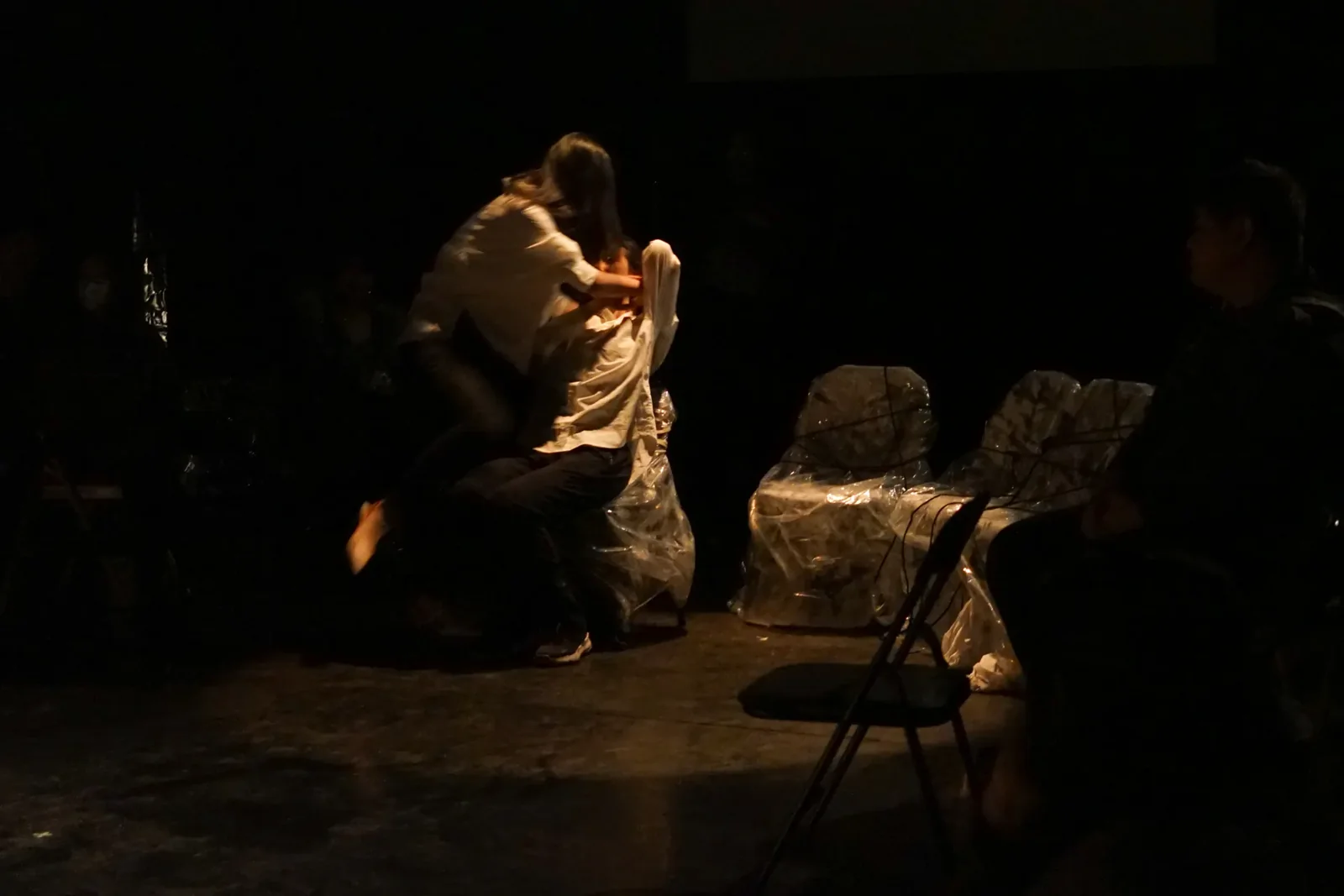
Public still DSC02770 from the main archive. It records a performance and cannot substitute for evidence of the eyes-closed training described in the text. View image source
3. Closing your eyes does not make the rule-giver disappear
Closed eyes temporarily make differences in performance experience less conspicuous, but do not automatically place participants under the same conditions. Some know the space better, some are sensitive to sound, and some are more anxious about losing orientation. Formally identical instructions impose different costs on different bodies. Explaining this prevents training from being mythologised into a machine for equality needing no explanation.
In the original account, stopping and continuing are still organised through instructions. Sustained movement makes it harder to withdraw into observation and requires new ways of sensing. This constraint may support discovery. It also shows that freedom is not the exercise's starting point but room to act gradually gained within constraints. Evaluation should look specifically at how instructions are answered, adjusted and ended.1
Performance stills offer another kind of observation: bodies isolated in darkness, arms emphasised by lighting and differences between sitting and standing can draw attention to how movement becomes visible. These images come from a performance, however, not a continuous record of that eyes-closed exercise. A performance photograph cannot establish the exact position of a touch described in writing or someone's feelings at that moment.
The most valuable use of images beside text is to let the two materials question each other. A training account prompts us to ask how a photographed posture formed; a photograph reminds readers that experience eventually enters light, distance and others' viewing. The materials supplement each other without needing to be assembled into an apparently gapless process.
4. What happens between “being occupied by a voice” and “speaking oneself”?
The pre-performance copy describes howling as a sound continually entering everyday life and dreams. It also presents the public performance as an invitation to make sound together. This turn from undergoing sound to producing it can be read alongside Li Chen's account: both concern how a person moves from receiving conditions to being able to answer them.2
The materials nevertheless perform different work. Pre-performance publicity must gather an audience, so its language accumulates intensity. The training account looks back after the event at hesitation and change. One is a promise, the other a local experience. Using the latter to prove the promise fulfilled for everyone inflates an individual feeling; using the former to suspect that all experience is merely publicity loses patience with actual change.
The short visual collection in the main archive offers a further distinction: approximately the first 63 seconds are a trailer, and the following 68 seconds a performance montage. One organises expectation; the other organises actions already recorded. They may use similar visual intensity but occupy different times. Readers can jump directly to the second part to compare the actions retained and the waiting between actions omitted.3
The montage is not called a full-performance recording here. Its rhythm can effectively convey force while making the process appear more continuous than the original event. More continuous material is needed to discuss who changed rules and when. To discuss how unfamiliar viewers are later brought quickly into a work, however, the montage itself is already an object worth analysing.
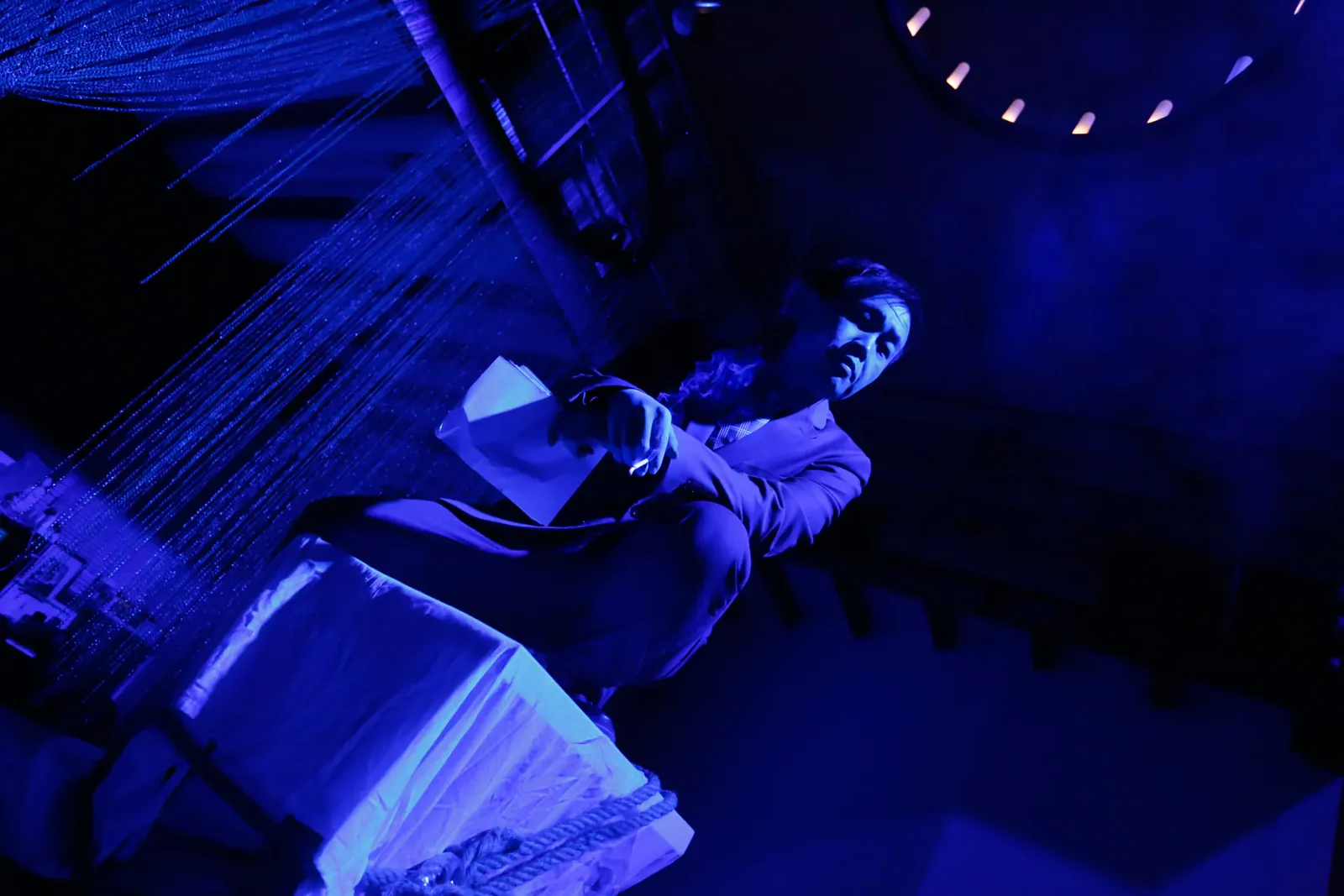
Howlers on the Rooftop, still MG_8101. Observe the relationship between body and light; the full entry retains the project association. View image source
- Watch the trailer · from 00:00: the collection opens with the trailer; the exact segment boundary is 01:02.633.
- Watch the performance montage · from 01:02: the location is checked against the main archive's segment record; the link begins about 0.6 seconds before the boundary.
5. Why does a one-time event need more than one record?
The public-performance announcement gives the date of 2 January 2021 and stresses that it will happen only once. Singularity does not mean that only one authoritative account may survive. Precisely because everyone cannot be returned to the same event, participants' writing, stills, trailers and performance fragments need to be preserved together. Each retains something the others readily lose.2
Photography can fix a gesture and its relation to light but cannot independently explain why the gesture occurred. Writing can connect fear and satisfaction, but the connection has already been organised afterwards. Continuous moving images can preserve duration while remaining limited by camera position. Each has strengths. Readers need clear paths between materials, not a demand that one medium eliminate the shortcomings of all the others.
Li Chen's poetic paragraphs about training particularly show that “recording” is not neutral transcription. Arrangement, recurring rhythms and metaphor are her labour of organising bodily experience for later readers. Calling that labour merely proof of the principal creators' method turns a participant back into an object for others to explain. Reading it as authored writing reveals how one event generates multiple works.
This also changes He Fa and P4's positions in the essay. The organisation provides conditions for gathering and public presentation; participants add their judgments; the later archive rearranges access. He Fa's emphasis on collective creation in the ten-year retrospective offers a clue to that self-understanding. Particular contributions must still be explained individually through credited, dated material.4
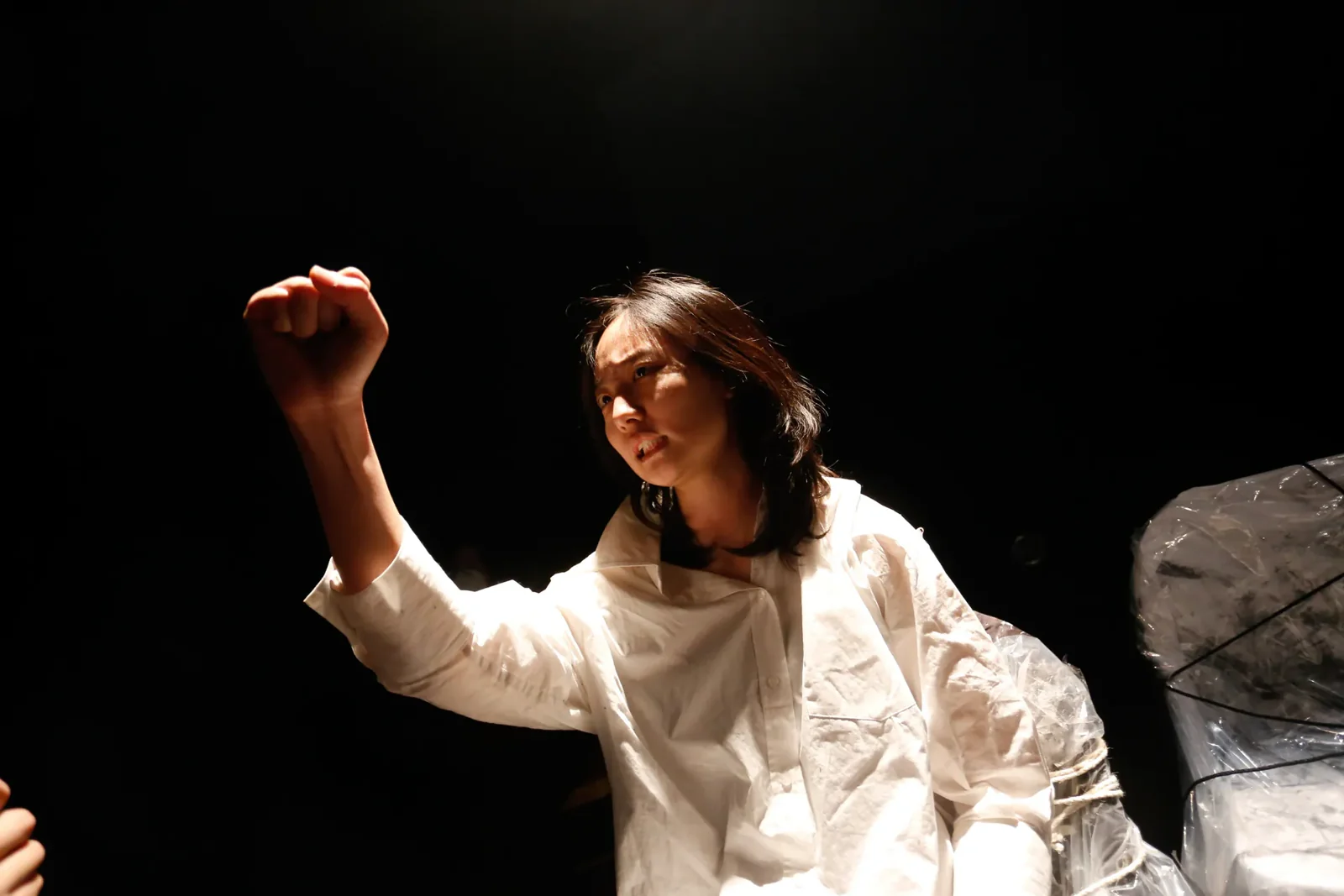
Howlers on the Rooftop, still MG_9164. Observe the relationship between body and light; the full entry retains the project association. View image source
- Main archive: performance-montage entry: establish that this is a performance montage, then compare it with the trailer and participants' writing.
6. How can we judge what collective creation has produced?
An overly convenient judgment equates stronger emotion with fuller collectivity. It overlooks observable parts of working together: whether someone can take up my proposal, whether I can change a misunderstanding, whether anyone undertakes the organising work that keeps an exercise going, and whether I can assess the event afterwards in my own words. An intense event may contain these capacities, or may not.
The cup exercise suggests at least three measures. First, perception: did participants discover sounds, distances and sensations previously unnoticed? Second, coordination: did others take up an imagination formerly sustained alone? Third, articulation: can the later account retain a complex description of initial reluctance and changes of feeling during the process? These measures relate to one another but cannot stand in for one another.
This analysis does not turn one experiential article into a universal training method. Its actions should be understood within their particular rehearsal conditions; nor does this essay infer inner feelings from a single still. What can be carried to other works is a set of comparative questions: how constraints produce possibilities, how local understanding is maintained, and who has the capacity to describe what happened together.
In Vortex, these questions meet harder material: car-park ground, how an action can be realised, and how a dating-and-marriage exchange is taken up. In Shoot Self with You, they become arguments about assessment, revision and ending. The connection between works is thus changing concrete action, rather than merely placing every project under “experimental theatre”.
- All project articles and moving images: continue to interviews, training and public images while preserving different participants' positions of narration.
Sources and original texts
- Am I a Reporter? (3) | Performer Training for Howlers on the Rooftop — Li Chen, 2021-01-05
2. 2 January! P4U Project Howlers on the Rooftop: Public Performance! — zaoyi, 2020-12-23
3. Howlers on the Rooftop: Project and Public Videos — P4 Theater main archive, project page
4. P4 Theater: Ten Years — He Fa, 2025-03-08
An essay for the P4 Theater website, based on public archives. Its analysis is not presented as the direct speech of He Fa or other participants; historical source texts retain their own credits and dates.
Chinese webpage: https://p4theater.cn/knowledge/howler-body-rule-collective/