
Republished in full on the official website: 2026-09-08; source version: 2026-07-04
Editor's Introduction
If photography not only retains the past but also arranges a position for a future viewer, looking encounters new limits. Moving through photographic traces, sound and performance remains, He Fa connects six theoretical lines to ask: why can a “you” called into being by an image still not treat the scene as its own possession? The full text retains the relations between these theoretical transformations and the pathways for further research.
This page uses the WeChat essay version dated 2026-07-04, originally credited to He Fa. “Future viewing flowing backward” is an interpretive proposition about the address of images and the viewer's position, not a claim that future audiences physically alter the past through reverse causation. The essay's transformations of the six theorists should be read separately from the concepts in their original works.
Source version: 2026-07-04; research archive made public: 2026-09-07; republished in full on the official website: 2026-09-08. The complete text, notes and references are retained according to the selected version.
- Original text in the research archive: consult the source version and original manuscript.
- YouTube: publicly available film with English subtitles: open the publicly released film. The research master and this public version have not yet been aligned shot by shot; this essay adds no unverified timestamp links.
- Download the selected source version (original Markdown): the source file is preserved verbatim for citation and version comparison.
Photography Is Not a Window, but an Address
This is the public research-archive version of the essay, retaining the arguments and limitations of its source version. Made public: 2026-09-07; this does not indicate that peer review has been completed.
Source-version date: 2026-07-04
Evidential scope: this is a manuscript formatted for publication on a WeChat official account. It brings together the existing lines of research on technological spectrality, second-person address, non-sovereign viewing, sound and performance remains in Shoot Self with You. It adds no new determinations concerning facts within the film, characters' psychology, real-world relationships, factual audience authorisation or page references in external literature.
Photography Is Not a Window, but an Address
Rewriting Belated Viewing in Shoot Self with You, from Bazin to Schneider
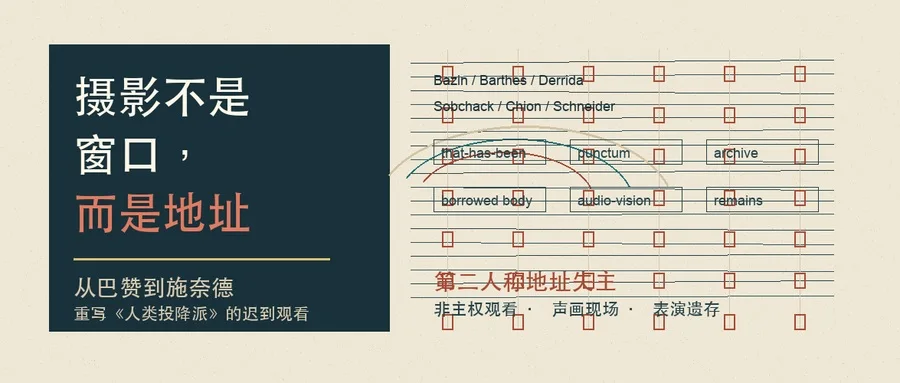
I. The Problem: Theory Is an Interface, Not the Master
Shoot Self with You is easily swallowed by theory.
It has handheld images, rehearsal spaces, theatrical structures and ambiguous questions addressed by figures to the camera and to people offscreen; it has sustained dislocations between sound and image, and end credits that overlay the scene. Any established theory could step forward to occupy a position: Bazin could call this the preservation of photographic reality; Barthes, the punctum of the image's mortality; Derrida, spectres and the archive; Sobchack, embodied viewing; Chion, sound reorganising the image; Schneider, performance remains.
But if an essay merely distributes the film among these theories, assigning each one a component to explain, it misses what is most dangerous about Shoot Self with You.
This film does not simply film a set of theoretical propositions. At the junction of filming, performance, sound, the archive and viewing, it poses a harder question: while a scene is taking place, photography has already handed it over to a future viewer; what, then, is this future viewer?
Is this person merely a spectator who arrives later? Merely a reader of the archive? Merely a theorist? Or has this person, from the beginning, flowed backward into the scene as a “you” that has no body and no authority, yet is already operative?
This essay calls that position “ownerless second-person address.”
Ownerless second-person address does not mean that the film has no address. On the contrary, its address is forceful. The film continually calls forth a “you”: someone questions the person behind the camera; someone's actions change under the pressure of being watched; sound draws in the scene beyond the frame; the end credits make future readers search anew for correspondences between bodies and names.
Yet this “you” cannot stably belong to any owner. At one moment it resembles a character, at another the camera, at another the camera operator, at another a future spectator, and at still another the position of the archive or the researcher. It is called forth and actually changes the scene, yet cannot be possessed.
Photography is not a window, but an address.
A window makes us think we stand outside and see inside; an address means that, as the scene takes place, it has already written a belated “you” into itself.
This is why the essay connects these six theorists. Bazin, Barthes, Derrida, Sobchack, Chion and Schneider are not six parallel footnotes here, but six thresholds in a single chain of questions: the image preserves reality; preservation brings mortality; mortality disrupts time in the form of spectres and archives; the viewer must enter this disruption bodily; sound prevents that entry from being controlled by the frame; performance leaves the disruption behind as remains.
What we arrive at is not a “sum of theories,” but a genealogy running from the photographic trace to the belated viewer.
II. Bazin: From “Having Been Present” to “Being Seen in the Future”
What matters most in Bazin's ontology of photography is not a simple assertion that photography is more truthful than painting, but his understanding of photography as a mechanical imprint left by reality.
There is a causal relation between the photographic image and what is photographed: the object was once before the lens, and light travelled from it to photosensitive material or an image-recording mechanism. A painting can be highly similar to its subject, yet it is still manually recreated; photography, at least in its basic structure, allows the human will to interpret to withdraw temporarily, letting reality enter the image through an automatic process.
This is also why Bazin connects photography with mummies, portraits and the ancient impulse to preserve the body: fearing time and death, human beings invent forms that preserve existence.
For Bazin, cinema goes further by preserving duration. Movements, spaces, surroundings and temporal relations remain within a single unfolding, rather than merely having one moment frozen into an image. This also explains his attention to the long take, depth of field and mise-en-scène: these forms do not rush to cut reality into a single meaning, but allow multiple bodies, directions and moral possibilities to coexist in the same space and time.
The ethics of the long take does not consist in “less editing is better,” but in its occasional willingness to let viewers confront reality in a state that has not yet been fully explained.
This is indeed one way into Shoot Self with You. It preserves rehearsal, pauses, bodily hesitation, offscreen pressure and sonic residues, without rushing to cut the scene into a smoothly consumable story. Many of its passages do not seek to explain an event clearly, but to retain a condition of the scene that is still unfolding and cannot yet be summarised.
Yet to call it merely a Bazinian preservation of reality would stop the argument too soon.
For the film's more radical aspect is not only that “reality has left a trace,” but that this trace is organised from the outset for a viewer who has not yet arrived.
In other words, photography here is not a window, but an address.
The logic of the window assumes that the viewer stands outside and the lens enables them to see inside. The logic of address says something different: as photography takes place within the scene, it has already inscribed a future recipient into that scene. This recipient has not yet arrived, yet already participates in the scene's structure as the pressure of someone who “will watch, will preserve, will misunderstand and will watch again.”
Bazin's proposition is: something happened here.
Shoot Self with You rewrites it as: this place will have been seen by someone who arrives late.
This is not wordplay. What actually changes is the tense. Traditional photographic ontology emphasises the past tense: the image attests that an object once existed. Shoot Self with You pushes photography into the future perfect: the scene is taking place, but it is already taking place under the conditions of future viewing.
The long take here is also more than reality's humble preservation; it limits the viewer's permissions. It tells the latecomer: you may enter, but only by this route; you may watch again, but cannot possess another camera that has not been given to you; you may linger, but must not mistake lingering for bringing the scene back to life.
Bazin's ethics of “keeping reality open” becomes here an ethics of “keeping the viewer subject to limits.”
III. Barthes: The Punctum Is More Than a Detail—It Is the Latecomer's Discovery of Having Been Awaited
In Camera Lucida, Barthes develops several concepts that have since been cited repeatedly in discussions of photography.
studium refers to the layer of a photograph that can be explained through culture, history, politics and knowledge. It allows us to understand the period, institutions, tastes and social context to which a photograph belongs.
punctum, by contrast, is not this general cultural interest, but some detail that suddenly pierces the viewer. It need not be grand, or even a subject deliberately arranged by the photographer; it might be a hand, a gesture, a fold in clothing or a slight shift of the gaze. What distinguishes the punctum is that we do not calmly read it out of the image: it wounds us in return.
Another line in Barthes is that-has-been: the photograph tells the viewer that the person photographed really was there. For this very reason, photographs always carry mortality. Even if the person was alive when photographed, at the time of viewing they have already become someone of the past, someone who will die or has died, someone preserved as an image-spectrum.
Barthes calls the photographed subject the spectrum. The word itself has spectral implications: once someone enters a photograph, they become an image-being that future viewers can gaze at, misrecognise, preserve and mourn.
Shoot Self with You certainly contains puncta in Barthes's sense. The white cloth, pauses, a gaze seeking an addressee, the absence of a response after a question, and the dislocation between names in the credits and bodies in the background can all produce an unpredictable pain in a particular viewer.
Yet understanding the film's punctum simply as “some moving detail” remains too narrow.
Where the film truly extends Barthes is this: the punctum is no longer merely a contingent detail within the image, but a piercing of the viewer's own position. The viewer does not see an object from the past and then get struck by one of its details; the viewer discovers that this past scene seems already to have reserved a place for their belated arrival.
This is what makes Shoot Self with You more complex than the ordinary mortality of images.
A photograph's mortality usually comes from “this person was once alive and has now entered the past.” In this film, mortality also comes from a more uncomfortable awareness: as a later viewer, I do not arrive innocently before the image; my viewing may already have been anticipated by the scene, built into the photographic mechanism, and summoned by sound and the credits.
The punctum is not “that detail belongs to the past,” but “I, this future viewer, turn out to belong to it as well.”
I thought I was watching a scene that had already ended, only to discover that, while it was taking place, it had already dispatched an unstable address to me.
Barthes says: this has been.
Shoot Self with You adds: the viewer who had not yet arrived had already been awaited by it.
Barthes's that-has-been therefore needs another formula here: who-has-not-yet-arrived.
Photography does not only tell us that “that person was once there”; it also produces “someone who has not yet arrived.” This person is not an authorised owner, but a belated recipient. They receive images, sounds, lists of names and residues, but cannot interpret receipt as possession.
The Barthesian punctum thus shifts from a photographic detail to an ethics of viewing: what is pierced is not my feeling, but my sovereignty as a viewer.
IV. Derrida: The Spectre Is Not the Return of the Dead, but Future Viewing Flowing Backward
Derrida's hauntology is often reduced to “the past will not die.” This is not entirely wrong, but it too readily identifies the spectre with the return of the dead, a bygone era or repressed history.
In Specters of Marx, what matters more about the spectre is time out of joint: the present is never a clean present, but is torn open by an unfinished past, a future not yet arrived, debts, mourning and relations of inheritance. The spectre neither fully exists nor fully fails to exist; it demands a response, yet cannot be reduced to a stably identifiable object.
Archive Fever takes the question further, into institutions of preservation. An archive is not a neutral storehouse, but a structure of address, power and interpretive authority. Who may preserve, name and retrieve; who may bring certain materials into public memory; who is excluded from the archive—these are not purely technical questions. The archive appears oriented toward the past, yet is always producing the future, because future people will reorganise the past on the basis of the archive.
The relation between Shoot Self with You and Derrida cannot stop at “the film is spectral” or “the credits are archival.”
Its spectrality does not consist in a ghost story, an apparition of the dead or the return of old events, but in a future viewer being called back in advance by the past. The future viewer was not present when the film was shot; yet the camera, second-person questions, sonic residues, end credits and archival overlay had already made this future position operative.
The spectre is thus not “someone already dead returning,” but “someone not yet arrived already beginning to affect the present.”
This is also why the archival layer of Shoot Self with You is not merely a conclusion. The end credits, roles, acknowledgements and institutional logos seem intended to archive the scene, giving a readable order to relations of creation, performance, filming and viewing. Yet bodies in the background, blurred scenes, sonic residues and vacancies outside the list continually remind us: the archive's overlaying of the scene does not mean its victory over the scene.
The more the archive names, the more it exposes the incompleteness of naming; the more it preserves, the more it reveals preservation's limits; the more it places people on a list, the more it makes us aware that some bodies, relations and forms of waiting still cannot be wholly taken away by that list.
What Derrida offers here, then, is not a ready-made conclusion, but a methodological caution.
We cannot write Shoot Self with You into an object “finally archived by theory.” On the contrary, the film places the researcher, too, within archive fever: we rewatch, capture frames, organise materials, write essays, build a Wiki and generate concepts, but none of these are clean acts performed outside the scene.
They continue the film's archival desire and must also accept the limits it sets: preservation is not settlement, explanation is not inheritance, and research is not possession.
V. Sobchack: Embodied Viewing Is Not Identification, but Constrained Bodily Borrowing
Sobchack's phenomenology of film opposes treating cinema as a purely visual object, as well as treating the spectator as a passive recipient wholly controlled by the apparatus.
For her, cinematic experience takes place between bodies: the film has its own ways of perceiving and moving, and its own expressive body; spectators, too, experience images with their bodies. We do not watch films with our eyes alone. Our sense of direction, breathing, muscular memory, tactile imagination, spatial tension and bodily boundaries all take part in viewing.
This theory matters greatly to Shoot Self with You, because viewing in this film is never purely visual.
Handheld movement, proximity, wide angles, motion, waiting, hesitation, obstruction, low positions and a sense of breathing all make viewers aware that they are not watching from an omniscient position. The camera is not a transparent passage but something like a borrowed body: it has distance, weight, agitation and the limitation of being unable to see everything at once.
Entering the film does not give the spectator a God's-eye view, but temporary use of this constrained body.
Yet this is precisely where the essay must depart from Sobchack. Embodied viewing is easily mistaken for deeper immersion, as though the more bodily sensation viewers experience, the further they enter the scene and the closer they come to reality.
For Shoot Self with You, the reverse is true: embodiment does not let spectators possess the scene, but makes them discover that they cannot possess it.
Handheld camerawork does not give you a stable “I,” but a temporary body that can move outside itself, misaddress and be watched by others. The wide angle does not let you see more and therefore master more; it prevents you from extracting figures cleanly from their surroundings, edges, third positions and the conditions of the scene. The long take is not immersive continuity, but locks you into a route you cannot skip.
This essay therefore rewrites Sobchackian embodied viewing as “constrained bodily borrowing.”
Viewing through a borrowed body is not POV. POV usually says: what you are now seeing is what a particular character sees. Viewing through a borrowed body says instead: this act of viewing now borrows a certain body, but does not guarantee that it belongs to that body. It may resemble a character, a cinematographer or a future viewer; at some moment, it may also expose its inability to belong anywhere at all.
This instability is precisely the condition under which second-person address emerges: viewing first borrows a body, then discovers that the body is not its own, and finally returns as an “I” that is seen and is not originary.
Sobchack helps us understand that spectators do not watch from outside the body; Shoot Self with You further helps us understand that the body spectators borrow does not belong to them either.
Film phenomenology is pushed toward ethics here: sensing the scene does not mean possessing it; having one's body mobilised does not mean receiving authorisation; being called by the film does not mean becoming its master.
VI. Chion: Sound Does Not Supplement the Image, but Prevents the Scene from Closing Its Doors
Chion's theory of sound has a basic premise: cinema is not image plus sound, but a new perceptual whole generated jointly by sound and image.
Sound does not merely supplement the image. It changes what we see, how we judge space, and how we experience time and causality. added value is the meaning, emotion, rhythm, weight and direction that sound adds to the image, making spectators think these things were already there in the image.
synchresis refers to the spectator's rapid fusion of sound and image when they occur simultaneously, as though they belonged to a single event. Acousmatic sound, offscreen sound and vococentrism likewise show sound's capacity to reorder the image.
The sound of Shoot Self with You is precisely what cannot be treated as “score” or “sound effects.” It is closer to the scene's mechanism for crossing boundaries.
The image seems to provide a boundary, yet sound continually renders that boundary ineffective: someone is offscreen; the scene has not stopped. Low frequencies, friction, breathing, material sounds, the tails of voices and ambient noise prevent the image from closing in on itself. Often, the image offers only partial bodies, obstruction, a low-lying space or a still pose, but sound tells us that the scene is still moving, relations continue outside it, and the viewer is not yet entitled to declare it over.
This is where Chion is taken further. audio-vision explains that cinematic perception is already a synthesis of sound and image, rather than first seeing an image and then adding sound to it. Shoot Self with You further makes sound a relay station for second-person address.
Sound often has no stable owner, nor can it always be reclaimed by the image. It sends a sentence, an intake of breath, a low-energy interval or a contact between materials offscreen, behind the camera and onward to a future repeat viewer. The image seeks to enclose the scene within the visible, but sound retains an outside like a gap in a door.
Sound in the film therefore does not “make the image more real,” but prevents the image from monopolising reality.
It forces the viewer to admit: what I see is not the whole scene, and what I hear cannot be fully assigned to a source. Sound brings me closer while making me aware that I have not arrived. It gives the future viewer an entrance, while retaining uncertainty at that entrance.
The ethics of sound, like the ethics of photographic address, is this: it summons you, but does not authorise you to close the case.
Sound is not an appendage to the image.
In Shoot Self with You, sound preserves the part of the scene the image has not contained, and prevents the viewer from mistaking “hearing” for “possessing.”
In this sense, sound is almost an archive before the archive of the end credits. It preserves the scene the image has not contained, the waiting after speech, and the pressure still reverberating through the space after a body has left.
Yet this is not preservation in the form of a clear list of names. It is an unstable preservation: it lets future viewers receive residues without being able to translate those residues into complete facts.
Chion helps us understand how sound and image combine to produce perception; Shoot Self with You shows us that sound can also prevent perception from becoming ownership.
VII. Schneider: Performance Does Not Vanish, and Remains Can Begin in Advance
A longstanding question in performance studies is whether performance disappears as soon as it happens.
One classic account holds that performance's ontology resides in its presentness: once completed, it no longer exists, and the remaining videos, photographs, props and writings are merely records, not performance itself. In Performing Remains, Schneider stresses instead that performance is not defined solely by disappearance; it also remains. Moreover, what it leaves is not ordinary objects, but bodily habits, gestures, reenactments, historical residues, repetitions of trauma and failed copies.
This turn is crucial for Shoot Self with You.
The film does not simply record an already completed theatrical work, nor treat rehearsal as preparation for a formal performance. What it films is the mutual contamination of actors, characters, rehearsal, viewing and recording.
Actors have not yet fully become their characters, yet are already changed by the characters' demands, lines, failures and the pressure of the scene; characters have not yet stably taken shape, yet are already preserved by photography, sound and future viewers as residues that can return.
In other words, performance remains do not appear only after the performance ends. They begin during rehearsal.
The white-cloth passage at the end makes this particularly clear. The character chooses to remain inside the theatre, while the actor steps out of the character and moves toward the production team or a position outside the film. This action should not be understood only as a metacinematic revelation, nor simply as a neat reversal in which “the actor leaves the character.”
More precisely, the actor carries out a kind of mourning for the character: the character remains in an interior space of anxiety, while the actor is able to withdraw from that space.
Yet the character does not thereby disappear. It continues to exist as white cloth, an invisible wish, residues of lines, end credits and a punctum for future repeat viewing.
Schneider allows us to say that performance continues as remains rather than simply disappearing on completion. Shoot Self with You brings this proposition forward by another step: remains are not passively left behind only after performance, but are produced by the photographic mechanism, future viewing and archival desire while performance is still happening.
Every hesitation, missed word, wait, movement outside the body and exit by an actor is already becoming a remain that can be viewed again in the future. Before performance becomes itself, it has already begun losing itself; before the character is complete, it has already begun to have an afterlife.
This also explains why the film's “surrender” cannot simply be read as giving up.
Surrender has two layers: the character sinks into the interiority of the script and anxiety, while the actor temporarily extricates themself by mourning the character. Yet this extrication is not a complete escape, because the image preserves the process of extrication and hands it to the future viewer.
Performance studies thus connects here with hauntology: performance remains are not a residue of the past, but future viewing entering performance in advance, so that performance bears its own afterlife from the beginning.
VIII. How the Six Theoretical Lines Converge in “Ownerless Second-Person Address”
We can now condense the six lines into a whole.
Bazin provides the “trace”: the image preserves reality.
Barthes provides the “wound”: what is preserved pierces the viewer with its mortality.
Derrida provides “disjointed time”: this wound is not simply past, but a disturbance of the present by spectres and archives.
Sobchack provides the “body”: the viewer is not an abstract consciousness, but enters the disturbance bodily.
Chion provides “boundary crossing”: sound prevents the body's entry from being controlled by the frame.
Schneider provides “remains”: performance continues to take place between disappearance and preservation.
But Shoot Self with You does not add these six points together; it redirects them jointly toward a question of grammatical person.
Photography preserves the scene, but not for a neutral eye: it preserves it for a future “you.” This “you” is pierced by the image, yet the pain comes from discovering that the past has already awaited them. This “you” resembles a spectre, because they have not yet arrived but already affect the present. This “you” must borrow a body to view, yet the borrowed body does not belong to them. This “you” continues to be summoned by sound, yet sound does not let them close the scene. This “you” confronts performance remains, yet those remains do not authorise them to resurrect or possess the performance.
Ownerless second-person address can therefore be defined as follows:
A cinematic address calls forth a “you,”
makes this “you” actually operative within the scene,
yet does not let it settle stably upon a character, camera, spectator, archive or researcher.
This definition contains three layers.
First, “you” is called forth, so it is not a void.
Second, “you” has actual effects, so it is not a purely interpretive illusion.
Third, “you” cannot stably belong anywhere, so it is not another name for spectator sovereignty, a character's viewpoint or authorial intention.
It is an operative yet ownerless address.
This point rearranges the six theorists' concepts. Bazin's preservation of reality becomes the preservation of an address; Barthes's punctum becomes the address piercing back; Derrida's spectre becomes the disjointed temporality of a future address; Sobchack's body becomes a borrowed body of address; Chion's sound becomes the forwarding of an address; Schneider's remains become the address's afterlife.
In other words, the film does not ask “who is looking,” but asks: when a “you” is called forth yet cannot be returned to any stable owner, how can viewing still take responsibility?
IX. Why This Is Not an Ordinary Claim about “Metacinema” or a “Rehearsal Documentary”
A conservative reader might ask: isn't this just metacinema?
The film exposes the camera, actors, production team and credits, making spectators aware that they are watching a film.
Or: isn't this just a rehearsal documentary?
The film records instability, trial and error, changes of character and residues of the scene during the creative process.
Such counter-readings are not entirely wrong, but they too quickly force the problem back into familiar categories.
“Metacinema” usually concerns how film exposes its own mechanisms and makes spectators aware that the medium is not transparent. Shoot Self with You certainly has this layer, but goes further: exposing the mechanism does not give spectators sovereignty over the truth.
Many metacinematic works, after revealing the apparatus, instead give spectators a higher-order sense of mastery: I know this is a film; I know how it manufactures illusion; therefore I am more lucid than an ordinary viewer.
Shoot Self with You does not do this.
After exposing the camera, sound, performance and archive, it does not hand the scene to a cleverer spectator, but makes spectators aware that they, too, are merely belated arrivals drawn into it.
“Rehearsal documentary” is also insufficient.
Documentary logic readily assumes a pre-existing process that the camera records, allowing later spectators to see it. But in Shoot Self with You, the camera does not stand outside the process.
Rehearsal changes because it is filmed; performance is transformed by future viewing; sound pushes the scene outward because it cannot be assigned a stable place; the archive of the credits exposes preservation's failure through its attempt to preserve.
There is no clean “rehearsal itself” that exists first and is then recorded in images. From the beginning, rehearsal is entangled with viewing, recording, preserving and watching again.
The claim made here is therefore narrower than “metacinema” and more stringent than “rehearsal documentary.”
It is not that the film is self-reflexive, nor that it records a process. Rather, the film prepositions a future viewer as a condition of the scene and continually limits that viewer's sovereignty. The spectator is called, but not authorised; theory is invited, but cannot become the master; the archive preserves the scene, but cannot settle its account.
This limit is the film's actual formal ethics.
X. Non-Sovereign Viewing: The Ultimate Ethics of the Theoretical Interfaces
If the essay were condensed into one statement, it would be:
Shoot Self with You transforms photography from a “window preserving the past”
into an “address summoning the latecomer,”
and compels that latecomer to learn non-sovereign viewing.
Non-sovereign viewing does not mean not looking, nor does it oppose theory, archives or repeat viewing. It expressly acknowledges the inevitability of seeing, preserving, scanning again and theoretical writing.
The question is that these acts cannot automatically turn into ownership.
A scene's entry into an image does not mean it belongs to the spectator; a body's entry into a list does not mean the archive has fully explained it; an actor's mourning for a character does not mean the character has been deleted; a sound's being heard does not mean it acquires a stable source; a detail's piercing us does not mean we gain the right to possess it.
This is also the shared boundary of the six theorists in this essay.
Bazin reminds us to respect reality's ambiguity, but Shoot Self with You asks us to respect the limits of future viewing.
Barthes reminds us that photographs can pierce the viewer, but the film asks viewers to acknowledge that pain does not authorise possession.
Derrida reminds us that the archive is always opened by the future, but the film asks the archive to acknowledge the boundaries of its failure.
Sobchack reminds us that viewing is embodied, but the film asks the body not to mistake borrowing for owning.
Chion reminds us that sound reorganises the image, but the film asks us not to mistake audiovisual fusion for a final determination of the facts.
Schneider reminds us that performance remains, but the film asks us not to mistake remains for an originary scene that can be resurrected.
The depth of Shoot Self with You does not lie in its “fitting” these theories, but in making them rewrite one another.
Photographic ontology must confront the future viewer; the punctum must confront the viewer's own position; hauntology must turn from the return of the dead to the prepositioning of the future; film phenomenology must turn from embodied immersion to constrained bodily borrowing; sound theory must turn from audiovisual synthesis to the impossibility of closing the scene; performance studies must turn from remains after performance to pre-remains within rehearsal.
The six lines ultimately converge in the same ethical proposition: even after seeing, we still cannot take away the people, scene, sounds, characters and remains.
Conclusion: This Place Will Have Been Seen by You, but You Cannot Possess It
The most fundamental tense of Shoot Self with You is not the past tense, but the future perfect.
It does not merely say “something happened here,” or “this place was recorded.” It says: while this place was happening, it had already been handed to a belated you; when you finally watch, this place will have been seen by you.
This “you” is not free. It is summoned by photographic address, led in by sound, entangled with performance remains, assigned a way of reading by the archive, pierced by the punctum and halted by ethical boundaries.
The film's “human surrender” thereby ceases to be merely a thematic emotion or posture and becomes the collapse of a regime of viewing: human beings can no longer pretend that looking can possess its object, that preservation can conquer time, that repeat viewing can resurrect the scene, or that theory can complete the film on its behalf.
Surrender is not admitting defeat, but acknowledging the failure of viewing sovereignty.
It is precisely in this failure that the film opens another, more difficult form of witnessing: the latecomer must arrive, but the latecomer cannot possess.
The six theorists connected in this essay are therefore not a map of external authorities, but a set of interfaces rearranged by the film. Bazin lets us begin with the trace; Barthes makes us feel the trace's punctum of mortality; Derrida lets us see how the punctum becomes spectres and archives of disjointed time; Sobchack makes us acknowledge that viewing must take place through a borrowed body; Chion lets us hear that the scene beyond the image is still continuing; Schneider helps us understand why performance does not disappear at its end.
And Shoot Self with You pushes all these interfaces in the same direction:
The image does not hand the past to a master.
The image hands an ownerless “you” to the future.
You have already been called. But you have not been authorised to possess.
Table of Theoretical Transformations
-
Bazin's ontology of photography: the original question concerns how photography preserves the traces and duration of reality; in Shoot Self with You, it becomes a question of how photography organises the scene in advance for a future viewer.
-
Barthes's theory of photography: the original question concerns how photographs pierce the viewer through
that-has-beenandpunctum; in Shoot Self with You, it becomes a question of how the punctum makes viewers discover that the scene has long awaited them. -
Derrida's hauntology and theory of the archive: the original question concerns how the past, traces, debt and archives disturb the present; in Shoot Self with You, it becomes a question of how future viewers have already flowed backward into the filming scene before they arrive.
-
Sobchack's phenomenology of film: the original question concerns how film viewing takes place bodily; in Shoot Self with You, it becomes a question of how viewers borrow a constrained body that does not belong to them.
-
Chion's theory of sound: the original question concerns how sound reorganises the perception of images; in Shoot Self with You, it becomes a question of how sound prevents the image from closing the scene and forwards second-person address.
-
Schneider's performance remains: the original question concerns how performance continues to remain after its supposed disappearance; in Shoot Self with You, it becomes a question of how remains emerge in advance during rehearsal and filming, and how characters acquire an afterlife.
References and Theoretical Starting Points
-
Bazin, Andre. "The Ontology of the Photographic Image." Film Quarterly 13, no. 4 (1960): 4-9. See also the relevant volumes of What Is Cinema?.
-
Barthes, Roland. Camera Lucida: Reflections on Photography. New York: Hill and Wang, 1981.
-
Derrida, Jacques. Specters of Marx: The State of the Debt, the Work of Mourning and the New International. New York: Routledge, 1994.
-
Derrida, Jacques. Archive Fever: A Freudian Impression. Chicago: University of Chicago Press, 1996.
-
Sobchack, Vivian. The Address of the Eye: A Phenomenology of Film Experience. Princeton: Princeton University Press, 1992.
-
Sobchack, Vivian. Carnal Thoughts: Embodiment and Moving Image Culture. Berkeley: University of California Press, 2004.
-
Chion, Michel. Audio-Vision: Sound on Screen. New York: Columbia University Press, 1994.
-
Schneider, Rebecca. Performing Remains: Art and War in Times of Theatrical Reenactment. London and New York: Routledge, 2011.
Wiki Evidence Notes
-
This WeChat manuscript is adapted from Photography Is Not a Window, but an Address: Rewriting Belated Viewing in Shoot Self with You, from Bazin to Schneider—2026-07-04; it adds no new determinations of facts within the film.
-
For the foundation of photographic address and the future perfect, return to Technological Spectrality, Essay 9: The Future Perfect and the Ontology of Photographic Address—2026-06-02.
-
For bodily borrowing, slipping in, return and the genesis of the second person, return to Technological Spectrality, Essay 24: The Genesis of the Second Person through Bodily Borrowing, Slipping In and Return—2026-06-02.
-
For future viewing flowing backward and temporal reflexivity, return to Technological Spectrality, Essay 27: Temporal Reflexivity and Future Viewing Flowing Backward—2026-06-02.
-
For the ownerless second person and non-sovereign viewing, return to Imaging with You: Illustrated Web Essay—The Ownerless Second Person and Non-Sovereign Viewing—2026-06-08, Non-Ownership after Visibility, The Archive Overlays the Scene, and Second-Person Waiting.
Website Supplement: Chapter-by-Chapter Material Guide
II. Bazin: From “Having Been Present” to “Being Seen in the Future”
- Photographic Address and the Future Perfect: related research cited in the original manuscript's Wiki evidence notes.
IV. Derrida: The Spectre Is Not the Return of the Dead, but Future Viewing Flowing Backward
- Temporal Reflexivity and Future Viewing: related research cited in the original manuscript's Wiki evidence notes.
V. Sobchack: Embodied Viewing Is Not Identification, but Constrained Bodily Borrowing
- Bodily Borrowing, Slipping In and Return: related research cited in the original manuscript's Wiki evidence notes.
VI. Chion: Sound Does Not Supplement the Image, but Prevents the Scene from Closing Its Doors
- Second-Person Waiting: related research cited in the original manuscript's Wiki evidence notes.
VII. Schneider: Performance Does Not Vanish, and Remains Can Begin in Advance
- Subsequent revision: the white cloth's two endings: comparing versions | This essay's mourning of the character is a theoretical interpretation. The revision of 7 September rereads the white-cloth proposal through a participant's own account, retaining uncertainty concerning motives and staging information.
X. Non-Sovereign Viewing: The Ultimate Ethics of the Theoretical Interfaces
- Non-Ownership after Visibility: related research cited in the original manuscript's Wiki evidence notes.
Materials and Original Texts
- Photography Is Not a Window, but an Address — He Fa, 2026-07-04
2. KINOK-RELATION DOSSIER / Positional Photography Manuscript | Why Must the Camera Holder Surrender Too? — Original byline: Ivan Weitov, 2026-05-12
3. What Is a Real Image? — He Fa, 2020-06-21
4. Shoot Self with You — P4 Theater, project entry point
This is a full republication from the P4 research archive. The official website has added the editor's introduction, image-source links and chapter-by-chapter material guide; the original manuscript's arguments, references and evidential limitations are retained according to the source version listed.
Webpage: https://p4theater.cn/knowledge/photography-as-address/