
Reading recurring lines, premiere photographs and versions of the original film together, this essay asks how identifying a person becomes a procedure demanding someone's disappearance, and how an archive can preserve that uncertainty.
P4 Theater website essay · 2026-09-08
1. More than a character has gone missing
The published text of Shadow Counterpoint begins by borrowing the voice of a case report: a woman has been killed; her family later denies that the deceased is her; a case thought to have been closed becomes a missing-person question again. This report belongs to the work's narrative and must not be treated as real news. Its effect is to put readers through two acts of confirmation in quick succession: first accepting “she has been found”, then being forced to acknowledge that “the person found may not be her”.1
Between these two steps, the body undergoes no new change in the text. What changes is what is said about it. The work thereby poses a more specific question than “split personality”: when appearance, name and other people's confirmation come apart, what must a person's presence pass through to be acknowledged? If even what we see with our own eyes can be overturned, sight no longer has the final say.
This is why the essay reads three kinds of material together. The 2016 GIF article preserves lines and the rhythm of a webpage; premiere photographs preserved by P4 retain the stage and viewing positions; the 720p public-access edition in the main archive restores duration to sound and action. The three record different things. Photographs cannot supply dialogue missing from the film, and the GIF article cannot be treated as a second-by-second performance record.2
Reading the text's opening, then looking at the premiere photographs and finally watching the original film is more productive than starting with a search for a complete story. This essay's central claim is that the work changes identity from an inherent attribute of a character into a relationship of continual recognition, doubt and demands for proof by others. That claim comes from the arrangement of the materials and changes in their language, not speculation about the creators' psychological motives.
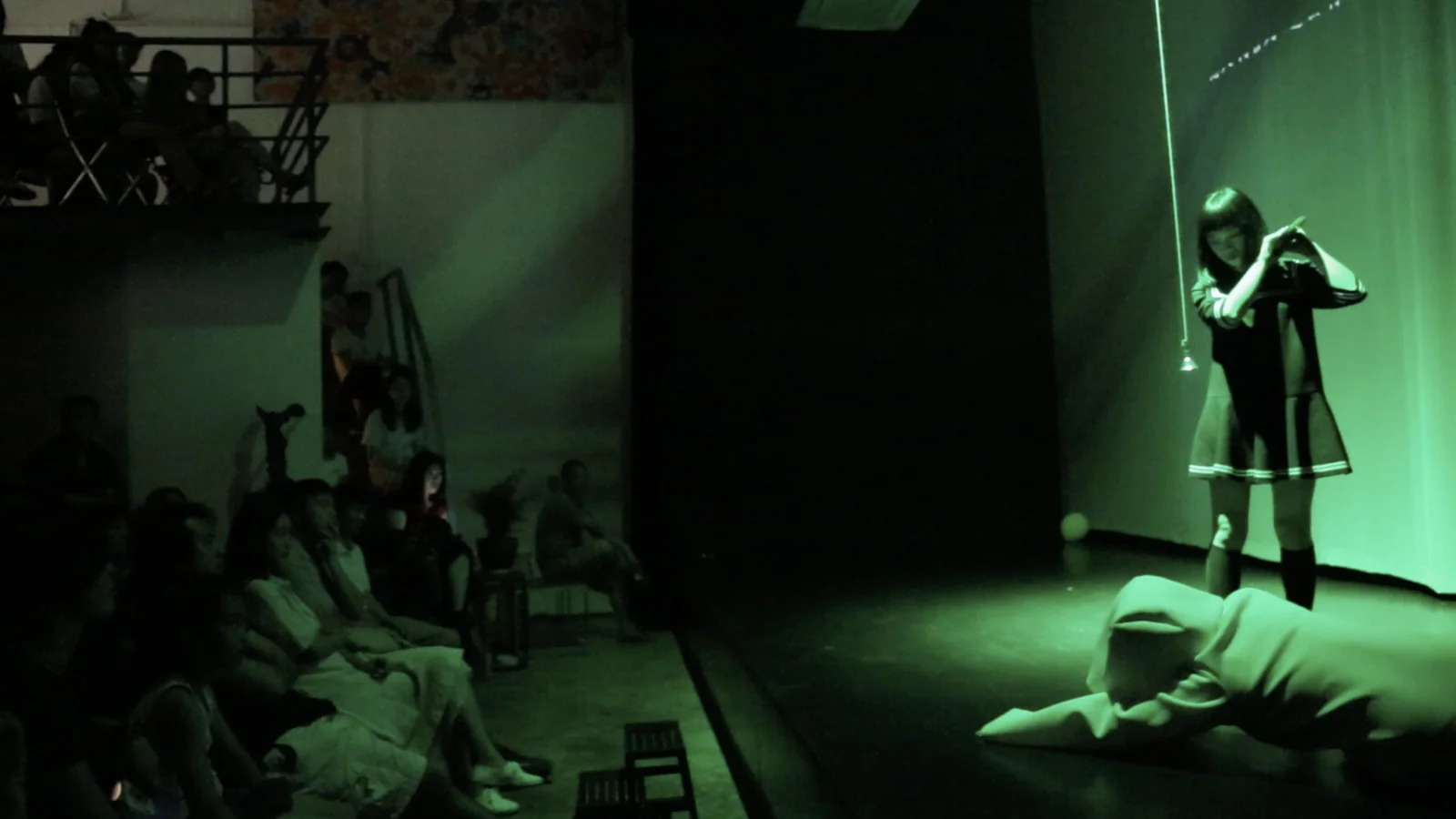
The premiere of Shadow Counterpoint. Historical photograph supplied by P4, labelled “premiere” in the original file; used here to compare viewing heights and spatial positions. View image source
- Read the original 2016 GIF article: begin with its case-report opening; the case belongs to the work's narrative.
2. When a sentence returns, what changes is who can believe it
The public text repeatedly returns to an arrangement to meet, confirmation of an accident and questions about the person seen. These statements bring back little factual information each time, yet continually intensify the demand to “make it clear”. Repetition resembles both the return of memory and questioning that refuses an answer already given. Both readings should remain possible; recurring sentences alone do not justify diagnosing a character with a mental illness.1
The first time readers encounter the arrangement to go and see pelicans, they can take it as the characters' shared past. On its return, it begins to resemble testimony that must be recited: are you still saying the same thing? Can you remain consistent? Identical wording might seem a sign of reliability, yet too much sameness can also prompt suspicion that it has been rehearsed. The work brings “consistent testimony” close to “suspicious recitation”.
Repetition therefore does more than amplify an emotion. It changes the use of language: a recollection gradually becomes an identity check. Someone must not only explain what happened but use an account consistent enough to prove that they are the person who experienced it. If every hesitation can be read as impersonation, a procedure demanding accuracy may itself produce someone unable to pass its test.
Another explanation remains equally possible: these repetitions may create formal rhythm rather than simulate an interrogation. To judge how the two overlap requires listening to the speed, pauses and responses on each recurrence in the film, and observing whether it comes from the same position. A webpage cannot perform that work. The full access edition is therefore linked here so readers can return to it with the question “Who is asking whom to repeat?”
- Watch Shadow Counterpoint, 720p public-access edition · 22:15: compare the voices, pauses and actions of recurring lines. The link starts at the beginning rather than assigning unverified dialogue timecodes.
3. Reading the premiere photographs: spectators do not share one image
In the premiere photograph, spectators sit close to one side of the performing area while others look down from above; standing and lying bodies occupy different heights onstage. The space first establishes unequal conditions of viewing. Those below may be blocked by people in front, those above see spatial relationships in plan, and the photographer reorganises all these positions within a frame. Being close to the event does not give everyone the same evidence.
This matters particularly in a work concerned with identification. Characters ask who the person they saw was, while spectators in the physical space can see bodies only from a particular direction. Narrative uncertainty and the limits of spectators' positions can thus illuminate one another. Yet the photograph shows only this instant. It cannot establish that every spectator actually felt doubt, or that the arrangement was designed specifically to express a philosophical proposition.
Another composite photograph places green and red stage states one above the other. The colour change gives the same work markedly different conditions of visibility: light and dark determine which parts of a body are read first, while large dark areas remain indistinguishable. The composite lets us compare two visual states quickly, but also compresses whatever waiting, transitions and actions may originally have separated them.
We should therefore distinguish “comparison between images” from “the performance's actual sequence”. The photograph can help analyse appearance and concealment; its upper and lower arrangement alone cannot reconstruct the plot. Likewise, an opening-event photograph can show how P4 once gathered spectators around a space, but cannot replace a complete audience record of a particular performance of Shadow Counterpoint.
4. Why is it harder to return a voice to one person than an image?
The text first asks what sort of sound was heard, then connects sound with whether a cry for help can be heard. Vision often leads us to think we can point to an object. Sound, however, can travel past an obstruction and reach us without its source being visible. Hearing in the work therefore does not immediately complete identification. It opens another gap: hearing something does not mean knowing whose voice it is.1
Once “another person exactly the same” appears, the question changes further. At first, the task is to discover who is the real person. Later, one of the two is required to disappear. This is a crucial shift: difficulty in identification becomes a reason to reduce the number of people to be identified. A rule unable to accommodate both does not revise its own judgment; it demands a reality containing only one person convenient to classify.
This essay understands that shift as the work's sharpest structural move. It does not depend on proving which character is the original self. On the contrary, deciding too quickly which is genuine may finish the work of this exclusionary procedure: once an original is chosen, the other seems automatically to lose a reason to exist. Readers can suspend their verdict on identity and attend instead to the position from which “there can only be one” is demanded.
Finally, densely arranged action commands on the webpage place bodies within a repeatedly executable procedure: move, stand, begin, end. Identifying a unique person sits in tension with requiring a body to perform standard actions. The more orderly the commands, the harder it becomes for a person's particular experience to enter them. Yet no bodily execution is entirely the same, so the procedure cannot wholly replace lived time.
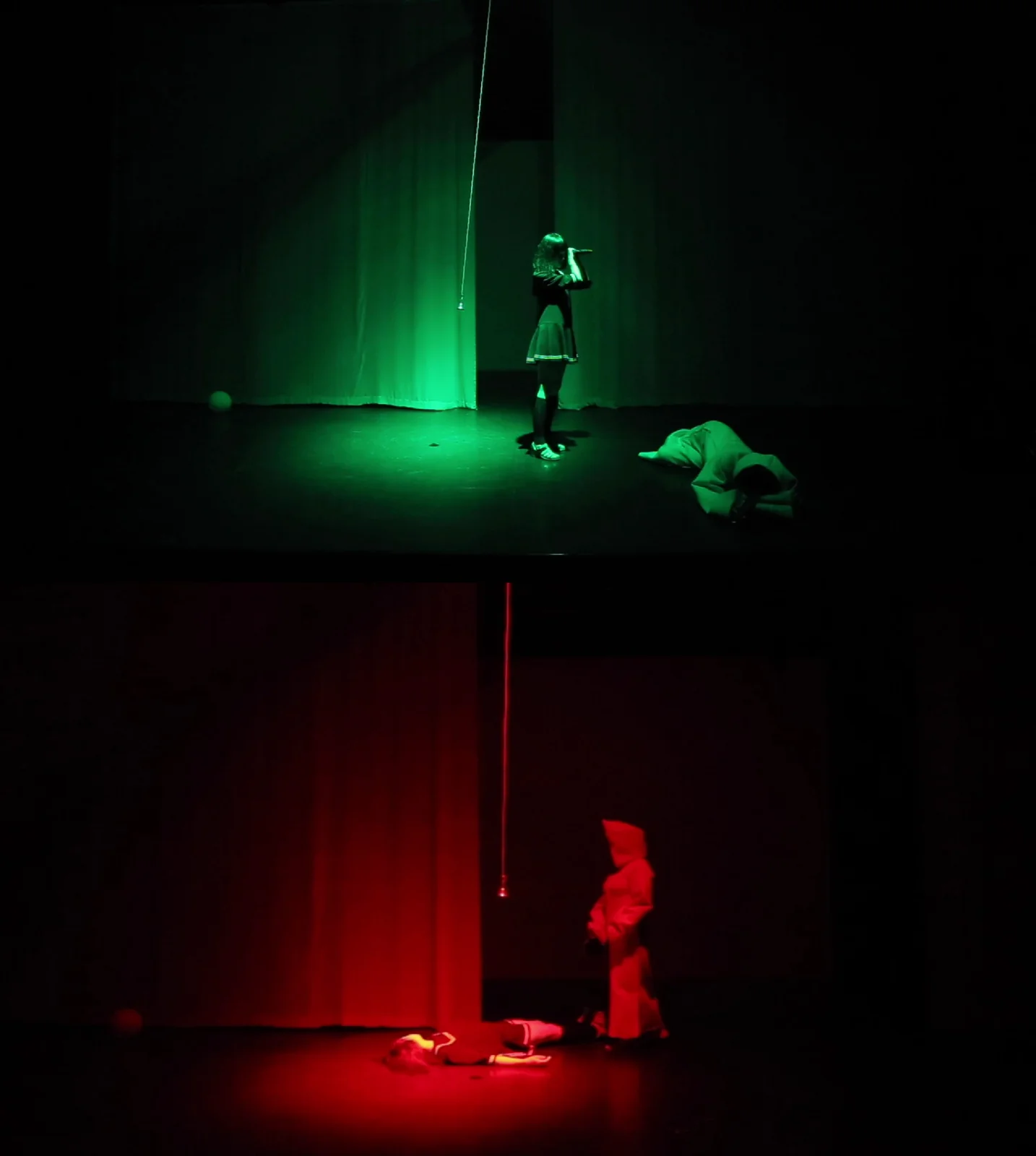
Stage photograph of Shadow Counterpoint, preserving the original upper-and-lower composite. Its arrangement is not used to infer the performance's chronology. View image source
5. The GIFs, full moving image and video essay offer three different entrances
The GIF edition deserves to be read in its own right because looping changes the direction of an event. In a continuous performance, a fall may lead to consequences; in a loop, it keeps beginning again. Viewers can recognise a posture quickly but lose “what happened after this time”. Recurring sentences and looping images together create a reading experience of being held in place. That experience belongs to the webpage's organisation and cannot simply be projected back onto the theatre.1
The main archive offers both a full-work access edition and a later English video essay. The former is suited to comparing what precedes and follows an action; the latter reorganises the questions into an interpretation. Both concern Shadow Counterpoint, but narration in a video essay cannot become something spoken in the 2016 performance. Naming them separately saves readers from having to guess what kind of material they have opened.2
“Full” also needs a defined scope. “Full-work access edition” refers to the version provided by the archive; it does not mean that the camera encompasses every position at the event. A continuously recorded shot still has an off-screen space, and an intact edited file may still omit scene changes. An archive's value lies in allowing specific material to be checked again, not in assigning any version a status of having missed nothing.
Readers can make a small comparison: first locate a recurring question in the GIF article and note how it occupies the page; then check voice, body and duration in the film; finally see how the video essay summarises it. If the essay's summary is much more definite than the film, evaluate that definiteness as part of the argument, not as an answer naturally supplied by the original footage.
- Later interpretation: If There Were Two of You, Which One Must Disappear? · 08:13: an English video essay. Read it separately from the original film to identify what the later interpretation adds.
- Main archive: version record for the full work: consult the access edition's archive entry, then return to the original article for comparison.
6. From an early work to P4's later questions of viewing
In P4 Theater: Ten Years, He Fa places photography, theatre and film within one retrospective account of his practice. This 2025 account helps us understand how he later organised his creative experience. It cannot prove that every formal choice in 2016 already anticipated Shoot Self with You. Writing history as a path destined to reach film would erase the early work's particular questions of sound, venue and narrative.3
A more explanatory connection compares how each stage distributes the power to confirm. Shadow Counterpoint makes names, appearances and testimony difficult to align; participants' writing about Real Image supplements photographs with experiences of the self that they cannot contain; the film Shoot Self with You and its criticism bring a person's expression into later viewing. These are not the same story, but all make “I saw it, therefore I know” insufficient.
This connection also makes demands on present-day articles. If illustrations merely prove that P4 once attracted a lively crowd, the archive wears particular works down into institutional atmosphere. If a photograph is made to bear dialogue and psychology it did not preserve, interpretation creates new false testimony. These materials can truly be connected only by letting images show what they can show, letting writing retain what it questions, and letting films restore duration.
The essay therefore leaves a set of questions to pursue, rather than a list identifying genuine and false characters. Who repeats the same sentence? Who can refuse to prove themselves again? When someone is misidentified, should their account change or should the rules of identification? These questions can lead back to Shadow Counterpoint and onward to P4's later photography and film without determining the same conclusion for every work in advance.
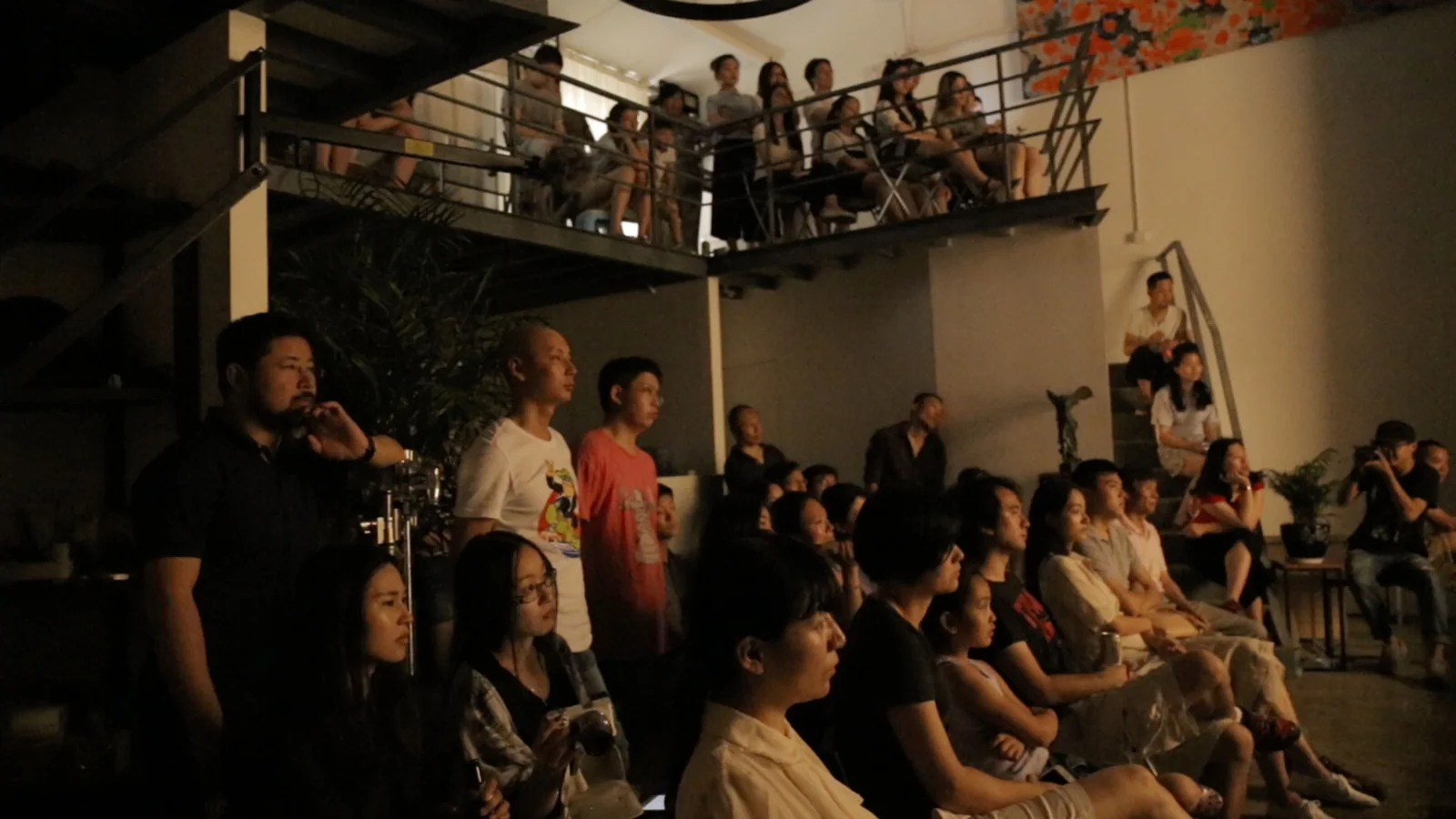
P4 Theater's opening event. Historical photograph supplied by P4; used to explain viewing positions in its early space, not as an audience record for a specific performance of this work. View image source
Sources and original texts
- P4 Theater | Shadow Counterpoint | GIF Edition — FakingAosome, 2016-06-12
2. Shadow Counterpoint: Project and Public Videos — P4 Theater main archive, project page
3. P4 Theater: Ten Years — He Fa, 2025-03-08
An essay for the P4 Theater website, based on public archives. Its analysis is not presented as the direct speech of He Fa or other participants; historical source texts retain their own credits and dates.
Chinese webpage: https://p4theater.cn/knowledge/shadow-identity-testimony/