
Reading the 2022 pre-performance announcement, Liang Yin's participant account and line-by-line subtitles from later shorts together, this essay examines how ordinary sites alter actions, everyday questions alter relationships, and editing poses the questions anew.
P4 Theater website essay · 2026-09-08
1. Begin with particular material, not a definition of “vortex”
The name Vortex readily invites a general explanation: everyone is drawn into modern life. But if that summary need never return to a particular scene, it could apply to almost any work. This essay chooses three smaller entrances: how the ground makes an action difficult, how a question about housing arranges a relationship between two people, and how later narration makes earlier dialogue carry new meanings.
The public article of 3 March 2022 identifies Vortex as North Wind Theatre Company's second play, describing a month of collective creation during which participants left and joined. It announces a public performance on 12 March and names eleven participants. What can be established here is the plan and self-description published at the time. Promotional promises about changes in spectators' inner lives need not be counted as achieved results in advance.1
A second article, dated 9 March and credited to Liang Yin, notes that he organised three improvisation workshops concerning relationships during rehearsals. This gives “collective creation” a specific trace of labour: someone proposes a structure for an exercise, others respond within it, and someone then writes about the experience. Participants provide material from life and also help decide how it is treated.2
The essay also uses subtitles from two shorts published in 2026. These are later edited viewing entries, containing live dialogue and editorial narration, not unprocessed verbatim records of the 2022 event. All time links below refer to those shorts themselves. They are not applied to the full film, and the narration's generalisations are not attributed to a performer from the original event.

Historical Vortex performance poster, originally published in the article of 3 March 2022. The poster and ticket information are displayed as historical documents. View image source
- Read the 2022 pre-performance announcement for Vortex: check the public description of collective creation, participant count and performance venue announced at the time.
2. Concrete ground is not an interchangeable background
Around 00:08 in the car-park short, narration begins describing performers' use of ground markings, wheel stops and concrete. It proposes a definite understanding of space: a site is more than a shell surrounding performance. Through differences of height, hardness and available standing space, it changes how a body can perform an action. The gestures spectators see therefore also carry the site's conditions.3
This can be understood on two levels. Visually, markings and fixtures reveal an everyday use; the site has not been erased into a neutral black box. In action, movement paths and ways of landing must meet particular surfaces. The former makes space a readable image; the latter makes it participate in the formation of movement. Saying only “the setting is distinctive” misses the more important second level.
The short's narration is nevertheless an interpretation and cannot by itself establish every rehearsal procedure. To see how rehearsal handles movement, continue to around 00:29, where the subtitles preserve a brief exchange about realising an action. Its value lies not in proving that a movement has been perfected but in allowing viewers to hear that “how to do it” remains a question for discussion.
We must also distinguish the rehearsal site from the formal performance venue in the announcement. The 2022 announcement gives the address of a social-organisation service centre; the later short presents car-park material. Belonging to the same project does not make these the same space. This section discusses rehearsal questions preserved in the project's moving images, without retrospectively rewriting the performance announcement from the short's setting.
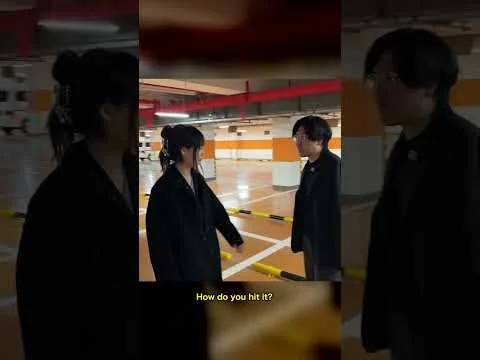
Official P4 short-video thumbnail, part of a 2026 editorial entry. It identifies the corresponding video and is not independent evidence of the 2022 event. View image source
- YouTube · 00:08 Explanation of the site: narration begins explaining how performers use the ground fixtures; distinguish it from live dialogue.
3. A movement takes more than a command to work
Around 00:15, narration summarises the need to rehearse and negotiate slapping and falling. After 00:29, more specific live speech addresses the difficulty of movement, bodily coordination and the intended effect. Separating the two reveals how narration turns local work into a general method while live dialogue remains with details still unresolved.3
This does not invalidate the narration. Interpretation necessarily makes connections through material. The key is whether readers can return to the smaller, less complete fragment and check whether the summary conceals differences. Two separate time links are therefore provided: one leads to the explanation of the site, the other to live discussion. A polished later formulation should not replace the actual exchanges between bodies.
The difficulty of movement involves at least three distinct demands: making what happens legible to spectators, enabling participants to coordinate, and making the action possible on this ground. One solution may be visually clear but require bodily relationships to be readjusted; another may be easy for participants but fail to communicate the intended effect. Rehearsal seeks a concrete form among these demands.
This exchange alone cannot establish the complete rehearsal arrangements or all participants' feelings. The smaller claim possible here is that a work's effects include unseen coordinating labour. Reading a forceful final action simply as spontaneous expression misses judgments about distance, support and presentation. Reading it entirely as technique misses why such actions must be received and sustained within relationships.
- YouTube · 00:29 Live exchange during movement rehearsal: from subtitle 17 onward, hear how realising the action still requires discussion.
- Open the full Chinese subtitles for the car-park short: each subtitle links to its corresponding video time; an SRT download is also available.
4. Why asking whether someone owns a home asks for more than a fact
The dating-and-marriage short begins with a question about housing, followed by a mortgage, rented space, a car and a bicycle. Each answer appears to provide information, yet the order of questions also constructs an acceptable picture of life: what should be avoided after marriage, what vehicle meets the conditions, what income situation requires explanation. The exchange is simultaneously screening a relationship, not neutrally exchanging facts.4
The bicycle passage especially deserves a slower reading. The question may initially treat a “vehicle” as a marker of one's capacity to provide a certain life. The answer makes it a bicycle, then the exchange turns to whether it has a rear seat. What could easily be understood as an asset check suddenly becomes a concrete imagining of whether two people could share a journey. The scale for judging a relationship does not remain fixed at price.
When both say that they have no money left at the end of the month, another similarity appears. It can be read as a shared acknowledgment of difficulty, but may still carry a tentative or performative rhythm. Subtitles alone cannot establish tone, and this essay offers no final judgment of the people here. Jumping to around 00:11 and 00:25 to hear pauses and responses is more explanatory than extracting just “housing” and “money”.
Later narration summarises the scene as a balance sheet and asks viewers what love is measuring. This captures one way economic conditions enter intimacy, yet may compress the different measure opened by the bicycle's rear seat. Preserving that incomplete alignment allows us to analyse the edit's argument instead of merely repeating it.
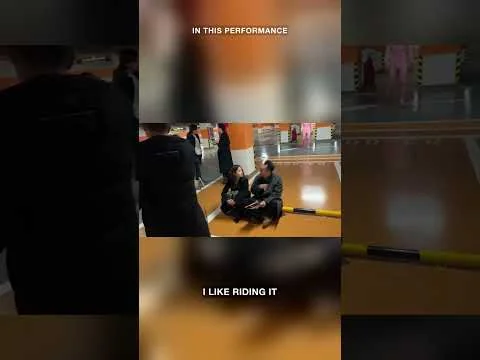
Official P4 short-video thumbnail. Dialogue locations in this section follow the main archive's Chinese subtitles; narration and live dialogue are analysed separately. View image source
- YouTube · 00:11 From a car to a bicycle: begin with the vehicle question, then hear how the rear seat changes the exchange.
- YouTube · 00:25 Both people's income situations: attend to the transition between live answers and editorial narration after 00:32.
- Open the full Chinese subtitles for the dating-and-marriage short: compare exchanges in subtitles 6–14 with editorial narration from subtitle 15 onward.
5. How a participant's account places limits on our interpretation
Liang Yin's article depicts himself as someone who keeps understanding others while becoming less certain of his own position. At one point, the writing adopts an ability to see through relationships; later, it asks whether that composure is merely a safer form of self-presentation. What matters is not deciding for the author which self is true, but observing how the article dismantles the interpretive authority it has just established.2
A bounded comparison with the dating-and-marriage passage is possible. People in the exchange learn about one another through conditions; the writer asks whether “understanding others” has become an ability that lets him avoid exposure. Both touch on asymmetry in relationships. The existing evidence cannot establish that the short's lines came from any particular workshop by Liang Yin, much less automatically treat them as his personal experiences.
When a first-person account retains its own uncertainty, a later interpretation that selects only its strongest sentences to support a theory can make it more certain than its author. The process of reflection disappears, leaving only material available for appropriation. For an archive such as P4's, rich in participants' writing, preserving self-correction often matters more than producing a unified “project spirit”.
He Fa's ten-year retrospective places varied sites alongside open recruitment, showing how such practices were understood later. Liang Yin's particular account reminds us that fluid spaces and open roles do not automatically remove the difficulties of withdrawing, performing or being unable to judge oneself within a relationship. The texts can be compared without letting an institutional retrospective cover over a participant's complex experience.5
- Read Liang Yin's participant account: attend particularly to the latter half, where self-understanding turns into self-questioning, and the final note about three workshops.
6. How shorts, subtitles and longer archives form a useful reading route
A short quickly brings a question before us; subtitles let us recover a sentence; historical articles restore its place in a project's chronology. Connected, the three let readers enter through a particular question without first mastering P4's entire history. Depth comes from returning and comparing, not from having to absorb all the material at once.
This essay therefore links directly to the material in each section: 00:08 for space, 00:29 for movement, 00:11 for the bicycle exchange and 00:25 for the discussion of income. These times are rounded down from Chinese subtitle timings preserved in the main archive, allowing readers to enter just before a line and hear its beginning. They are positions within the shorts, not precise scene numbers calculated from an original film.
Subtitles also have limits. The archive states that its files match content read back from YouTube. This establishes consistency of preservation, not that every word has been checked manually against the audio. Here, subtitles help locate material and distinguish passages; tone, bodies and relationships between shots still require returning to the video. If written words differ from what is heard, preserve that difference rather than letting the text decide what happened in the sound and image.
Returning finally to “vortex”, this essay has not understood it simply as an inescapable situation. A more specific structure is that actions already begun, questions already asked and interpretations already adopted continue to demand others' responses; those responses may then change the initial intention. Ground changes movement, a rear seat changes the meaning of “vehicle”, and a personal account changes the position of the person who understands. The work forms in these turns that cannot be wholly controlled in advance.
Sources and original texts
- North Wind Theatre Company | Can a Butterfly’s Gentle Wingbeat Set Off Another Tornado Vortex? — P4 Theater / North Wind Theatre Company, 2022-03-03
2. North Wind Theatre Company | What Is It Like to Be in Vortex? — Liang Yin, 2022-03-09
3. How a Car Park Becomes a Performance Space: Full Chinese Subtitles — P4 Theater video / main archive subtitles, 2026-08-09
4. Housing and Bicycles in a Dating-and-Marriage Conversation: Full Chinese Subtitles — P4 Theater video / main archive subtitles, 2026-08-10
5. P4 Theater: Ten Years — He Fa, 2025-03-08
An essay for the P4 Theater website, based on public archives. Its analysis is not presented as the direct speech of He Fa or other participants; historical source texts retain their own credits and dates.
Chinese webpage: https://p4theater.cn/knowledge/vortex-space-and-dialogue/