
Republished in full on the official website: 2026-09-08; source version: 2026-09-07
Editor’s Introduction
Why are completing a performance, stopping a current line of questioning, and deciding the subsequent uses of footage not interchangeable? This revision places the participant’s own design for an ending at the center of the argument and fully acknowledges that “skipping a scene” did change the subsequent agenda. What deserves close reading is not only its proposal of bounded endings, but its willingness to let evidence revise its judgments.
This page republishes the independent revised manuscript v2 of 2026-09-07. Phrases such as “this round” and “not publicly released” retain the status at the time of writing; the date of republication on the official website is listed separately. “The efficacy of completion” and “bounded ending” are the author’s analytical and normative proposals, not verified conclusions about actual production relations or legal rights.
Source version: 2026-09-07; research archive publication: 2026-09-07; complete republication on the official website: 2026-09-08. The full text, notes, and references follow the selected version.
- Original text in the research archive: consult the source version and original manuscript.
- YouTube: public version of the film with English subtitles: open the publicly available film. The research master and this public version have not been synchronized shot by shot; no unverified timestamp links are added here.
- Download the selected source version (original Markdown): the source file is preserved word for word for citation and version comparison.
Who Can Make a Completion Count?
This is the public research-archive version, preserving the argument and limitations of the source version. Publication date: 2026-09-07; this does not indicate completed peer review.
Source version date: 2026-09-07
Evidentiary limits: This manuscript is an evidence-led revision of an independent essay, not a degree certification or an external review judgment. Film timecodes and speaker attributions are inherited from existing logs. This round examined four contact sheets, read the complete bodies of four texts published in 2023 and five partial verification reports, but did not rewatch or relisten to the entire original film, or obtain contemporaneous blocking plans and original postproduction revisions. Recollections do not override dialogue; sound energy and public space do not prove consent or coercion; roles, authors, institutional publication, and audience experience are not conflated. The efficacy of completion is a working concept, not the name of a legal right. The earlier v1 and raw versions are retained.
Who Can Make a Completion Count?
The Efficacy of Completion, Participant Authorship, and Bounded Endings in Shoot Self with You
Return to the series contents (internal archive reference, not released with this essay). This is the independent revised manuscript v2; the v1 manuscript is retained as a separate version. Codes in the body correspond to the second round of evidence verification; earlier materials correspond to the first-round source bundle (internal archive reference, not released with this essay).
Abstract
This essay reframes the question of ending in Shoot Self with You: instead of assuming an “inescapable media system,” it examines contention between different demands for completion. Drawing on existing dialogue logs, partial audiovisual records, four contact sheets, and pre-performance, post-performance, and audience texts published in connection with the same project, it distinguishes three noninterchangeable phenomena: the local withdrawal of a demand, the cessation of further questioning in a particular exchange, and a person’s final decision over all relations and uses of material. Taking the agenda shift produced by “skipping the puppet play” as a positive instance of local efficacy, treating the change following “OK” as an undecided case, and centering the participant’s account of the planned disappearance under a white cloth and the improvised questioning near the exit, the essay argues that continuation does not necessarily mean domination, nor does ending necessarily require complete reconciliation. The same event may simultaneously carry a performer’s formal aims, an audience’s experience, and the film’s subsequent organization. It also corrects criticism’s tendency to treat participants solely as objects of protection, incorporating their theoretical expression and scene design into the evidence of authorship. The “bounded ending” proposed here is not a closure exempt from criticism. It permits a demand to be completed or stopped within a jointly acknowledged scope of work, without making every unresolved relation a precondition for further delivery. This normative proposal is argued separately from particular events within the film. Existing material is not used to adjudicate actual consent, harm, production power, or effects on the entire audience.
Keywords: Shoot Self with You; efficacy of completion; participant authorship; closing sequences; collective creation; ethics of images
1. Reframing the Question: What Exactly Does an Ending End?
In a text published after the public performance of The Last Rehearsal, Sun Jiarui describes a specific idea for an ending: covering the performers with a white cloth lying on the ground, moving upstage, then quietly leaving, with the cloth remaining onstage to create the effect that the people had disappeared. He calls it a magic trick and connects the action to blocking discussed a few days earlier. He then recalls a question asked as he was about to exit, outside the script according to his account: was this what he wanted? He answered “yes,” but could not determine whether he mainly wanted the performance to end or whether the question had touched on something important.[H3]
This material changes the starting point for interpreting the white-cloth passage. Earlier readings could too readily understand the cloth primarily through a contradiction between concealment and public viewing: a body tries to hide, but the film records that concealment, so withdrawal fails once again. Yet if the cloth also serves a participant-designed means of theatrical termination, we cannot judge it solely by the standard of actual invisibility or escape from all viewing. Allowing an audience to see an effect of disappearance and ensuring that no image system ever preserves oneself again are entirely different tasks.
The new question is therefore not “what does the white cloth really symbolize?” It is: when does an action intended to complete a performance become connected to another question about desire, relations, and self-explanation? Does this connection merely extend the performance, change who can decide the ending, or make two different endings compete precisely where the participant cannot offer a single explanation either?
This essay does not treat that account as a transparent reconstruction of the entire occasion. It is a formally organized first-person text published after the performance, not a contemporaneous script. Claims that something was “discussed in advance” or “outside the script” still require verification through versioned materials. Yet the text already suffices to reject an unnecessary simplification: participants are not merely objects to be watched, named, and explained by theory. They also propose concepts, design actions, evaluate others’ interventions, and try to guide a work toward an ending they consider viable.
Relative to v1’s emphasis on continual evaluation and the extension of obligations, this revision moves in two directions. It tests which local endings actually make a difference, while acknowledging that some conflicts are not a simple opposition between completion and noncompletion, but disagreements among different authors, viewers, and media layers over “what is being completed.” The essay therefore no longer assumes that every withdrawal is ultimately absorbed. It centers a question bounded by scope: who can make which completion take effect against which subsequent demands?
2. Materials and Method: From Participants’ Accounts to Sequences in the Film
This essay uses three complementary but noninterchangeable kinds of material. The first consists of the completed film’s existing dialogue logs and audiovisual checks; the second includes the 2023 recruitment proposal, pre- and post-performance accounts, and an audience text about the same performance; the third consists of primary theoretical texts on conversational closing, repair, and the evaluation of relational art. The method is a bounded close reading of a case with counterexamples, not a survey of behavioral frequencies across the whole film or interview research into the crew’s actual relationships.
This round newly read two continuous ranges of the dialogue log: file lines 1720–1845 and 1974–2025, totaling 178 lines. It read five partial verification reports in full, actually examined four existing contact sheets, and read the complete bodies of four historical web articles. Timecodes and speaker identifications follow prior records; the master film was not relistened to in full. Accordingly, sound, image, and continuous sequence are discussed only where corresponding material exists. Numerical precision is not presented as the result of new measurement in this round.[L0; F1–F5; I1–I4]
The historical web pages are later presentations of WeChat official-account articles on P4’s local website. Dates, titles, and credits come from that archive; this round did not verify every 2023 snapshot of the original site. Editorial introductions, participants’ accounts, and closing promotion or afterwords must be kept distinct. An institution’s preservation of an audience member’s text does not strip it of all significance, but the publication selection and editing process have not been independently checked. Likewise, a participant’s account is not raw data devoid of rhetoric, memory, or organization simply because it comes from that person.
Cross-checking must also be confined to specific propositions. A post-performance article recalls an exchange, and the dialogue log contains a corresponding question and two instances of “yes.” This strengthens the evidence that the exchange entered the current film. It does not simultaneously prove every remembered detail, the prior blocking, or the motives behind the answers. Support for one proposition cannot upgrade the rest of a source wholesale.
The essay particularly rejects two evidentiary shortcuts: directly adjudicating political meaning through sound-energy or brightness measurements; and inferring that a particular participant could not withdraw merely because audiences, equipment, or bodies remain in the frame. Contact sheets can show composition at sampled moments, but cannot put every unseen person back into the image. Source-page titles and interpretations are themselves texts requiring critical reading, not conclusions immune to challenge.
3. Theoretical Dialogue: Ending and Continuing Are Not Predetermined Categories of Good and Evil
Continual training and ongoing evaluation are not mechanisms of the age newly discovered by this essay. Deleuze’s “Postscript on the Societies of Control” already discusses continuous modulation and forms of control in which finality is hard to obtain.[E6] The interpretive contribution here does not consist in renaming that proposition “permanent audition.” It lies in distinguishing whether a particular demand can truly end within ongoing relations, and why its ending need not mean the disappearance of every relation.
Schegloff and Sacks’s study of conversational closing offers an important correction. Some possible pre-closing positions also allow previously unmentioned matters to enter. The subsequent continuation of talk therefore does not automatically indicate a defect in the preceding closing action. The same lexical form, “OK,” must also be judged within its sequence, rather than uniformly classified as agreement or refusal.[E1, 303–306]
Another study of conversational repair distinguishes the initiation of repair from its outcome, and the person identifying a difficulty from the person completing the adjustment.[E2, 363–365] A participant’s challenge to a standard and the subsequent reformulation by the person proposing it are thus two traceable actions. They still do not amount to proof that long-term power has been redistributed.
These distinctions come from conversation research; they are not ready-made classifications of Shoot Self with You. The film includes roles, organizational instructions, improvisation, and later arrangement. Where independent original audio and complete context are absent, these concepts are used only to organize questions, not to force a line into an established conversational type.
Artistic evaluation requires another dialogue. Bishop asks relational art to specify the relations it produces, for whom, and why, rather than letting the mere presence of interaction establish value.[E3, 65] Gillick challenges her selection from particular works and artists’ writings, while Bishop’s response insists that the viewer’s position cannot be replaced by authorial intention.[E4, 98, 104–106; E5, 107] The debate is not used here to choose an authority to judge P4. It imposes constraints in both directions: makers’ goodwill cannot testify for viewing effects, and participants’ already complex creative work and thinking must not be erased simply to give a critical account structural clarity.
A further terminological limit should be retained. In her response, Bishop mentions her understanding of Krauss’s concept of recursive structure.[E5, 107] Accordingly, “elements of a work participate in forming its rules” cannot become a discovery unique to P4 simply through renaming. Nor is it on the same level as organizational feedback requiring actual return channels, decision records, and subsequent implementation. This essay does not use that term to explain every recurrence directly; it traces bounded endings and their consequences.
4. The Efficacy of Completion: Not the End of Everything, but a Demand No Longer Restarting by Default
Version 1 defined the efficacy of completion as follows: within an explicit scope of task, relation, and use, does recognition of a completion alter the obligation to keep proving, supplementing, or responding, and what reasons are required to reopen a demand? This essay retains that definition but adds two limits.
First, completion does not consist solely of the instant when someone says “finished.” It may form through proposals, confirmations, objections, clarifications, and subsequent actions. Looking only at a closing word can compress an organized process into an isolated command. Second, research cannot require every local ending simultaneously to redistribute power across the entire project. An action’s becoming stoppable, however limited that possibility, should be recorded faithfully. Otherwise, “truly effective” becomes an eternally unreachable threshold, and we ourselves rule out counterevidence.
At least three things must be distinguished: a task being registered as complete or canceled; the relevant person no longer being required to complete the original task; and the subsequent uses to which the remaining material is put. These need not occur together. Canceling a performance segment while continuing to tidy the venue does not mean the cancellation failed. Stopping the current questioning while retaining footage does not automatically mean comprehensive withdrawal succeeded.
To make the efficacy of completion more than an attractive phrase, the essay applies a scope test: first identify the original demand, then ask whether subsequent demands still concern the same thing. If what follows is simply another task, “things are still happening” cannot be taken as proof that the old demand has regained force. If the old demand returns under a new name, the continuity in object, evaluative standard, or cost must be specified; a similar atmosphere alone is insufficient.
This also explains the difference between a bounded ending and complete reconciliation. An argument can stop before both sides share an interpretation. A theatrical action can be completed without repairing character relations. Filming can end while future uses remain to be negotiated. Making the resolution of all relations a precondition for permitting an ending renders every ending inherently insufficient.
A bounded ending is not unconditional exemption from responsibility. New evidence, others’ unanswered interests, and explicit commitments can still justify reopening. What this essay opposes is treating the perpetual possibility of improvement or someone’s remaining lack of understanding as direct authorization to add unlimited demands of the same kind. This is an explicit normative judgment made by the essay, not an established system within the film or the name of an existing legal right.
5. Participants Are Not Waiting for Theory to Rescue Them: Authorship Is Already Present
The recruitment proposal of June 3, 2023, designated the third part as an actual public performance and explicitly stated that its theatrical content would be designed and arranged by three actors.[H1] This is a public statement of an initial creative arrangement; it does not prove the degree of its later realization. Yet it already prevents “actor” from being understood by default as someone who merely executes another person’s intentions.
The pre-performance text of August 19, 2023, further reveals this authorial position. Jiarui discusses why an image in a photograph cannot be equated with himself, how performing a role can become a way of entering relations, and his own readiness to agree to perform. He does not ask readers to treat the text as the whole truth. Instead, he actively identifies its fragmentariness, partiality, and organization: he could also write a different text praising the performance, but that too could not simply be taken as reality.[H2]
This is not meaningless self-negation. It distinguishes an experience from a narrative about that experience and refuses to let any one narrative deliver a final verdict. At the same time, he continues to express affection for the people gathered together and a desire to create. Criticism that extracts only his exhaustion and self-disgust as a sample of “the contemporary subject controlled by the system” misses the reflection the text is already performing.
Research must therefore beware of a protective dispossession: in trying to show how much pressure someone bears, it reduces that person’s own concepts, choices, evaluations, and formal designs to unconscious symptoms. Participant authorship does not appear for the first time when a critic acknowledges it. Criticism should first explain what the participant has already done and how those actions relate to others’ arrangements.
Conversely, authorship does not mean independently bearing every consequence. A person’s creative ability and awareness of performing do not mean that they can always control intensity, leave at any time, or govern postproduction uses. Capacity and vulnerability do not cancel each other out. Rather than choosing between the images of passive victim and wholly autonomous author, the essay examines more specifically what the participant can propose, change, or prevent at different stages.
6. A Standard Is Questioned: Repair Occurs, but What Does It Repair?
The previous round had already identified a reverse effect within continuous dialogue. After “it doesn’t quite meet my expectations” at 02:00:38.266 comes “then you didn’t make your expectations clear” at 02:00:40.900. Following requests concerning vocal delivery and practice, the person making the demand says “that isn’t what I meant,” then suggests that the way the information was conveyed may have caused misunderstanding and withdraws that demand to speak clearly.[First-round source bundle, L0–L1]
This sequence at least prevents the generalization that “only those being evaluated need to explain themselves.” An argument over whether someone meets a standard becomes an argument over whether the standard is clear. The person initiating the demand no longer occupies only the position of judgment, but also the position of explaining their own requirements.
Yet “let everyone see you” subsequently appears, suggesting that one performance demand may have been adjusted into another. The essay neither treats the adjustment as wholly ineffective nor directly counts it as joint rule-making. Conversational repair and the transfer of governing power need separate descriptions.
The most important distinction is not whether the attitude is friendly, but whether the response changes the original demand. If “speak clearly” becomes another practicable task, one can no longer say there has been no revision at all. If the new task again leaves those being evaluated unable to judge what would suffice, the earlier revision does not exhaust the problem. In improvisational creation, standards may need to emerge through practice rather than being fully specified beforehand. Whether all parties jointly bear that exploration still requires concrete evidence.
This distinction helps criticism avoid another excessive demand: treating every unclear standard as manipulation. Artistic collaboration sometimes needs to discover standards not yet known. The issue is not that everything must be perfectly explained at the beginning, but whether the process of discovering standards can be challenged, and who bears the costs in time and exposure when they change.
7. Two Instances of “OK” Cannot Be Given the Same Conclusion
1. At 133 Minutes: The Repeated Demand Ceases to Appear; Its Cause and Institutional Significance Remain Unconfirmed
Beginning at 02:13:12.733, Ricky responds to a demand to leave the stage, then receives another demand and an evaluation of the performance. At 02:13:23.200–25.266, he challenges this by pointing out that he was invited to act in this play. At 02:13:26.533–27.433, another voice gives three instances of “OK.”[L0-B; F1]
An earlier verification page interpreted the stronger sound energy as an active cutoff rather than genuine acceptance. That interpretation is possible, but cannot follow from loudness alone. In the current continuous dialogue, the same demand naming Ricky and telling him to leave does not recur after “OK” within the range read, ending at 02:20:04.633. Other events and arrangements for the “next scene” continue in the meantime.[L0-B]
This supports a more limited observation of outcome: within the current record, repetition of this round’s explicit command ceased. It cannot independently establish whether this happened because the objection worked, the other party conceded, the person actually exited, the performance moved into another scene, or actions occurred that the dialogue log did not record. Causation and the consequences for power remain undecided.
But “cause undecided” does not mean “nothing changed.” If criticism insists that the original command necessarily continued merely because a full deliberation of reasons did not take place, it too erases a difference actually present in the sequence. The essay therefore registers this as a candidate for local closure, not a triumph of liberation or a total victory of domination.
The exchange at 137 minutes imposes a more basic limit. After “I don’t want to appear together with you anymore” come “are you feeling better?” and “mm.” But the dialogue log attributes both of the latter utterances to Amon, rather than recording “mm” as Ricky’s answer.[L0-C; F2, 52–61, 89] Two adjacent voices therefore cannot automatically be assembled into a complete story of care accepted and a condition improved. Conversely, this gap does not prove that the care was false. It requires us first to establish who responded to whom, before discussing the response’s effects.
2. At 139 Minutes: A Shift in the Agenda Shows Local Efficacy More Clearly Than a Word of Praise
The evidence for “skipping the puppet play” is stronger. A proposal to skip it appears at 02:19:36, followed by questions about whether to skip it and whether that is certain. “Not performing it here” is repeatedly confirmed, followed by exchanges of “where will it be performed?”, “it has already been performed,” and “there’s no need to perform it.” After “OK” at 02:19:57.066, the next line already asks “so is it the final scene now?” After a response, another question concerns arrangements for that final scene.[L0-D]
Unlike the isolated phrase “you are the winner,” this chain shows the subsequent task itself shifting to another scene. It offers an observable local change of agenda. Anyone still insisting that “the system makes every stopping impossible” must explain why this change cannot be acknowledged, rather than merely saying that the work continued afterward.
Repeated confirmation cannot automatically be treated as an escalation of pressure either. Within this sequence, it may at least help clarify which scene is being canceled and whether it will continue at the present location. We do not yet know the negotiation’s entire background of power, but there is already no reason to equate confirmation itself with coercion.
This positive example does not prove whether the puppet play was performed elsewhere, or whether every participant had an equal right of cancellation. It establishes something smaller: when the object is clear, the response identifiable, and subsequent tasks really no longer require the original activity, local efficacy can cautiously be acknowledged. Doing so does not eliminate political questions. It gives them a basis for comparison: why is a turn possible here, while stopping is difficult elsewhere?
8. The White Cloth’s Two Endings: Formal Completion and the Explanation of Desire
The post-performance account first makes the white cloth an operation within a jointly created work, rather than merely a psychological or ethical metaphor. According to the text, the performers originally planned to create an onstage disappearance through covering, moving, and leaving. This required coordination among the object, bodily routes, audience sightlines, and the timing of the exit.[H3]
The aesthetic success of this operation is not measured by actual bodily eradication or the erasure of every record. A magic trick produces a particular effect through conditions of visibility. If criticism demands that the camera must also go blind or else withdrawal has failed, it replaces a performance aim with an absolute concealment the performance may never have promised.
The question asked near the exit, however, introduces a second task. The issue is no longer only where to move next or how to leave the cloth onstage, but whether this is what you want and whether you want others not to see you. A formal proposal may thereby become a legible explanation of desire.
The essay uses “may” not to blur a crucial judgment, but to distinguish two levels of evidence. The personal account explicitly describes the question as outside the script. The dialogue log preserves a corresponding question and two instances of “yes” after 02:31:01.700. Together, they support analyzing this exchange, but cannot replace the contemporaneous script that has not yet been obtained, still less guarantee that every remembered sequence matches the current edit exactly.[H3; L0-E]
What needs analysis is competition between two creative undertakings: one completes an established form; the other generates a new relational question at that form’s edge. Improvisation need not be dismissed as interference; it may give the scene an intensity it would otherwise lack. Established blocking need not be dismissed as outmoded control; it may be the participant’s active way of organizing material and enabling a work to end.
The argument therefore cannot be divided in advance along the lines of “openness equals freedom, planning equals oppression.” Improvisation can expand expression, but can also occupy an endpoint someone else has arranged. Planning can constrain actions, but can also supply jointly recognizable conditions for stopping. The question is how, in this particular scene, the two creative undertakings change each other, and who can judge whether the new question should continue occupying the original ending.
9. One Answer’s Multiple Uses: Why We Cannot Know on His Behalf What “I Don’t Know” Means
The post-performance text’s explanation of the two instances of “yes” precisely refuses a single motive. Its author does not know whether he mainly wanted to end the performance or had been touched by an important question. The essay must retain this statement, rather than first promoting one half to the truth and treating the other as self-concealment.[H3]
Pragmatically, an answer can perform several functions at once: taking up the other person’s question, enabling the exchange to move forward, preserving a form of emotional acknowledgment, or trying to bring things to an end sooner. Recognizing that these functions may coexist does not mean their relative proportions at that moment have been measured.
This limits two opposing interpretations simultaneously. On the one hand, a “yes” cannot establish that the person has clearly adopted every proposition about desire or fully consented to subsequent filming, editing, and circulation. On the other, the answer’s occurrence amid high sound energy or in a public space does not establish that it must be unfree. Insufficient evidence of full consent is not proof of the absence of an active response.[F4, 112–118]
The partial verification page contains an epistemological leap that must be corrected: it rewrites an inability to establish A as an established not-A. This essay leaves the original measurements intact and does not declare all material invalid because it identifies an inferential problem. It simply brings the strong conclusion back within the scope of what can support it. Sound and image can help explain the form of interaction; they cannot substitute for independent evidence of willingness, capacity, and actual relations.
The participant’s own reservation about the answer also poses a deeper normative question: can ending avoid requiring a full surrender of one’s true motives? Someone may have legitimate reasons to stop a task without being able to organize every feeling into a contradiction-free narrative. This essay argues that bounded endings should not always have to wait for such self-transparency. That is, however, an ethical requirement needing a separate argument, not a conclusion about actual authorization directly deduced from the scene.
10. The Film Does Not Always Keep the Same Person within the Same Kind of Looking
Examining contact sheets near the exchange at 151 minutes reveals another change easily obscured by a totalizing theory. The annotated stills corresponding to the question and the first “yes” face tables and chairs, equipment, string lights, and the operating area, rather than continuously facing the body beneath the white cloth. The annotated still for the second “yes” later shows white covering at close range; subsequent sampled images turn toward the equipment area, the audience, and the performance space.[I3, I4; F4, F5]
This cannot prove that the magic trick succeeded, nor can the visible faces establish who is speaking. At minimum, it means that the entire passage should not be described as the camera holding the same body in the same composition throughout. The filmed field changes, while sound does not necessarily follow the object toward which the image points.
This formal change is more specific than “the greater the concealment, the greater the visibility.” For the theatre audience, the disappearance organizes what can and cannot be seen onstage. For film viewers, the camera can also turn toward operating equipment, other people’s presence, and the seating area. The two kinds of viewing do not share a boundary. Rather than canceling the magic trick by recording the body under the cloth, the film may establish another experience of ending by bringing the conditions of viewing themselves into the frame.
But this cannot automatically be upgraded to liberation. Making the apparatus visible does not give everyone control over it. Formal analysis contributes an account of how film reorganizes the original performance’s endpoint. Determining whether participants took part in that reorganization still requires editing versions and decision records.
The white-cloth passage therefore needs at least three analyses at once: as a participant-designed theatrical action; as a local sequence in which speaking and self-explanation shift direction; and as an audiovisual relation reorganized by film. No layer can monopolize the other two. Discussing symbolism alone misses blocking; discussing rights alone misses form; discussing film form alone may erase the others’ labor and judgment that generated it.
11. Different Successes Do Not Cancel Each Other Out: Authors and Audiences at the Same Performance
In the post-performance account, Jiarui credits an intervening person with getting a stalled performance moving again. He also writes that although he knew He Fa was performing, he still wanted to reject the judgment dismissing that intervention: it was good as it was. This shows that, for him, “continuing” does not always mean passive endurance. At least in this part of his recollection, he regards continued happening as a desirable creative effect.[H3]
The levels of narration must be strictly preserved. This essay does not automatically identify the person called Binbin in that text with Ricky in the dialogue log, nor has it obtained evidence establishing the exact shot corresponding to every remembered action. What the text supports is that participants do make their own formal evaluations, not that the identities of all events outside the film have been fully confirmed.
The same project also preserves a positive text by an audience member present at the performance. In Beginning to Speak, Wang Yanan connects turns and interruptions to the possibility of expressing oneself anew, and describes an experience of feeling as though one were inside the recording camera.[H4] This is not a reaction we have imagined for an audience, but an actually published personal account. It is also not representative of the entire audience, nor a survey of later viewers of the completed film.
This text and the passages in which the performer feels failure need not negate one another. The performer may be evaluating whether he can sense the audience or realize the blocking. The audience member may be evaluating being moved and reestablishing expression. The director may be evaluating overall form, while later editing has another set of tasks. Different positions produce not only different answers; they may be answering different questions.
An audience member’s being moved therefore cannot prove that the performer bore no cost, nor can a performer’s frustration declare an audience member’s experience illusory. Adding and subtracting these judgments into a “net benefit” would flatten the differences between their objects. This essay prefers to retain a structure in which they do not settle one another’s accounts: each success and failure is accurately identified, rather than one being used to close the case on the whole event.
This also reopens the question of the film’s value. A work can fail at some aims yet organize important forms through those failures. It can also merely accumulate mistakes without achieving sufficient organization. Distinguishing the two requires showing how sound and image make differences perceptible, not declaring that real events are inherently profound. Criticism must remain able to say that a form fails at a particular point; participants must remain able to disagree with the director’s judgment of what is good or bad.
12. Not Indefinite Postponement, but No Requirement to Resolve Every Relation That Day
The continuous dialogue log also offers a formulation different from permanent deferral. Beginning at 02:10:32.933, Amon says, “everything has to be resolved within this one day, today.” Another voice overlaps during the sentence; Amon then says “is that so?” before turning to an explanation that one might know what happened only by watching the film.[L0-A; F3]
This essay does not directly recast that sentence as a director’s command. Without independently relistening to the intonation, it cannot force a determination of whether “is that so?” responds only to the intervening voice or also questions Amon’s own general statement. What can currently be analyzed is that a proposition about “resolving everything today” is uttered and placed alongside a question and an explanation concerning future viewing.
The temporal problem thus takes more than one form. Repeated demands to continue can certainly become a burden. A demand to explain everything, reconcile, and find answers within one day can also compress complex relations into too short a deadline. These do not necessarily form a single system, and one line cannot establish that the entire film operates under a universal double bind. Together, however, they remind us that an ending should neither be indefinitely postponed nor equated with the final resolution of every problem.
The bounded ending proposed here finds a specific object between these two extremes. A performance can end while an argument remains provisionally unresolved. Filming can stop, with arrangements for the material discussed separately. Someone can stop answering the current question without first proving that they have understood the whole relation. This does not delete unresolved matters; it refuses to let all of them automatically justify further demands for the same kind of expression.
Bounded endings must also take responsibility for what they leave behind. If someone stops their task while transferring care, equipment cleanup, or explanatory burdens to others without discussion, emphasizing only their own ending is insufficient. The normative focus is therefore not the sanctity of an isolated individual’s declaration of withdrawal, but enabling those concerned to explain what is being stopped, what tasks follow, and why discussion might be reopened.
13. From Formal Judgment to Practical Judgment: One Measure Cannot Replace Every Question
This essay does not require art to become a model of a just institution before it deserves to be watched. A scene that exposes difficulties and prevents others’ judgments from being easily unified can possess significant formal force. It need not close with eventual consensus. Disagreement itself can be something the work needs to preserve.
Yet preserving disagreement differs from those concerned being able to influence how it is preserved. This connects with the distinction concerning binding changes to rules in P4’s Second Convergence on Reality Rehearsal: From Questions of Truth and Falsity to the Power to Set Conditions—2026-07-13. This essay does not turn that normative threshold into an all-purpose artistic scorecard: an instance of local support need not first transform an institution to have value. Conversely, a project claiming that joint governance has been achieved cannot prove it merely by showing that opposition appears in the work.
Four questions should be answered separately: does the completed film establish discernible audiovisual relations? Can participants put their own formal judgments into practice? Does a particular interactional demand stop locally? Are there verifiable joint decisions about the material’s subsequent use? The answers need not agree. An institution’s provision of resources does not prove that all uses have been negotiated. Nor does an explicit account of discomfort automatically cancel every aesthetic value of a work.
For Shoot Self with You, this round’s evidence strengthens the judgment that participants possess conceptual expression and designs for endings. It strengthens the judgment that at least one act of skipping had local efficacy for the agenda, and adds a record of a positive audience experience at the same performance. It does not supply the missing before-and-after postproduction revisions, still less prove every decision about public use. These gaps should limit the essay’s conclusions, rather than be rewritten as a total verdict for or against the project.
14. The Strongest Objections and the Evidence That Could Change This Essay
1. If the Post-Performance Account Is Literary, How Can It Revise a Film Analysis?
This objection is valid insofar as the material cannot transparently reflect events, but it does not follow that the material is useless. The essay does not replace verbatim dialogue with memory. It uses the account to identify how a participant explains his creative aims and experience. If a contemporaneous blocking plan later shows that no white-cloth disappearance was planned, the claim about “prior design” must narrow to a post-performance narrative. The claim about how the participant interprets the ending can remain. The two propositions need separate testing.
2. Could the Local Agenda Change Simply Follow the Original Script?
Absolutely. The essay does not use “skipping” to establish actual organizational democracy. If the passage was scripted beforehand, it still presents an interactive form capable of changing a task in the completed film, but cannot prove that power was provisionally ceded on the occasion itself. Moving from form into production history requires script versions or relevant decision records. This is a counterexample to the claim that “all endings within the film are ineffective,” not decisive evidence about whether the project was actually fair.
3. Does Analyzing Endings Risk Reducing a Film to Meeting Minutes?
If we ask only who makes a demand and who accepts it, we will indeed miss the film. The essay therefore analyzes dialogue sequences together with formal conditions such as the participant’s white-cloth proposal, changes in camera direction, and the audience’s inclusion in the image. The point is not to code every utterance and derive a power score, but to explain how different endings acquire different senses of reality through bodies, objects, images, and sounds. If the image order on which the analysis relies proves discontinuous, the relevant temporal judgments must be revised. Stills provide only preliminary visible conditions.
4. Could Emphasizing Participant Authorship Instead Downplay the Pressure They Bear?
Only if creative capacity is equated with omnipotent self-control. This essay argues the opposite: authorship requires us to take participants’ formal proposals and evaluations seriously, while the costs they bear require us not to treat those proposals as an advance acceptance of every consequence. Both can coexist. “Knowing one is performing” cannot cancel consequences; “feeling exhausted” cannot cancel one’s ability to judge a work.
5. Is the Audience Text Merely a Positive Review Selected by the Institution?
Its selection and editing process are unknown, so it cannot be generalized. The essay introduces it not to add a favorable vote, but to test the hypothesis that “viewing can produce only one kind of entrapment.” One explicit different experience suffices to limit a universal assertion, but not to estimate the proportion of viewers. Nor can the earlier round’s criticism of Iceberg be repurposed into a set of positive and negative responses to this film. A study of the completed film’s circulation must build its own body of viewing material, rather than treating responses to the performance as a survey of film criticism.
15. Conclusion: Let a Completion Count, While Allowing Others to Retain Different Completions
Shoot Self with You need not take “all withdrawals are impossible” as its final interpretation. Continuous sequences show demands changing after challenges, explicit commands ceasing to recur within particular intervals, and a program item being skipped through confirmation. Participants both want the performance to keep producing something and try to design a form that brings it to an end. The film’s complexity does not arise because these differences are ultimately flattened, but because they can coexist.
The white-cloth passage becomes this round’s strongest example. It is both a material of visibility and invisibility and, in the participant’s account, a proposed ending. The question asked near completion may enrich the work, but may also change the object of the original ending. Two instances of “yes” cannot provide a complete psychological answer, and the critic cannot fill in the author’s “I don’t know.” Meanwhile, the camera’s changing orientation toward equipment, audiences, and covering means that the film does not simply inherit the same endpoint as the stage.
The essay retains the core of the efficacy of completion: does a completion change what can subsequently be demanded of those concerned? But it no longer looks for subjecthood only on the side of those evaluated. It also looks for coauthors among those who design actions, pose challenges, and judge what works. The point is not first to acknowledge their right not to be coerced and then hand creation back to the director. It is to include their formal judgments, from the outset, in the dispute over how the work comes to hold together.
A bounded ending therefore does not abolish discussion. It allows this undertaking to be completed within its scope without declaring another disagreement resolved. Nor does it authorize an unlimited sequel: reusing material, redefining a person, and introducing new demands each require their own reasons. Openness cannot mean only that a work is forever entitled to continue. It should also mean that people can question the conditions of continuation.
If this essay must be condensed into one proposition for further testing, it is this: the difficulty of collective creation lies not only in no one being able to end, but also in different people potentially trying to complete different things. What truly needs discussion is which kind of completion can constrain the next step without delivering a final verdict on other people’s experiences.
References
- Schegloff, Emanuel A., and Harvey Sacks. 1973. “Opening Up Closings.” Semiotica 8(4): 289–327. This essay uses the discussion of closing sequences around pp. 303–306.
- Schegloff, Emanuel A., Gail Jefferson, and Harvey Sacks. 1977. “The Preference for Self-Correction in the Organization of Repair in Conversation.” Language 53(2): 361–382. This essay particularly uses the initiation/outcome distinction on pp. 363–365.
- Bishop, Claire. 2004. “Antagonism and Relational Aesthetics.” October 110: 51–79. Scans of pp. 65, 66, and 79 were checked. This partial reading is not represented as a review of every artistic case discussed.
- Gillick, Liam. 2006. “Contingent Factors: A Response to Claire Bishop’s ‘Antagonism and Relational Aesthetics’.” October 115: 95–106. The objections concerning evidence and interpretation on pp. 98 and 104–106 are used; their entire factual dispute has not been independently resolved.
- Bishop, Claire. 2006. “Claire Bishop Responds.” October 115: 107. The full response is used; her paraphrase of Krauss is not counted as a direct reading of Krauss’s original text.
- Deleuze, Gilles. 1992. “Postscript on the Societies of Control.” October 59: 3–7. The reformatted text hosted by Purdue University is used to locate the concept of continuous control. PDF page order is not presented as original journal pagination.
Original-text links, the scope actually checked, and the nature of republication are documented in the E1–E6 source record. The efficacy of completion, bounded ending, and case judgments are this essay’s analyses, not the cited authors’ original terms or their conclusions about this film.
Local Materials and Citation Conventions
H1: P4, This Is a Recruitment Text for Shoot Self with You, archive date 2023-06-03, local HTML body line 761. H2: This Is the Last Rehearsal! It’s Real! It’s All Real!, attributed to Sun Jiarui, archive date 2023-08-19, body line 739. H3: I Disappeared—After Performing The Last Rehearsal, attributed to Sun Jiarui, archive date 2023-09-02, body line 739. H4: Wang Yanan, Beginning to Speak, archive date 2023-08-30, body line 739. Editorial notes, authorial text, afterwords, and promotion within each article must not be conflated. Absolute paths, checksums, and original-text links are detailed in the second-round source record.
L0 is the external character dialogue log. L0-A corresponds to file lines 1739–1745; L0-B to 1781–1789 and the subsequently read range; L0-C to 1807–1810; L0-D to 1827–1845; and L0-E to 1998–2014. F1–F5 are five existing partial audiovisual checks; I1–I4 are the four older contact sheets actually examined in this round. Together they constrain formal judgments, but do not independently establish actual authorization, the complete live occasion, or participants’ psychology.
First-round verification concerning an evaluator’s reformulation, the naming of a winner, the 2020 rules, and the 2021 interview is retained in 2026-09-07—Refusal, Repair, and the Power to Set Conditions—Local and External Evidence Bundle (internal archive reference, not released with this essay). This essay does not treat the 2020 rules directly as actual 2023 agreements, others’ experiences in 2021 as those of this film’s participants, or 2022 criticism of Iceberg as this film’s reception history.
From v1 to v2: Record of Actual Revisions
This manuscript does not merely append references to v1; it reorganizes the center of the argument. It retains the distinction among procedure, obligation, and subsequent use; revises the white cloth from a single metaphor of concealment into a formal action incorporating participant design; changes skipping from a speculative example into a local positive case with confirmation and a subsequent agenda; retains the change in commands after “OK” at 133 minutes as a limited result without deciding motive; corrects the question-and-answer pairing at 137 minutes to avoid assigning Amon’s “mm” to Ricky; adds pre- and post-performance accounts to acknowledge participants’ already existing conceptual expression and formal evaluation; adds an audience text from the same performance without balancing it against the performer’s feelings as a total quantity; distinguishes “unable to prove consent” from “having proved unfreedom”; and substitutes bounded endings for the assumption that everything must finally be reconciled.
The gaps still constraining v2 are the absence of contemporaneous white-cloth blocking plans and original editing correspondence; the lack of a complete new listening to the windows discussed; the inability of sampled stills independently to prove continuity; the insufficiency of correspondences between the post-performance account and film dialogue to verify every recollection; and the failure in this round to find before-and-after versions showing that a participant’s objection actually changed the final cut. No external peer review has been conducted; this manuscript has not been publicly released.
This round adds only this manuscript and the second-round source record, and updates the contents and log. Version 1, the earlier report, historical articles, the dialogue log, and prior audiovisual evidence are all retained. This manuscript’s interpretation does not rewrite the original material.
Official Website Supplement: Chapter Materials Navigation
1. Reframing the Question: What Exactly Does an Ending End?
- Jiarui: I Disappeared: source H3—the white-cloth disappearance proposal and uncertainty within the answer.
5. Participants Are Not Waiting for Theory to Rescue Them: Authorship Is Already Present
- 2023 recruitment text: source H1—the pre-performance arrangement for three actors to design and arrange the work.
- Jiarui’s pre-performance account: source H2—experience, narrative, and participant authorship.
7. Two Instances of “OK” Cannot Be Given the Same Conclusion
- Second round of evidence verification: dialogue ranges, primary texts actually checked, and limits on conclusions.
8. The White Cloth’s Two Endings: Formal Completion and the Explanation of Desire
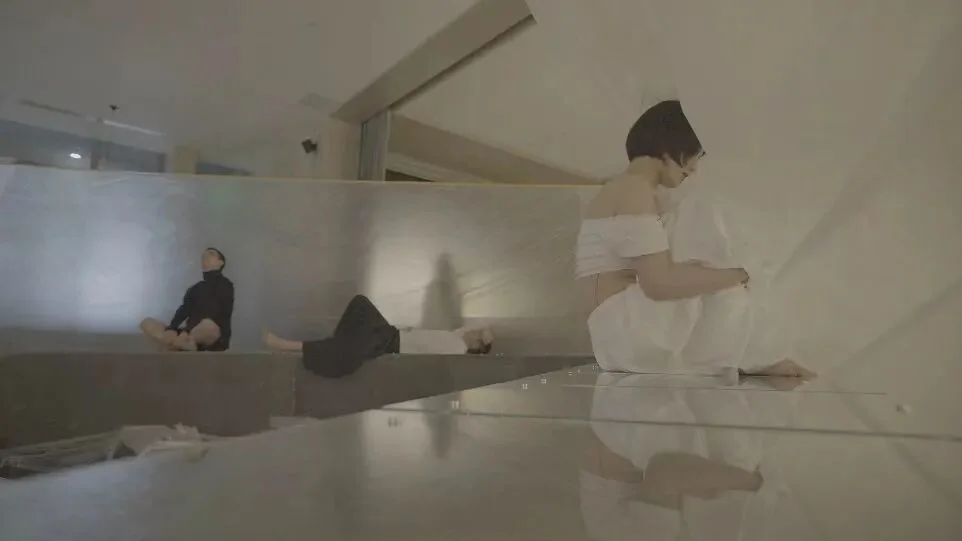
Editorial illustration | Originally published in I Disappeared—After Performing The Last Rehearsal. Read as visual material belonging to that article; no complete sequence of the white-cloth action is inferred from a single image. Image source
- Jiarui: I Disappeared: source H3—the white-cloth disappearance proposal and uncertainty within the answer.
9. One Answer’s Multiple Uses: Why We Cannot Know on His Behalf What “I Don’t Know” Means
- Jiarui: I Disappeared: source H3—the white-cloth disappearance proposal and uncertainty within the answer.
11. Different Successes Do Not Cancel Each Other Out: Authors and Audiences at the Same Performance
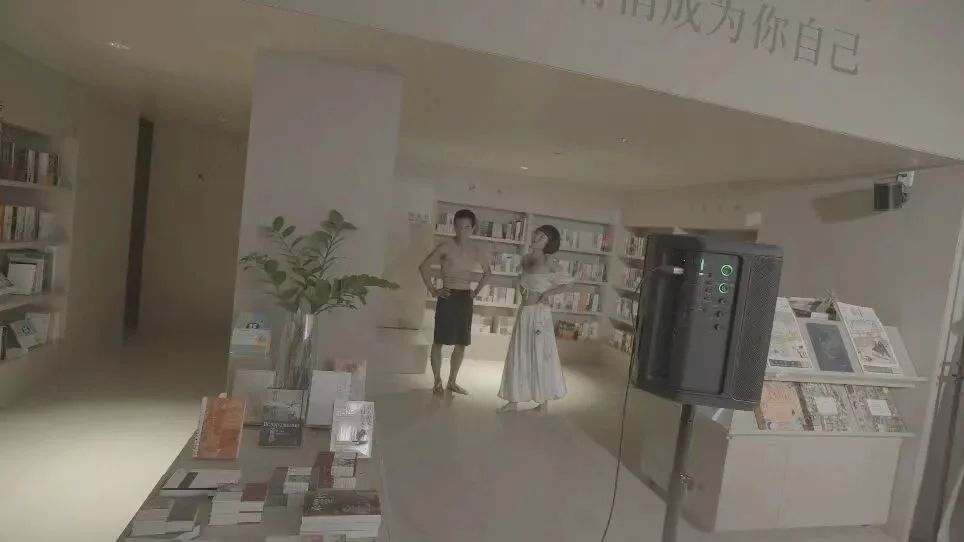
Editorial illustration | A live-event image originally published in the post-performance article. Compare the visible field, objects in the venue, and the later written account; faces are not used to determine who is speaking. Image source
- Wang Yanan: Beginning to Speak: source H4—a personal experience from an audience member at the same performance.
14. The Strongest Objections and the Evidence That Could Change This Essay
- Second round of evidence verification: dialogue ranges, primary texts actually checked, and limits on conclusions.
Materials and Original Sources
- Who Can Make a Completion Count? — P4 Theater Research Archive, 2026-09-07
2. Shoot Self with You | I Disappeared—After Performing The Last Rehearsal — Jiarui (credited in the body) / published by P4, 2023-09-02
3. The Last Rehearsal: Review | Beginning to Speak—Wang Yanan — Wang Yanan, 2023-08-30
4. Shoot Self with You — P4 Theater, project entry
This is a complete republication from the P4 research archive. The official website adds the editor’s introduction, image-source links, and chapter materials navigation. The original argument, references, and evidentiary limits are retained according to the listed source version.
Web page: https://p4theater.cn/knowledge/who-can-make-completion-count/