The Last Rehearsal × Shoot Self with You
After the White Cloth
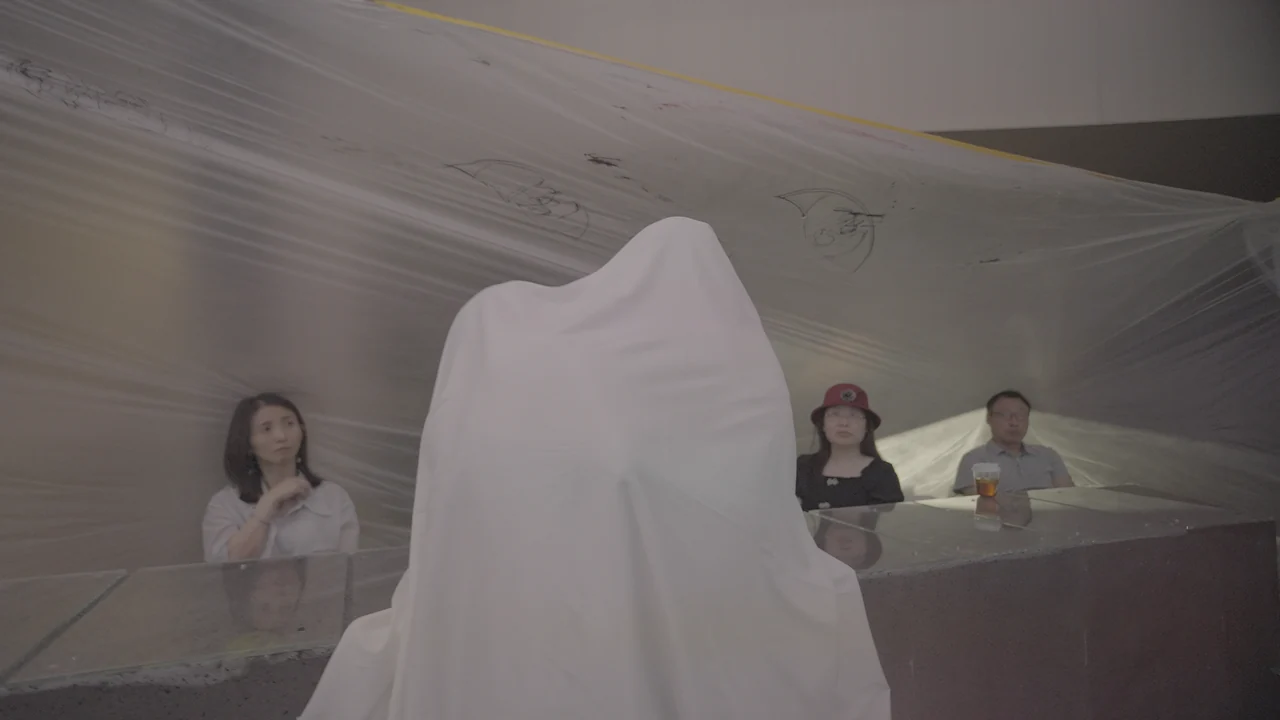
The draft sends a king through a door to the moon. In rehearsal, three people propose crossing the audience under a large cloth. At the stage exit, someone suddenly asks whether disappearing is what the other person really wants. Follow the cloth across the records and you can see how the play ends, and why the film carries on.
- 31 July · Working draftThe words put a door in front of the king
- 19 August · Rehearsal originalThe performers look for a route through the seats
- 26 August · Performance cameraThe audience stays in view as the cloth goes up
- At the exit · Recollection and recordingA question is audible at an exit we can barely see
- Public film edition · From 02:31:57After declaring the show over, the film goes back to the door
31 July · Working draft
Where can a door take you?
The Last Rehearsal draft gives the door a definite destination. It stands at the edge of a cliff, and the minister says the king can reach the moon in a single step. In a later passage the minister narrates the king warming up, running towards the door and crossing it. The king has made it through. The voice on this side gets as far as ‘our king’ and stops.
The draft keeps going. Later comes a chain of questions: if things will still be the way they were, would you still go or speak? The replies are refusals. The last instruction is for C to begin again. Read next to the door, it gives the draft two impulses. Someone wants to leave, and a line can still call the action back to the beginning. Both impulses return in the performance and the film, carried by different people and things.
19 August · Rehearsal original
Can you actually make it through the audience under a cloth?
Around 42:57 in the local camera recording C0246, someone proposes that all three performers cross through the seats under a big cloth and take the subway home. The public cut Tomorrow Does Not Exist keeps the exchange at 34:13. Someone quickly points out that they are surrounded and there is no way out. It is easy to say ‘outside’. Once everyone has sat down, somebody still has to find a route.
The camera original holds several more minutes of suggestions. Could the light be turned on the audience? Should the cloth be white? Could the last person toss it into the air before leaving? The audience is already part of the blocking. Their seats decide where the performers can go, and what they can still see decides whether the departure looks like a disappearance.
Listen for the suggestion about crossing through the seats and the first objection to the route.
Play Tomorrow Does Not Exist · 34:13
26 August · Performance camera
What can the audience still see after the cloth goes up?
Around 01:37:00 in C0299, from the performance at Ciyu Bookstore, one person stands and lifts an edge of the cloth. At 01:37:15 the cloth rises in two shapes across the middle of the frame. People seated to the sides remain in view. The camera gives us two places to look: there is the movement of the cloth at the centre, and there are the people nearby who are still watching.
The cloth subsequently hides much of the long camera view, so the recording gives us only fragments of the performers’ route. In his account afterwards, Sun Jiarui remembers the plan as slipping away together backstage and leaving the cloth behind onstage, like a disappearing act. The route in his account goes through a different exit from the one proposed in rehearsal. The performance camera shows when the fabric gets between the people and the lens, and leaves the rest of their route out of sight.
Around 01:38:10–01:38:17, both recordings pick up the lines about managing alone and asking the other person to go ahead. The 31 July draft has those words in the opposite order: first go ahead, then I can manage alone. In the performance, the person says they can manage alone before telling the other person to go. The cloth is already up and the farewell remains audible. More than a minute later the camera picks up another voice asking whether someone can still be seen.
Three short recordings precede C0299 in the public compilation. C0299 starts at 02:24. The 31-second excerpt above uses the original camera time.
Play the performance camera · 01:39:20 in the compilation
The Last Rehearsal · 26 August performance notice, poster and credits · Ciyu Bookstore camera archive · C0299 begins at 02:24 · Sun Jiarui, “I Disappeared” · account published 2 September · Last Rehearsal working draft · 31 July 2023
At the exit · Recollection and recording
Who is answering whom when a question interrupts the exit?
Sun Jiarui remembers that just as they reached the exit, Ameng asked whether disappearing was what he really wanted. He remembers saying yes twice. He writes that he could not tell whether he was trying to finish the scene or answering a question that really had reached him. The disappearing act was still under way. Someone beneath the cloth had to answer a question there and then.
The performance camera’s sound records the exchange around 01:39:42–01:40:04. A separate field recording lines up with the same sound. In Sun’s article, the words are about nobody being able to find you. In the recording, they are about nobody being able to see you. One puts the question to where a person might go. The other keeps it close to what the people in the room are able to see. That shift in wording gives the recollection and the live act of hiding different distances.
The question returns in the film around 02:30:55. The image shows an equipment table, a lit screen and the people beside it. It cuts close to the white cloth when the voice says that nobody can see you. The shot does not assign a face to each voice in turn. Wang Yanan wrote of feeling inside the camera when watching P4’s recording. Here the voices tell you that a question is getting closer to someone, while what you can see depends on where the camera turns.
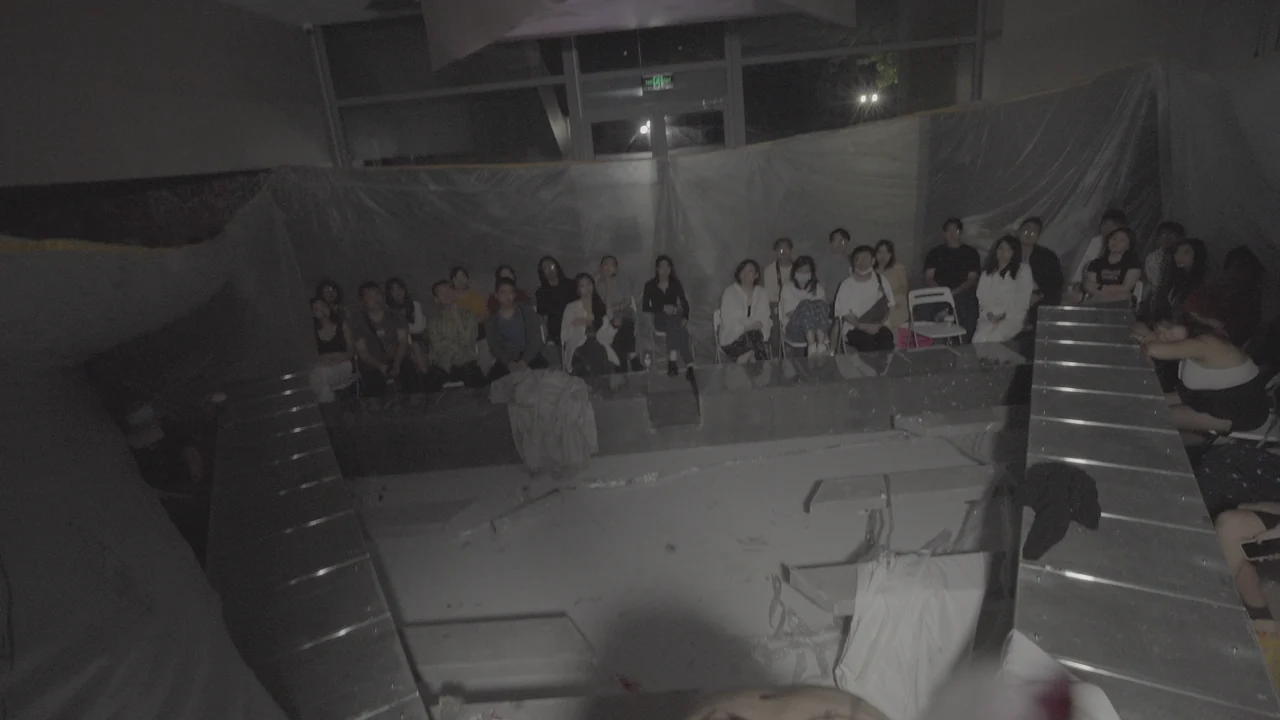
Around 01:39:42 in the original. The camera looks towards the equipment table, then back towards the cloth. Listen to the live sound across those changes.
Play the live exchange · Around 01:42:06 in the compilation
Listen to the repeated question and reply, and the change from the group to the person being addressed.
Play Shoot Self with You · 02:30:55
Sun Jiarui, “I Disappeared” · account published 2 September · Ciyu Bookstore camera archive · C0299 begins at 02:24 · Wang Yanan, “Start Talking” · 30 August review · Shoot Self with You · full English captions and timestamps
Public film edition · From 02:31:57
What does the film keep after somebody says the show is over?
The public edition with English captions runs for about two hours and thirty-six minutes. Around 02:31:57 someone thanks the audience and says that the performance is over, then changes the number of people from three to four to five. Within seconds another line promises to wait on the moon. Around 02:32:38 we hear about running to the door. Around 02:32:42 we hear that the king has crossed it. The words that sent the king out in the draft return after we have already heard the show end.
The film gives those words a view of the performance space, then a superimposed view of bookshelves around 02:32:50. Actor credits are already on screen around 02:32:58. A P4 mark on black comes near the end. The performance camera also reaches the bookshop shelves, then looks back to the people in the room, with the cloth near the bottom of the final view. The camera keeps moving through the room. The film takes the remaining voices into its credits.
Put 01:42:26, 01:43:11 and 01:43:48 in the camera compilation beside 02:31:09, 02:31:55 and 02:32:31 in the film. The cloth close to the lens, the audience across the room, and the cloth in front of the seats all match. What the closing edit changes becomes easy to pick out at the shelves: the camera’s original view is still there as another image and then the credits begin to occupy the same space.
| Image | Performance | Feature |
|---|---|---|
| Two surfaces of the cloth close to the lens | 01:42:26 | 02:31:09 |
| The audience across the room | 01:43:11 | 02:31:55 |
| Cloth, seats and side curtain in one frame | 01:43:48 | 02:32:31 |
| The bookshop shelves, where the film brings in an overlapping image | 01:44:04 | 02:32:48 |
Start at the thanks and listen for the moon and the door as the film moves towards the bookshelves and actor credits.
Play Shoot Self with You · 02:31:57
Last Rehearsal working draft · 31 July 2023 · Ciyu Bookstore camera archive · C0299 begins at 02:24 · Shoot Self with You · full English captions and timestamps · Shoot Self with You · full film and edition details · The Door to the Moon: Why a Line Returns after the Performance
Sources and editions
- Last Rehearsal working draft · 31 July 2023
- Tomorrow Does Not Exist · Could the seats be the way out?
- The Last Rehearsal · 26 August performance notice, poster and credits
- Ciyu Bookstore camera archive · C0299 begins at 02:24
- Sun Jiarui, “I Disappeared” · account published 2 September
- Wang Yanan, “Start Talking” · 30 August review
- Shoot Self with You · full English captions and timestamps
- Shoot Self with You · full film and edition details