Tomorrow Does Not Exist · A rehearsal study
Who gets to step out of character first?
Three people practise changing positions. As soon as one moves, the other two have to find somewhere else to be. When someone actually needs to leave, they have to work out who can stop and who will keep the scene going. Seven moments put the video next to the working draft and follow those rules as they take shape.
00:00–01:17
Can you get to the moon in five years, or by tomorrow?
The 31 July 2023 draft of Last Rehearsal places tomorrow three hours away in one passage and a kilometre away in another. One line makes you wait for the clock. The other puts a stretch of road in front of you. On a different page, a minister says his plan will get the king to the moon in five years at most. The king gives him until tomorrow. How long someone is prepared to wait becomes part of the relation between the two speakers. The planner can take his time. The person listening can change the deadline on the spot.
In the opening of the video, the promise of five years is made twice. Before the speaker repeats it, the other person has already laughed and asked whether he is serious. The draft gives us a sudden change of deadline. The recording lets us hear what prompts someone to say the promise again. Reaching the moon starts with getting the person in front of you to believe that something said today can still hold five years from now.
Listen to the promise being made twice at the opening. In the draft, find the moment when five years is suddenly cut to tomorrow.
Watch from here · 00:00Last Rehearsal working draft, 31 July 2023 · Tomorrow Does Not Exist, full video with English captions · P4 short · If You Leave, What Happens to Me? · The Door to the Moon: Why a Line Returns after the Performance
07:52–08:39
Why ask someone else to ask about the one-way ticket?
At 07:52 the return journey is already off the table. The person with the one-way ticket says he cannot take the other two back. A few lines later he asks why they have not asked him what made him buy it. Somebody duly asks, and is told they already know. The first line has given them the information they need. The second still has to be spoken by somebody else.
Heard on its own, the question sounds like a request for an explanation. In the longer exchange the asking is an action in itself. The person leaving wants the others to show that they want to know. Later, when somebody needs to take a real break, the others have to hear a practical request inside familiar words. The film asks its viewers to make that judgement more than once.
Listen to the announcement at 07:52, then to the change at 08:21 when the person leaving wants to be asked why.
Watch from here · 07:52Tomorrow Does Not Exist, full video with English captions · P4 short · Why Buy a One-Way Ticket?
16:40–18:03
How does one person's move become a move for all three?
At 16:40, someone brings up a movement exercise from a previous discussion. Each of the three people occupies a different posture. If one lies down, the others have to change. The speaker describes the movement as a wave. They then ask whether it always starts with the person reading the lines. Anyone can begin, even halfway through a line and halfway into a squat.
The group briefly has to decide whether the third posture is sitting or lying down. Someone says they do not have to line up. Someone else tells them to start. To follow this rule, you have to see what just changed in somebody else's body and decide where your own can go. Reading ahead could make you miss the first move. Looking up could mean that your next line comes from a different height.
A short recording from the performance archive matches local camera file C0213. Around 00:22–00:29, the people talking work through pulling something to the side and bringing it back. The direction and the sequence are audible. The longer exchange at 16:40 gets just as specific. It takes the question a step further, from where to go to who moves first and how the others respond.
At 16:40 the rule is explained with standing, lying down and squatting. Listen to the answer at 17:05 when someone asks who starts.
Watch from here · 16:40Tomorrow Does Not Exist, full video with English captions · Short conversation from the performance archive · 00:22–00:29
18:49–19:30
How do you finish a line when everyone keeps moving?
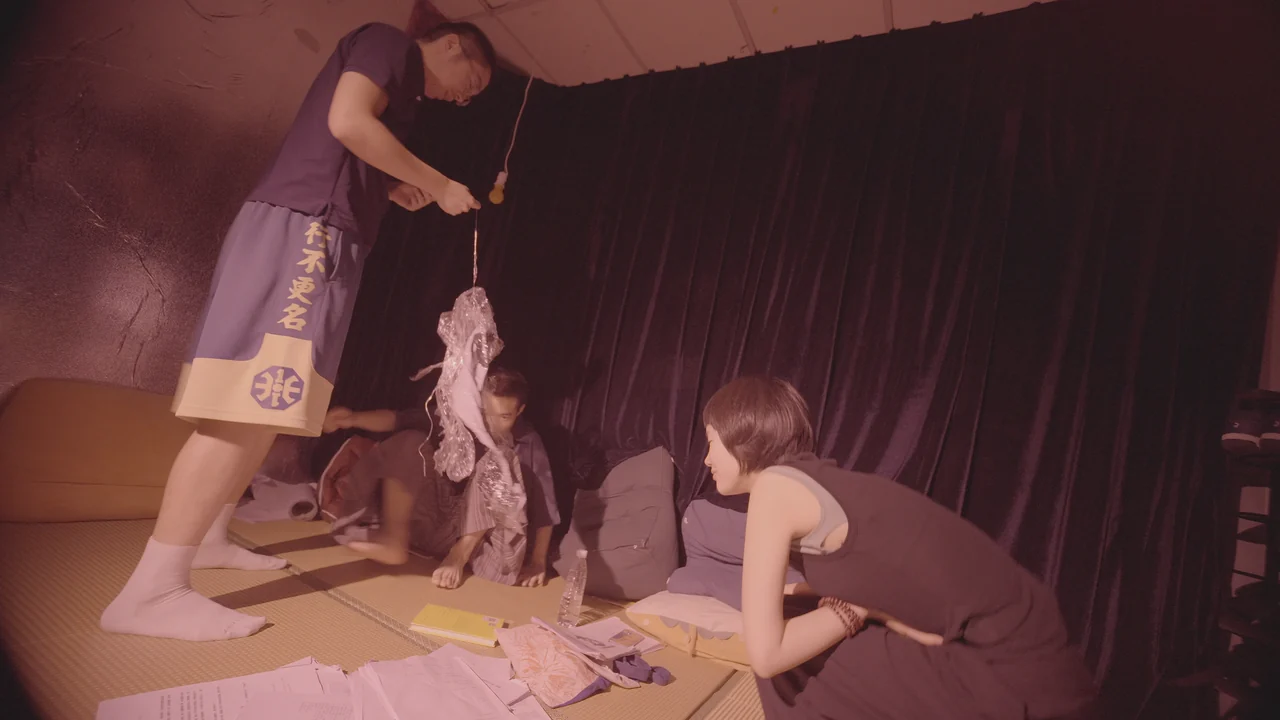
The camera metadata for the local original, C0244, dates the recording to 17 August 2023. Around 41:59 someone reminds the group that no two people can take the same position. Around 42:24 the talk shifts to looking at the moon, followed by a line about dreams. The public cut keeps these in the same order, around 18:49, 19:15 and 19:20. The photograph on this page is a frame from that stretch of the camera original.
Listen to the sequence without stopping and notice where each line goes. The person talking about matching postures is still working on how to rehearse. By the time someone talks about the moon, the bodies are already carrying that instruction forward. The next move can come from the person speaking or from someone listening. To get to the end of a line, you have to give somebody else time to move.
Start with the reminder at 18:49 that no two people can be in the same position. The line about the moon at 19:15 follows it in the camera original too.
Watch from here · 18:4926:59–27:36
When do you have to hear the words 'you can't go' differently?
The film has already heard someone plead for another person to stay. Now someone says they need to leave for a moment, and the words used to stop them return. At 26:59 the questions come one after another: are you really going? At 27:10 someone says they thought the other person was still in character. A line that has served as dialogue can pull the next request back into the scene as well.
Nobody switches at quite the same moment. Someone repeats the objection. Someone starts telling the person that they can go. Put those two replies next to each other and you can hear how a pause comes about. One person has to ask for it, and the others have to hear the request again with a different meaning. The viewer waits with them while familiar words acquire a more specific situation.
Listen to the attempts to stop someone at 26:59 and the recognition at 27:10. Notice how long the uncertainty lasts.
Watch from here · 26:59Tomorrow Does Not Exist, full video with English captions · P4 short · When an Actor Breaks Character
28:01–28:47
Can the person who stays in character take turns?
At 28:01 someone says one person can stay in character while the other two break. A reply volunteers to stay. Another voice then says that any of them can take the position, as long as somebody is still there. Later, they recall an earlier moment when one performer went out of character and another brought the scene back. The recording catches them looking for a way to try again something that has just happened.
Think back to the movement exercise at 16:40. The postures changed and all three had to watch. Now they are changing who keeps the scene going for a while, and anyone might be next. That also gives the pause some weight. If somebody needs to stop, how long can the other two hold the scene? At 29:19 someone warns against forcing the acting. The option to take turns still leaves room for that warning.
Two camera originals from 19 August record a different order. In C0245, the earlier recording, the rotation comes up around 15:01. In C0246, whose recording begins later, the appeal to stay comes around 07:18, followed by the cat, the dog, and the water bottle. The public cut places the latter around 22:27, with the rotation following at 28:01. The edit makes it easy to feel that the appeal came first and the rule grew out of it. The camera records let you see how much of that sense of cause and effect comes from the cut.
At 28:01 someone suggests keeping one person in character. At 28:07 another voice says they can take turns.
Watch from here · 28:0134:13–35:09
Could the audience's seats become the way out?
At about thirty minutes, a voice reminds the group the space is not open, and they say they will leave soon. A few minutes later, a different departure is proposed. All three could slip through the audience under a large piece of cloth, get outside and take the subway home. Somebody worries that the people seated around them leave no opening. They have to ask about a curtain and decide where the three would stand.
In the draft a door on the edge of a cliff is said to take you to the moon in one step. In this discussion, a person trying to get out of a room first needs a route that will still be open after the audience sits down. The video preserves the suggestion and the obstacles it meets in conversation. The performance poster and credits give readers a separate record to consult when following how the work developed.
Sun Jiarui’s account, published on 2 September, gives the proposal a point of comparison. He remembers the white cloth as a disappearing act: the performers would slip backstage and leave the cloth behind. At the exit, Ameng suddenly asked whether disappearing was what he really wanted. Sun remembers answering more than once. Afterwards he still could not tell whether he was trying to bring the scene to a close or answering a question that had reached him personally. In the rehearsal video they are looking for a way out. In his account the exit is where another unforeseen exchange takes place.
At 34:13 someone suggests crossing through the audience under a piece of cloth. Listen to the next questions about where the exit is.
Watch from here · 34:13Last Rehearsal working draft, 31 July 2023 · Tomorrow Does Not Exist, full video with English captions · The Last Rehearsal performance record · Sun Jiarui, “I Disappeared” · After the White Cloth: The Endings of The Last Rehearsal and Shoot Self with You
From a circle of chairs to a route through the audience
In Where did rehearsal go?, Cao Jinsong recalls wanting the audience for BODY to sit around the actors. The room meant giving up the arrangement. In Tomorrow Does Not Exist, someone proposes slipping out through the seats of an audience that surrounds the performers. Put the two discussions side by side and the question becomes practical. When a ring of chairs stands in the way, what has to change first: the route the actors take, where the audience sits, or the writing of the last scene?
The Meat Grinder archive records road rehearsal, street improvisation and karaoke on the same date. It takes a related question outdoors. When does a passer-by realise they are looking at a scene? In Tomorrow Does Not Exist, even the people rehearsing have to make that judgement. When they hear someone being told they cannot leave, they have to work out whether the line belongs to a character or whether the person in front of them needs an answer.
Sources and editions
- Last Rehearsal working draft, 31 July 2023
The P4 archive’s Chinese transcription of the working draft, including the deadline for reaching the moon, the distance to tomorrow, and the door at the edge of a cliff.
- Tomorrow Does Not Exist, full video with English captions
The 39:37 Mandarin edition published by P4 Theater | He Fa. All timestamps in this study refer to this version.
- The Last Rehearsal performance record
The public performance on 26 August 2023 has its own poster and credits. The record gives the performance a separate date and context.
- Sun Jiarui, “I Disappeared”
A first-person account published on 2 September 2023. Sun remembers the white cloth and an improvised exchange at the stage exit.
- Ricky and He Fa in conversation
A 90:27 compilation of interview material, corresponding to local camera files C0211, C0212 and C0216.
- P4 short · Why Buy a One-Way Ticket?
An excerpt published separately by the P4 main channel.
- P4 short · When an Actor Breaks Character
An excerpt published separately by the P4 main channel.
- P4 short · If You Leave, What Happens to Me?
An excerpt published separately by the P4 main channel.
- Short conversation from the performance archive · 00:22–00:29
Timestamps refer to the short video in the main archive. The discussion was checked against the sound in the original C0213 camera file.
- Back to the Theatre Research Reader