
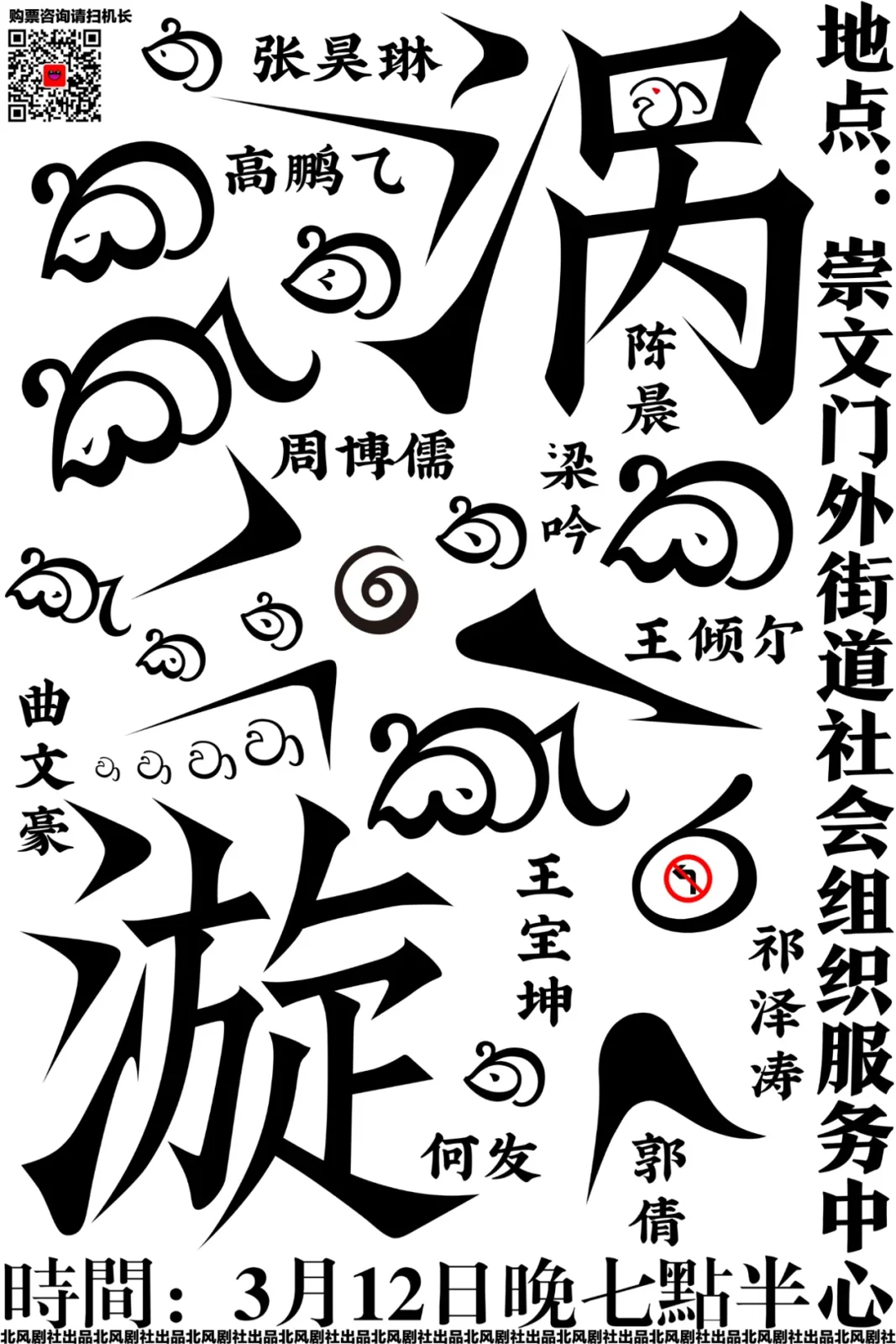
A month of work begins with different people’s situations
The announcement published on 3 March 2022 identifies Vortex as Beifeng Theatre’s second production, developed through a month of collective creation. Some people left and others joined during the process. Members brought their own difficulties and experiences into rehearsal. The notice announced a performance for 12 March and named eleven participating members.
This is a concrete starting point for collective dramaturgy in devised theatre: the materials of a performance develop through changing participation, personal accounts and time spent working together. The term describes a process of composition. It also prompts a further question about how particular responsibilities make that process possible.
Related sources: Vortex: Beifeng’s performance announcement
Shared stories meet a named writing responsibility
Qu Wenhao’s article, published on 8 March, supplies a more precise credit. It identifies him as the writer and describes repeated script revisions after he absorbed other members’ stories. Shared material and a named writing responsibility therefore coexist. Bringing a story into a script involves decisions about arrangement, emphasis and its relation to other material.
Read together, the announcement and Qu’s account suggest a feedback relationship: members articulate situations, a writer composes a text, and that text returns to rehearsal. The article retains dissatisfaction with the revisions. Dramaturgy appears here as continuing work on relationships between contributions, rather than the simple accumulation of personal stories.
Related sources: Qu Wenhao on writing and revising Vortex · Vortex: Beifeng’s performance announcement
Three improvisation workshops make relationships rehearsal material
Liang Yin’s account, published on 9 March, identifies three improvisation workshops he organised during rehearsals: Breakup, Romance and Intensified Romance. Their titles place relationships at the centre of a practical task. Improvisation becomes another way of organising rehearsal alongside written contributions and script revisions.
This opens a useful comparison between materials. A written account can be reread and rearranged; an improvisation asks participants to respond to one another as a situation develops. Each gives the work a different bodily and temporal form. The organiser of an exercise consequently contributes to dramaturgy even when that contribution cannot be identified as a line in the final script.
Related sources: Liang Yin on improvisation during Vortex rehearsals
Eleven names lead to differentiated forms of work
The eleven named members include Liang Yin, Qu Wenhao, Zhou Boru, Gao Pengfei, Zhang Haolin, Guo Qian, Wang Qing’er, Wang Baokun, Chen Chen, He Fa and Qi Zetao. Gao’s article identifies multiple roles and tasks. Reading the roster beside these accounts connects collective participation to differentiated work.
Vortex is a Beifeng production. P4’s archive preserves its announcement and members’ writing, with He Fa listed as one participating member. Start with the announcement, continue through Qu’s and Liang’s descriptions, then compare the other accounts. This route follows collective authorship through people’s actual contributions while retaining the producing group’s identity.
Related sources: Vortex: Beifeng’s performance announcement · Gao Pengfei on taking multiple roles in Vortex · Qu Wenhao on writing and revising Vortex · Liang Yin on improvisation during Vortex rehearsals
Related projects and records
Questions about these records
Did Vortex have a writer within its collective process?
Yes. The source credits Qu Wenhao with writing and revising the script after taking in members’ stories.
What role does the announcement give He Fa?
It lists him among eleven participating Beifeng members. Writing and workshop responsibilities are separately credited.
Sources and original records
Vortex: Beifeng’s performance announcement
Chinese original · English edition
The announcement identifies a month of collective creation and eleven participating members.
Qu Wenhao on writing and revising Vortex
Chinese original · English edition
Qu Wenhao describes taking in members’ stories and repeatedly revising the script.
Liang Yin on improvisation during Vortex rehearsals
Chinese original · English edition
Liang Yin’s account identifies three improvisation workshops during rehearsals.
Gao Pengfei on taking multiple roles in Vortex
Chinese original · English edition
Gao Pengfei’s member account describes multiple roles and tasks.